







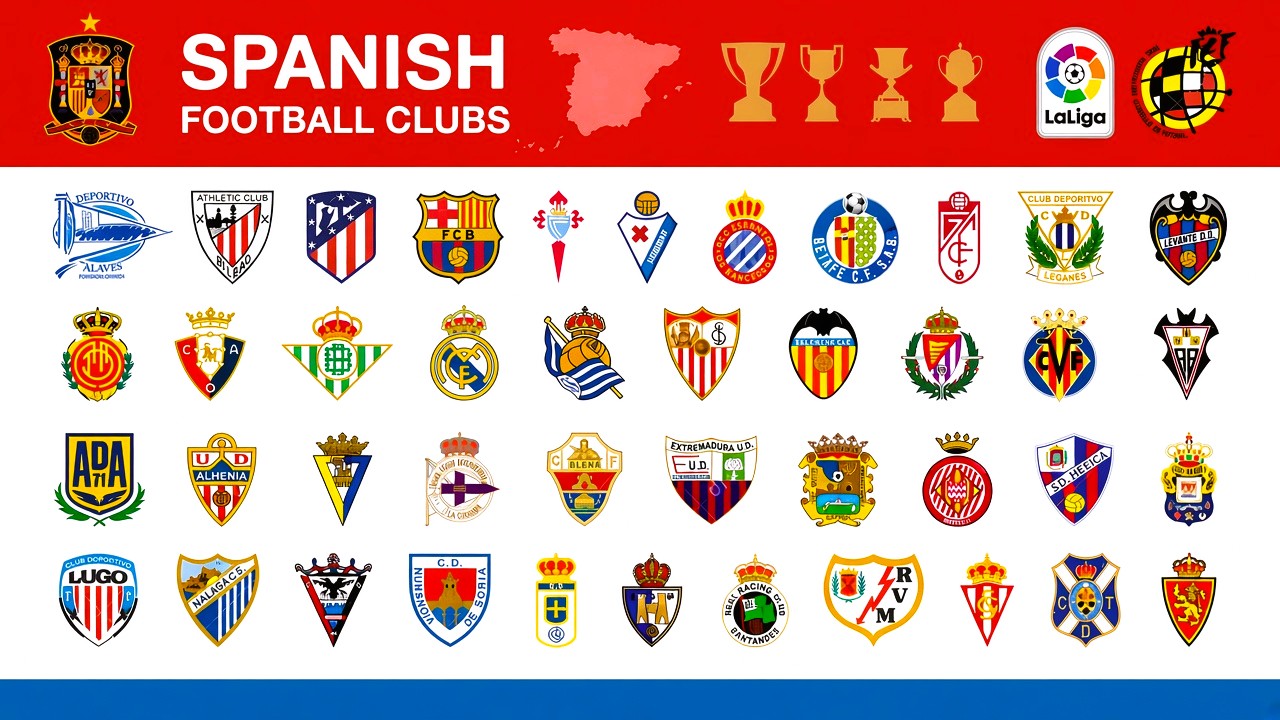

Spain has football clubs competing across several professional and semi-professional divisions.
La Liga and Segunda División form the top two tiers of the men’s national league system.
This guide lists the 42 clubs competing in La Liga and Segunda División during the 2026–27 season, with each club’s founding year, stadium and city.
How Many Football Clubs Are There in Spain?
The total number depends on the levels included. Spain’s football pyramid stretches from the professional top flight down through Primera Federación, Segunda Federación, Tercera Federación and regional leagues, involving hundreds of clubs.
For this guide, the focus is on the two highest divisions in Spanish men’s football, which together feature 42 clubs during the 2026–27 season.
| Division | Clubs in 2026–27 |
|---|---|
| La Liga | 20 |
| Segunda División | 22 |
| Total | 42 |
La Liga Football Clubs in Spain
La Liga (LaLiga EA Sports) is the top division of Spanish men’s football. It features 20 clubs in the 2026–27 season.
Three clubs were promoted from Segunda División for the 2026–27 season: Racing Santander, Deportivo A Coruña and Málaga. They replaced Mallorca, Girona and Oviedo, who were relegated to the second tier.
| Club | Founded | Stadium | City |
|---|---|---|---|
| Deportivo Alavés | 1921 | Mendizorrotza | Vitoria-Gasteiz |
| Athletic Club | 1898 | San Mamés | Bilbao |
| Atlético Madrid | 1903 | Riyadh Air Metropolitano | Madrid |
| Barcelona | 1899 | Spotify Camp Nou | Barcelona |
| Celta Vigo | 1923 | ABANCA Balaídos | Vigo |
| Deportivo A Coruña | 1906 | ABANCA-Riazor | A Coruña |
| Elche | 1923 | Martínez Valero | Elche |
| Espanyol | 1900 | RCDE Stadium | Cornellà de Llobregat |
| Getafe | 1983 | Coliseum | Getafe |
| Levante | 1909 | Ciutat de València | Valencia |
| Málaga | 1948 | La Rosaleda | Málaga |
| Osasuna | 1920 | El Sadar | Pamplona |
| Racing Santander | 1913 | El Sardinero | Santander |
| Rayo Vallecano | 1924 | Vallecas Stadium (temporary) | Madrid |
| Real Betis | 1907 | Estadio de La Cartuja (temporary) | Seville |
| Real Madrid | 1902 | Santiago Bernabéu | Madrid |
| Real Sociedad | 1909 | Reale Arena | San Sebastián |
| Sevilla | 1890 | Ramón Sánchez-Pizjuán | Seville |
| Valencia | 1919 | Mestalla | Valencia |
| Villarreal | 1923 | Estadio de la Cerámica | Villarreal |
Some clubs are using temporary stadium arrangements during the 2026–27 season. Stadium listings reflect the venue arrangements applicable to the season and may change.

Segunda División Football Clubs in Spain
Segunda División (LaLiga Hypermotion) is the second tier and features 22 clubs in 2026–27.
It includes the three teams relegated from La Liga (Mallorca, Girona, Oviedo) plus four promoted from Primera Federación (Tenerife, Eldense, Sabadell, Celta Fortuna).
| Club | Founded | Stadium | City |
|---|---|---|---|
| Albacete | 1940 | Carlos Belmonte | Albacete |
| Almería | 1989 | UD Almería Stadium | Almería |
| Andorra | 1942 | Estadi de la FAF | Encamp (Andorra) |
| Burgos | 1994 | El Plantío | Burgos |
| Cádiz | 1910 | JP Financial Estadio | Cádiz |
| Castellón | 1922 | SkyFi Castàlia | Castellón de la Plana |
| Celta Fortuna | 1927 | Estadio de Balaídos | Vigo |
| Ceuta | 1956 | Alfonso Murube | Ceuta |
| Córdoba | 1954 | Nuevo Arcángel | Córdoba |
| Eibar | 1940 | Ipurua | Eibar |
| Eldense | 1921 | Pepico Amat | Elda |
| Girona | 1930 | Montilivi | Girona |
| Granada | 1931 | Nuevo Los Cármenes | Granada |
| Las Palmas | 1949 | Gran Canaria | Las Palmas |
| Leganés | 1928 | Ontime Butarque | Leganés |
| Mallorca | 1916 | Son Moix | Palma |
| Oviedo | 1926 | Carlos Tartiere | Oviedo |
| Real Sociedad B | 1951 | Zubieta estadioa | San Sebastián |
| Sabadell | 1903 | Nova Creu Alta | Sabadell |
| Sporting Gijón | 1905 | El Molinón | Gijón |
| Tenerife | 1912 | Heliodoro Rodríguez López | Santa Cruz de Tenerife |
| Valladolid | 1928 | José Zorrilla | Valladolid |
FC Andorra is based in Andorra rather than Spain but competes in the Spanish football league system.
Which Are the Biggest Football Clubs in Spain?
Real Madrid and Barcelona are among the most prominent football clubs in Spain, with extensive domestic success and international recognition.
Atlético Madrid is also one of the country’s leading clubs, while Athletic Club, Valencia, Sevilla and Real Sociedad have played significant roles in Spanish football history.
Club size can be measured in different ways, including trophies, European achievements, financial strength, supporter numbers and historical influence.
The importance of Spanish football, however, extends beyond its most internationally recognised teams, with clubs across the country representing distinct regional traditions and identities.
Final Thoughts
La Liga and Segunda División represent the top two levels of Spanish men’s football, bringing together clubs with different histories, regional identities and ambitions.
This guide provides a quick reference to the 42 clubs competing across those divisions in 2026–27, including their founding years, stadiums and locations.