








The road to glory at the 2026 FIFA World Cup is no longer just about who qualifies—it’s about who faces who when it matters most.
With the tournament expanding to 48 teams for the first time, the knockout stage introduces a brand-new 32-team bracket, setting the stage for the most complex and dramatic elimination phase in World Cup history.
As the group stage concludes across United States, Canada, and Mexico, the focus shifts to a high-stakes path where every match becomes do-or-die.
The top two teams from each group, alongside the eight best third-placed sides, advance into a fixed bracket that determines the entire journey to the final—no second chances, no easy routes.
From potential heavyweight clashes involving giants like Argentina national football team, France national football team, and Spain national football team to surprise matchups featuring emerging nations, the bracket is where narratives are defined.
Early-round encounters could feel like finals, while underdogs are given a genuine opportunity to rewrite football history on the biggest stage.
This guide breaks down the FIFA World Cup 2026 knockout stage bracket, including full matchups, paths, and who faces whom in every round.
As the tournament moves into its most decisive phase, the question becomes simple—but ruthless: who faces who, and who survives?
World Cup 2026 knockout stage bracket (Full Overview)
The FIFA World Cup 2026 introduces an expanded knockout structure, moving from a 16-team to a 32-team bracket to accommodate the 48-nation field.
Following a group stage consisting of 12 groups of four, the top two teams from each group and the eight best third-place finishers will advance to the inaugural Round of 32.
This change extends the tournament to 39 days and increases the total match count to 104, with teams reaching the final four now playing eight matches instead of seven.
The knockout stage is scheduled to begin on June 28, 2026, with the final match taking place on July 19, 2026, at MetLife Stadium in East Rutherford, New Jersey.
To ensure competitive balance, FIFA has implemented a tennis-style seeding system that separates the top four world-ranked teams.
Spain (1) and England (4) are placed in one half of the bracket, while Argentina (2) and France (3) occupy the other, meaning these top seeds cannot face each other until at least the semi-finals.
Matches in the knockout rounds are single-elimination. If scores remain level after 90 minutes of regulation, teams will play 30 minutes of extra time, followed by a penalty shootout if necessary to determine a winner.
High-tech officiating, including AI-supported digital avatars, will be utilized throughout these high-stakes rounds to assist in making rapid and accurate offside and foul decisions.
Round of 32 Matchups – Who Faces Who
Standard Match Pairings
The group winners are usually paired with the eight runners-up or eight third-placed teams from a different group.
Runners-up from the same group are placed on opposite sides of the bracket to ensure they do not meet again until the final.
| Group Winner | Round of 32 Opponent | Venue |
|---|---|---|
| Winner Group A | 3rd Place (Group C/E/F/H/I) | Mexico City |
| Winner Group B | 3rd Place (Group E/F/G/I/J) | Vancouver |
| Winner Group C | Runner-up Group F | Houston |
| Winner Group D | 3rd Place (Group B/E/F/I/J) | San Francisco |
| Winner Group E | 3rd Place (Group A/B/C/D/F) | Boston |
| Winner Group F | Runner-up Group C | Monterrey |
| Winner Group G | 3rd Place (Group A/E/H/I/J) | Seattle |
| Winner Group H | Runner-up Group J | Los Angeles |
| Winner Group I | 3rd Place (Group C/D/F/G/H) | New York New Jersey |
| Winner Group J | Runner-up Group H | Miami |
| Winner Group K | 3rd Place (Group D/E/I/J/L) | Kansas City |
| Winner Group L | 3rd Place (Group E/H/I/J/K) | Atlanta |
Full World Cup 2026 knockout stage bracket (Visual Guide)
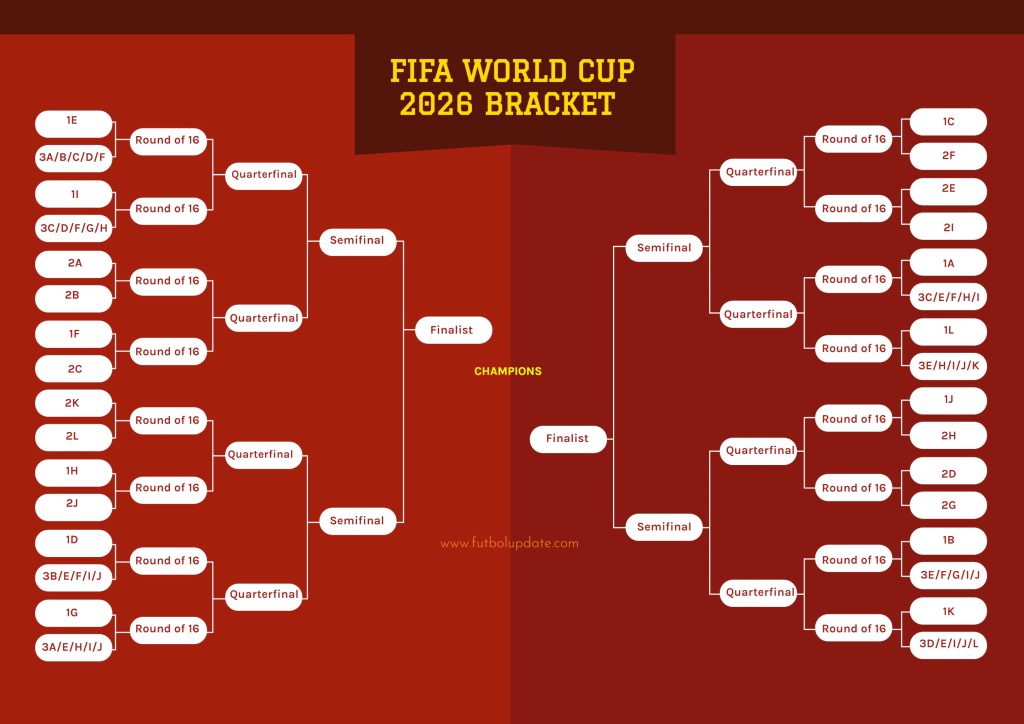
This World Cup 2026 bracket visual guide shows the complete knockout path from the Round of 32 to the final, including all matchups and progression routes.
Use this bracket to quickly understand who faces who and how each team can reach the final. For a detailed explanation, see the World Cup 2026 knockout format .
World Cup 2026 knockout format
How the World Cup 2026 Bracket Works
Round of 32 Format
The World Cup 2026 bracket introduces a new, thrilling phase: the Round of 32. Unlike previous 32-team tournaments that began with the Round of 16, this edition features a preliminary knockout round involving 32 teams.
This group consists of the 12 group winners, the 12 group runners-up, and the 8 best third-placed teams from the 12 groups.
Bracket Structure Explained
The World Cup 2026 bracket is a “fixed” path, meaning there is no reseeding after each round. The tournament is divided into two distinct halves: the Left Side (or “Top Half”) and the Right Side (or “Bottom Half”).
A team’s journey to the final is predetermined based on their group and finishing position.
For example, the winner of Group A is slotted into a specific spot and will remain on that side of the bracket for the entirety of the tournament, potentially setting up a semi-final clash with the winner of Group C, provided both keep winning.
What Happens After Each Round
The progression is linear. The survivors of the Round of 32 move to the Round of 16. From there, the field narrows to the Quarterfinals (8 teams), the Semifinals (4 teams), and finally, the two nations that will battle for the star above their crest in the Final.
- Round of 32 → 16 winners advance to Round of 16
- Round of 16 → 8 teams reach quarterfinals
- Quarterfinals → 4 teams head to semifinals
- Semifinals → 2 teams contest the final (plus third-place playoff)
How Teams Qualify for the Knockout Stage
Group Winners & Runners-Up
The primary qualification route is through the 12 groups. Each group consists of four teams. The team that finishes first (Group Winner) and the team that finishes second (Group Runner-up) automatically secure their place in the knockout bracket. These 24 teams form the backbone of the Round of 32.
Best Third-Placed Teams Explained
For the first time in a 48-team World Cup, eight third-placed teams will also advance. This adds a layer of complexity to the group stage, as teams finishing third can still harbor realistic hopes of progressing, making goal difference a critical factor until the final whistle of the last group match.
Ranking Criteria for Third-Placed Teams
To determine who advances, FIFA uses the following tie-breakers:
- Total Points
- Goal Difference
- Goals Scored
- Fair Play Points (Yellow/Red card counts)
- Drawing of lots
Round of 32 Matchups (Projected)
The FIFA World Cup 2026 Round of 32 matchups are determined by a bracket that pairs group winners with runners-up or third-placed teams, while runners-up often face each other.
Based on early expert predictions and the official draw, here is a projected overview of the first knockout round.
Likely Matchups Based on Group Predictions
These projections assume favourites win their groups and historical trends hold for qualifying third-place teams.
| Match | Projected Fixture | Venue |
|---|---|---|
| 73 | South Korea (A2) vs Switzerland (B2) | Los Angeles |
| 74 | Germany (E1) vs Scotland (C3/D3/F3) | Boston |
| 75 | Netherlands (F1) vs Morocco (C2) | Monterrey |
| 76 | Brazil (C1) vs Japan (F2) | Houston |
| 77 | France (I1) vs Egypt (G3/H3) | New York/NJ |
| 78 | Ecuador (E2) vs Norway (I2) | Dallas |
| 79 | Mexico (A1) vs Senegal (I3/F3/H3) | Mexico City |
| 80 | England (L1) vs Algeria (J3/K3) | Atlanta |
| 81 | USA (D1) vs Canada (B3/E3/F3) | San Francisco |
| 82 | Belgium (G1) vs Denmark (A3/E3/J3) | Seattle |
| 83 | Colombia (K2) vs Croatia (L2) | Toronto |
| 84 | Spain (H1) vs Austria (J2) | Los Angeles |
| 85 | Italy (B1) vs Australia (D3/G3/I3) | Vancouver |
| 86 | Argentina (J1) vs Uruguay (H2) | Miami |
| 87 | Portugal (K1) vs Paraguay (D2) | Kansas City |
| 88 | Turkey (D2) vs Egypt (G2) | Dallas |
Early Blockbuster Fixtures
Several matchups are already being circled as potential “early finals” due to the bracket structure and group-stage seedings:
- Argentina (J1) vs Uruguay (H2): A massive South American “Clásico del Río de la Plata” could happen immediately if Uruguay finishes second behind Spain in Group H.
- Netherlands (F1) vs Morocco (C2): This pits the 2022 semi-finalists (Morocco) against a powerful Dutch side in Monterrey.
- Brazil (C1) vs Japan (F2): Brazil’s flair against Japan’s high-tech tactical discipline is projected for Houston.
- France (I1) vs Senegal (I3/F3): If Senegal advances as a top third-place team, they could face France in a rematch of the famous 2002 opener.
- Mexico (A1) vs Senegal/Denmark: As a top seed, Mexico is likely to face a dangerous European or African side that slips to a third-place qualifying spot.
The “Wimbledon” Seeding Path
FIFA’s new seeding system ensures the top four teams—Spain (1), Argentina (2), France (3), and England (4)—stay in separate quadrants.
- Spain & England are in the top half of the bracket.
- Argentina & France are in the bottom half.
- If all four win their groups, they cannot meet until the semi-finals.
Round of 16 & Quarterfinal Paths
How the Bracket Progresses
The tournament follows a fixed bracket path from the Round of 32 through to the final at MetLife Stadium.
| Round | Match Progression Logic | Key Dates |
|---|---|---|
| Round of 16 | The 16 winners of the Round of 32 (Matches 73–88) are paired sequentially (e.g., Winner 74 vs Winner 77). | July 4 – 7 |
| Quarter-finals | The 8 winners of the Round of 16 (Matches 89–96) advance to four quarter-final matches. | July 9 – 11 |
| Semi-finals | Winners from the Boston and Los Angeles quarter-finals meet in Dallas, while winners from Miami and Kansas City meet in Atlanta. | July 14 – 15 |
Possible Quarterfinal Clashes
If group favorites advance as expected, several “blockbuster” matchups are possible in the quarter-finals:
- England vs Spain (Match 97): If both win their groups and subsequent knockout matches, these European giants are on a collision course to meet in the first quarter-final in Boston.
- USA vs Belgium (Match 98): Should the USA win Group D and advance, they could face the winner of Group G (potentially Belgium) in Los Angeles.
- France vs Netherlands (Match 99): A potential heavyweight clash in Miami if France (Group I) and Netherlands (Group F) both top their groups and navigate the early knockout rounds.
- Argentina vs Portugal (Match 100): If Argentina wins Group J and Portugal wins Group K, they could meet in the final quarter-final in Kansas City.
Path to the Final – Step-by-Step
Route for Group Winners
Winning your group is more crucial than ever in the 2026 format. Group winners are generally rewarded with matchups against either group runners-up or third-placed teams.
To ensure competitive balance, FIFA has established two separate pathways that keep the top four seeds—Spain (1), Argentina (2), France (3), and England (4)—apart until the semi-finals.
This allows group winners to potentially conserve energy and avoid a major powerhouse until the Round of 16 or quarterfinals.
Route for Third-Placed Teams
The eight best third-placed teams are determined by a separate ranking based on points, goal difference, and goals scored.
Their specific placement in the Round of 32 is highly complex and depends on which group combinations produce the advancing teams.
Which Side of the Bracket Is Harder?
Determining which side of the FIFA World Cup 2026 bracket is “harder” depends on whether the top seeds win their groups.
The “left” side (heavier on European/ South American powerhouses from Groups E, F, I, J) looks tougher on paper.
The “right” side offers more potential for upsets but still features England, Portugal, and Argentina-adjacent paths. Expect the final to pit one giant from each half.
Full Knockout Stage Schedule
| Round | Dates | Number of Matches |
|---|---|---|
| Round of 32 | June 28 – July 3, 2026 | 16 |
| Round of 16 | July 4 – July 7, 2026 | 8 |
| Quarter-finals | July 9 – July 11, 2026 | 4 |
| Semi-finals | July 14 – July 15, 2026 | 2 |
| Third-place match | July 18, 2026 | 1 |
| Final | July 19, 2026 | 1 |
Key Matchups to Watch
Potential “Clash of Titans”
The fixed bracket structure ensures that the top four seeds—Spain (1), Argentina (2), France (3), and England (4)—are kept in separate quadrants, preventing them from meeting until the semi-finals.
- Argentina vs. Portugal (Possible Quarter-final): If both win their groups (J and K) and advance, a historic final World Cup meeting between Lionel Messi and Cristiano Ronaldo could occur in Kansas City on July 11.
- England vs. Spain (Possible Quarter-final): The two top-ranked European sides are on a collision course to meet in Boston on July 9 if they both top groups L and H respectively.
- France vs. Netherlands (Possible Quarter-final): A heavyweight European battle is projected for Miami on July 11 if both nations win their groups (I and F).
- Brazil vs. England (Possible Quarter-final): Perennial favorites Brazil (Group C) could face England in a high-profile matchup if they navigate their way to the Boston or Los Angeles quarter-final slots.
Tactical Battles
Projections for the 2026 tournament suggest a shift in tactical dominance away from pure possession-based models.
- Transition vs. Control: Matches featuring teams like Morocco or Japan against traditional powers like Brazil or the Netherlands will highlight the effectiveness of high-pressing and clinical transition football.
- The “Host Advantage” Factor: The USA and Mexico have paths that keep them in familiar regional hubs (West Coast for USA, Central/South for Mexico) to minimize travel fatigue, a critical tactical advantage in the expanded 39-day schedule.
Dark Horses & Upset Predictions
Teams That Could Surprise
- Norway: Led by Erling Haaland and Martin Ødegaard, Norway is frequently cited as a top “under-the-radar” threat. Their high-octane attack makes them a dangerous unseeded opponent for group winners in the Round of 32.
- Morocco: After their historic semi-final run in 2022, Morocco remains a “dark horse” favorite. Their defensive geometry and tactical discipline are viewed as a direct counter to the individual brilliance of teams like Brazil.
- Japan: Known for disciplined pressing and tactical synchrony, Japan is projected to be a “disruptor” that could navigate deep into the bracket if they repeat their 2022 group-stage successes.
- South Korea: Captained by Son Heung-min, the team is identified as a “professional disruptor” capable of forcing errors from elite opponents through synchronized pressing.
Possible Cinderella Runs
- Curaçao: Despite its small size, Curaçao is noted for its fluid, technical style under experienced coach Dick Advocaat. They could advance as a top third-place team by winning just one group match.
- Ecuador: With a deep talent pool and strong performance in South American qualifying (second only to Argentina in goals conceded), Ecuador is a popular pick for a surprise knockout run.
- Senegal: Combining veteran leadership (Mane, Koulibaly) with versatile young talent growing across Europe, Senegal is viewed as Africa’s most consistent threat to the traditional powerhouses.
Host Nation “Spoilers”
- USA & Mexico: Both have paths that capitalize on massive home support in cities like Los Angeles and Mexico City, potentially allowing them to “gatecrash” the later rounds.
- Canada: While facing a tough group (potentially including Italy and Switzerland), Canada’s familiarity with northern venues like Toronto and Vancouver makes them a viable candidate for a Round of 32 surprise.
Tournament Predictions & Scenarios
The Most Likely Final: Spain vs. Argentina
This is widely considered the “dream final” for the 2026 edition. Because FIFA’s new seeding system places Spain (Seed 1) and Argentina (Seed 2) on opposite sides of the bracket, they cannot meet until the championship match at MetLife Stadium on July 19.
- Spain’s Edge: They enter as the statistical favorites (+400) due to their tactical consistency and the maturation of stars like Lamine Yamal and Gavi.
- Argentina’s Factor: As defending champions, their route is considered the “Path of Experience.” Their side of the bracket is heavy with South American rivals (Uruguay, Brazil), but their knockout pedigree makes them the most likely candidate to emerge from the bottom half.
The “Surprise” Final Scenario: England vs. Spain
While both are top-four seeds, an England vs. Spain final would actually be a “bracket upset” based on current seeding.
- The Conflict: Under the fixed bracket, if both teams win their groups (H and L), they are scheduled to meet in the Quarter-finals or Semi-finals (depending on specific group crossover).
- The Scenario: For this to be the Final, one of these giants would likely need to finish second in their group to flip to the opposite side of the bracket. If England finishes as a runner-up while Spain wins their group, they could theoretically avoid each other until the final.
Predicted Winner: Spain
As of March 2026, Spain is the consensus pick to lift the trophy.
- Depth: They possess the highest “squad floor,” meaning even their rotational players fit perfectly into their high-possession system.
- The Model: Analytical simulations give Spain a 14.9% probability of winning, the highest of any nation. They are favored to dismantle “transition-heavy” teams through superior ball control.
Dark Horse Finalist: Portugal
If you are looking for a non-top-four seed to crash the final, Portugal (+1100) is the most common prediction.
Their squad depth is arguably equal to England’s, and their placement in Group K gives them a path that could avoid Argentina and France until the very late stages.
Related
- Full list of Qualified Teams for 2026 World Cup (qualified-teams)
- UEFA & Intercontinental Playoff Results & Path (playoffs)
- Knockout Stage Bracket & Path to the Final (knockout-path)
FAQs – FIFA World Cup 2026 Bracket
How many teams qualify for the knockout stage?
32 teams qualify (24 group winners/runners-up + 8 best third-placed teams).
How does the bracket work?
Fixed single-elimination with no reseeding. Specific group-based pairings in Round of 32, then locked paths to the final.
Can third-placed teams win the World Cup?
Yes. Once a third-placed team enters the Round of 32, they have the same standing as any other team. Portugal won Euro 2016 after finishing third in their group.
When does the knockout stage start?
The Round of 32 begins on June 28, 2026.
When is the final?
The 2026 World Cup Final will be held on July 19, 2026, at MetLife Stadium in East Rutherford, New Jersey.
Is the World Cup 2026 bracket fixed or reseeded?
The FIFA World Cup 2026 bracket is fixed from the start of the tournament, meaning teams follow a predetermined path to the final without any reseeding.
Live World Cup 2026 Bracket Updates (2026 World Cup)
This page will serve as your central hub for the 2026 FIFA World Cup knockout stage. Following the conclusion of every match, we will update the bracket in real-time.
- Results: Final scores and match statistics will be posted immediately after the final whistle.
- Updated Bracket: The interactive bracket above will be refreshed to show advancing teams and the next round’s matchups.
- Analysis: We will provide post-match analysis on how each result reshapes the path to the final.
Bookmark this page to follow the World Cup 2026 bracket live, including updated matchups, results, and the full path to the final.