




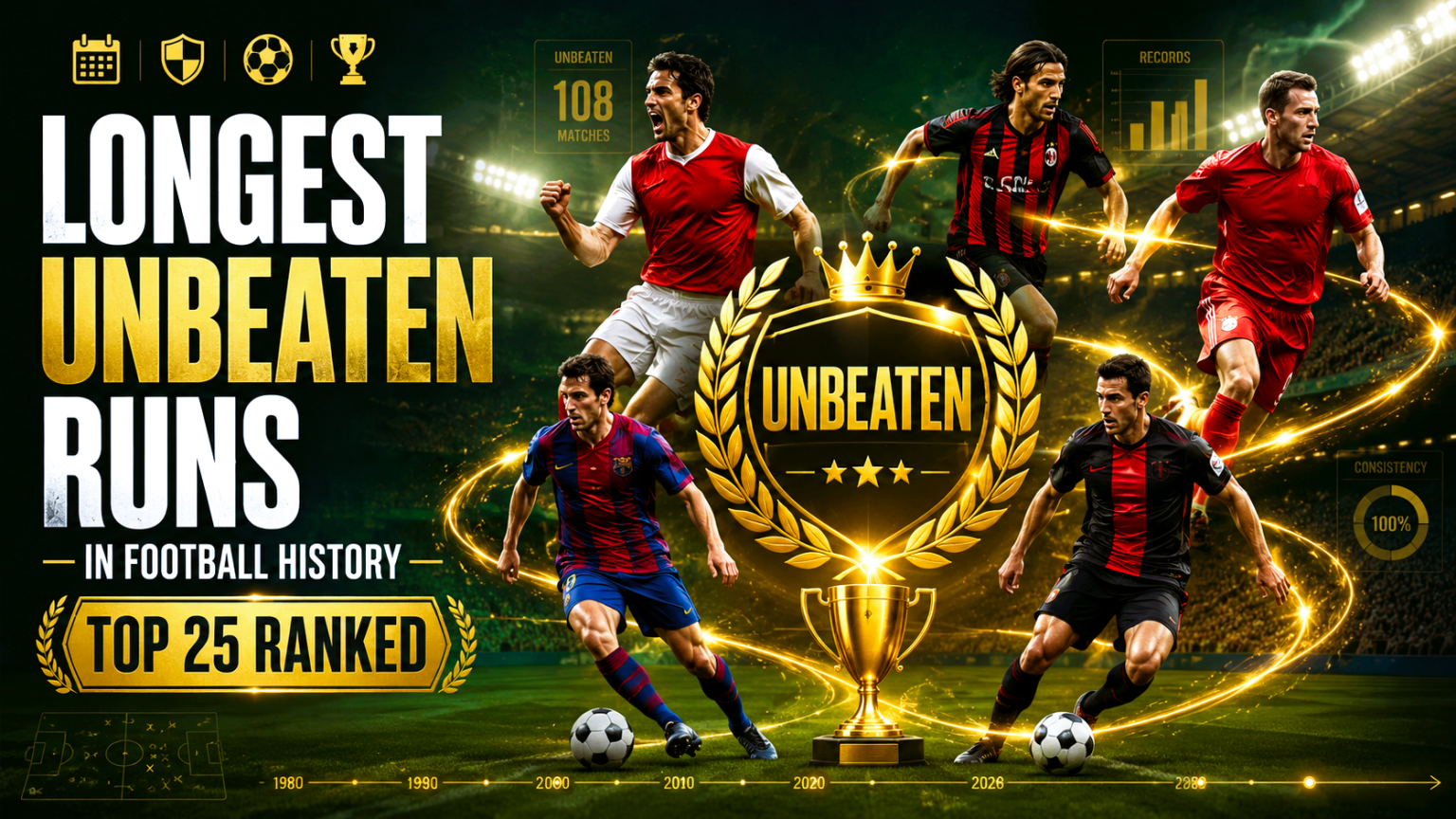

Football rewards moments of brilliance. A wonder goal, a last-minute winner, a trophy lifted under fireworks. But nothing in the sport is harder to sustain than an unbeaten run.
Winning a single match takes one good night. Staying unbeaten across a season, or several seasons, takes a level of consistency that very few clubs or national teams have ever managed. Injuries pile up. Fixture lists get congested.
Rivals figure out your patterns. One bad refereeing decision, one deflected shot, and months of work can vanish in ninety minutes.
That is exactly why unbeaten runs carry so much weight in football history. They are not just about talent.
They are about squad depth, tactical discipline, mental resilience, and a manager’s ability to keep a group hungry even when there is nothing left to prove in the short term.
This guide breaks down an important distinction that a lot of casual lists get wrong. A league-only unbeaten run only counts domestic league matches.
An all-competition unbeaten run includes cup games, continental fixtures, and sometimes even friendlies. The two are not directly comparable, even though they often get lumped together in casual conversation.
Steaua București’s world record of 104 unbeaten league games is a different achievement from Bayer Leverkusen’s 51-game unbeaten run across all competitions, even though both are extraordinary.
Club records and international records also need to be kept separate. A club plays 40 to 60 matches a season. A national team might play eight to fifteen.
That means an international unbeaten run of 38 matches, the current record held by Spain, actually spans years rather than months, and represents a completely different kind of consistency than a club chasing the same feat inside a single campaign.
The rankings below were built using verified figures from official club and federation records, UEFA and FIFA data, and Guinness World Records entries, cross-checked against reporting from the matches themselves.
Every entry is separated by competition type so you know exactly what you are comparing.
By the end of this guide, you will know which club holds the outright record, which national team just made history at the 2026 World Cup, how each of Europe’s top five leagues stacks up, and why even the greatest unbeaten runs in football history were always destined to end.
Top 25 Longest Unbeaten Runs in Football History
The table below ranks the 25 longest unbeaten runs across club and international football. Matches Unbeaten reflects the specific competition scope noted in each entry, since league-only and all-competition totals are not directly interchangeable.
| Rank | Club / National Team | Matches Unbeaten | Years | Competition(s) | Manager |
| 1 | ASEC Mimosas (Ivory Coast) | 108 | 1989–1994 | Ivorian League | Various |
| 2 | Steaua București | 104 (league) / 119 (all) | 1986–1989 | Divizia A, Cupa României | Various (incl. Anghel Iordănescu) |
| 3 | Benfica | 56 | 1976–1978 | Primeira Liga | John Mortimore |
| 4 | FC Porto | 55 | 2010–2012 | Primeira Liga (all competitions) | Jesualdo Ferreira / André Villas-Boas |
| 5 | Bayern Munich | 53 | 2012–2014 | Bundesliga | Jupp Heynckes / Pep Guardiola |
| 6 | Celtic | 69 | 2016–2017 | Domestic (league, League Cup, Scottish Cup) | Brendan Rodgers |
| 7 | AC Milan | 58 | 1991–1993 | Serie A | Fabio Capello |
| 8 | Bayer Leverkusen | 51 | 2023–2024 | All competitions | Xabi Alonso |
| 9 | Arsenal | 49 | 2003–2004 | Premier League | Arsène Wenger |
| 10 | Juventus | 49 | 2011–2013 | Serie A | Antonio Conte |
| 11 | Dinamo București | 47 | 1991–1992 | Divizia A | Various |
| 12 | Barcelona | 43 | 2015–2016 / 2017–2018 | All competitions | Ernesto Valverde (peak run 2017-18) |
| 13 | Real Madrid | 42 | 2023–2024 | La Liga | Carlo Ancelotti |
| 14 | Nottingham Forest | 42 | 1977–1978 | Football League First Division | Brian Clough |
| 15 | Real Sociedad | 38 | 1979–1980 | La Liga | Alberto Ormaetxea |
| 16 | Paris Saint-Germain | 36 | 2015–2016 | Ligue 1 | Laurent Blanc |
| 17 | Hamburger SV | 36 | 1982–1983 | Bundesliga | Ernst Happel |
| 18 | Spain (national team) | 38 | 2024–2026 | International (all matches) | Luis de la Fuente |
| 19 | Italy (national team) | 37 | 2018–2021 | International (competitive) | Roberto Mancini |
| 20 | Argentina (national team) | 36 | 2019–2022 | International (all matches) | Lionel Scaloni |
| 21 | Brazil (national team) | 35 | 1993–1996 | International (all matches) | Various (incl. Carlos Alberto Parreira) |
| 22 | Spain (national team) | 35 | 2007–2009 | International (all matches) | Luis Aragonés / Vicente del Bosque |
| 23 | Morocco (national team) | ~34 | 2025–2026 | International (all matches) | Walid Regragui |
| 24 | Senegal (national team) | 33 | 2023–2025 | International (all matches) | Aliou Cissé |
| 25 | Manchester City | 27 | 2020s | UEFA Champions League | Pep Guardiola |
ASEC Mimosas
ASEC Mimosas of Ivory Coast hold one of the longest recognised unbeaten league runs anywhere in world football, stretching 108 consecutive matches in the Ivorian top flight between 1989 and 1994.
The club dominated domestic football during this period behind a conveyor belt of academy talent that would later produce several African stars who moved on to European leagues.
The run is less globally documented than the European entries on this list, largely because West African league archives from that era are thinner than those in Romania, Italy, or England.
Still, statisticians and football historians widely cite the streak as one of the longest of all time. ASEC used their period of dominance to collect multiple Ivorian championships in succession, building a squad culture around discipline and continuity that outlasted managerial changes.
The eventual defeat, when it came, ended one of the most remarkable spells of consistency in African club football.
Because it happened outside Europe’s more heavily archived leagues, the exact match that ended it is harder to pin down definitively than the European entries on this list, but the overall streak remains a benchmark figure whenever unbeaten runs are discussed on a global scale.
Its historical significance lies in showing that record-breaking consistency in football is not confined to Europe’s giants.
ASEC’s run predates the financial gulf that later separated African and European clubs, and it stands as a reminder of the depth of footballing talent produced on the continent.
Steaua București
Steaua București’s unbeaten run remains the most cited record in European football history.
Between June 1986 and September 1989, the Romanian side went 104 consecutive league matches without defeat, a run that extended to 119 games when cup fixtures are included.
During that stretch, Steaua claimed five consecutive Divizia A titles and four Romanian Cups.
The run began not long after Steaua’s greatest triumph, the 1986 European Cup final win over Barcelona in Seville, settled on penalties after goalkeeper Helmuth Duckadam saved four consecutive spot kicks.
That victory, the first European Cup won by an Eastern European club, launched a period of near-total domestic dominance built around a squad featuring a young Gheorghe Hagi.
Playing under the patronage of the Romanian Army during the final years of Nicolae Ceaușescu’s regime, Steaua enjoyed resources and refereeing conditions that gave them a considerable edge at home, a context that is frequently mentioned alongside the record.
Even accounting for that context, the sheer length of the run, three full seasons of Divizia A football plus cup ties without a single loss, remains statistically unmatched by any major European league champion.
The run ended on 9 September 1989 when bitter rivals Dinamo București won at Steaua’s Ghencea stadium.
Politically, the timing was significant too, arriving just months before the Romanian Revolution reshaped the country entirely. Steaua’s streak remains the standard against which every subsequent European unbeaten run is measured.
Benfica
Benfica’s 56-match unbeaten run in the Primeira Liga between 1976 and 1978 made them the first Portuguese club to complete an entire season without defeat, a campaign built around key figures like Fernando Chalana, Toni, Manuel Bento, and Humberto Coelho.
Manager John Mortimore oversaw a period where Benfica’s blend of technical quality and defensive organisation proved unshakeable across two full domestic seasons.
The team won 28 matches and drew only two during the unbeaten league season, a level of dominance that reset expectations for Portuguese football.
Benfica’s status as Portugal’s most successful club was cemented further by this period, adding to a trophy cabinet already stacked with European Cup final appearances during the Eusébio era of the previous decade.
What made the run remarkable was its consistency against domestic rivals Porto and Sporting CP, both of whom struggled to find any way past Benfica’s defensive structure for the better part of two years.
The eventual defeat came against fierce rivals Porto in August 1978, a fitting way for one of Portuguese football’s great streaks to end.
Historically, the run represents the peak of a Benfica side that, while never quite recapturing the continental success of the 1960s, established a domestic legacy that current generations of Portuguese football fans still reference when debating the greatest teams the league has produced.
FC Porto
FC Porto’s 55-match unbeaten run between 2010 and 2012 spanned the final months of Jesualdo Ferreira’s tenure and the entirety of André Villas-Boas’s title-winning campaign.
Villas-Boas, in his first senior managerial role, guided Porto to a domestic treble in 2010-11, winning the Primeira Liga, the Taça de Portugal, and the UEFA Europa League without losing a single competitive match that season.
The squad featured Radamel Falcao, who scored goals at a remarkable rate throughout the campaign, alongside João Moutinho and James Rodríguez in midfield.
Porto’s attacking football combined with defensive solidity made them close to unstoppable domestically, and their run comfortably surpassed the previous Portuguese benchmark of 53 games set under Sir Bobby Robson in the 1990s.
Villas-Boas left for Chelsea after that historic season, but his successor continued the momentum into the following campaign before the streak eventually came to an end against Gil Vicente.
The 3-1 defeat snapped one of the most impressive club runs seen anywhere in Europe over the previous two decades.
The significance of Porto’s run lies in how it combined domestic dominance with continental silverware, something few of the clubs on this list managed simultaneously.
It remains a defining moment in Villas-Boas’s career and one of the great modern Portuguese footballing achievements.
Bayern Munich
Bayern Munich’s Bundesliga record of 53 consecutive unbeaten matches ran from November 2012 to March 2014, spanning the treble-winning Jupp Heynckes campaign of 2012-13 and the start of Pep Guardiola’s reign afterward.
Bayern beat Hamburg’s long-standing German record of 36 games during the run, extending their dominance well beyond what any previous Bundesliga side had achieved.
During the streak, Bayern won the Bundesliga, DFB-Pokal, and UEFA Champions League treble in 2013, becoming only the second German club to achieve that feat.
Key players included Manuel Neuer, Philipp Lahm, Bastian Schweinsteiger, Franck Ribéry, and Arjen Robben, a squad regarded as one of the finest in Bundesliga history.
Guardiola’s arrival in the summer of 2013 did not interrupt the momentum, and Bayern continued winning at a rate few German sides have matched before or since.
The run finally ended in a 2-1 defeat away to Augsburg in late March 2014, a result that shocked the Bundesliga given how comfortably Bayern had been winning up to that point.
The streak remains the longest in Bundesliga history and one of the clearest examples on this list of a genuine golden generation peaking at exactly the right time, under two different but equally demanding managerial regimes.
Celtic
Under Brendan Rodgers, Celtic put together a 69-match unbeaten run across all domestic competitions between May 2016 and December 2017, smashing the club’s own 100-year-old British record of 62 games set by Willie Maley’s side between 1915 and 1917.
The run included a full unbeaten league season, a Scottish Cup, and a Scottish League Cup.
Key figures included captain Scott Brown, Moussa Dembélé, and Kieran Tierney, with Rodgers instilling an attacking, possession-based approach that overwhelmed most Scottish Premiership opposition.
Celtic’s dominance was so complete that beating them became a genuine talking point across Scottish football for well over a season.
The run ended in stunning fashion. Hearts beat Celtic 4-0 at Tynecastle in December 2017, inflicting Rodgers’s first domestic defeat since taking charge.
Sixteen-year-old Harry Cochrane opened the scoring, and Celtic never recovered on the day, a result that shocked a team that had looked untouchable for eighteen months.
Rodgers himself said afterward that the run might never be equalled, and the achievement remains a landmark in Scottish football history.
It also reinforced Celtic’s status as the dominant force north of the border during that era, extending their run of consecutive league titles at the same time.
AC Milan
Fabio Capello’s AC Milan went 58 Serie A matches unbeaten between May 1991 and March 1993, a run that remains the longest in Italian top-flight history.
Capello inherited a squad built by Arrigo Sacchi and immediately delivered an unbeaten Serie A title in 1991-92, becoming only the second team to complete an Italian league season without a loss.
The squad featured Franco Baresi, Paolo Maldini, and Alessandro Costacurta at the back, with the Dutch trio of Marco van Basten, Ruud Gullit, and Frank Rijkaard providing attacking quality few teams in Europe could match.
Van Basten finished as Serie A’s top scorer during the unbeaten league campaign, netting 25 goals.
Milan carried the run into the following season, extending their dominance before Parma finally ended it with a 1-0 win at San Siro in March 1993, settled by a Faustino Asprilla free kick.
The defeat came in the ironic circumstances of facing the same opponents against whom the run had begun, a 0-0 draw with Parma back in May 1991.
The run’s significance goes beyond the numbers. It produced one of the most feared defensive units in football history and helped set up Milan’s 4-0 demolition of Barcelona in the 1994 Champions League final, a fitting coda to Capello’s defining Milan era.
Bayer Leverkusen
Xabi Alonso’s Bayer Leverkusen produced the longest unbeaten run in European club football since the Second World War, going 51 matches across all competitions without defeat between May 2023 and May 2024.
The run included Leverkusen’s first-ever Bundesliga title, secured with a perfect unbeaten league campaign, alongside a run to the DFB-Pokal and UEFA Europa League finals.
Florian Wirtz, Jeremie Frimpong, Granit Xhaka, and Victor Boniface formed the spine of a team that combined relentless pressing with clinical finishing.
Leverkusen had not lost since a 3-0 defeat to VfL Bochum in May 2023, and the club’s first-ever Bundesliga championship arrived with games to spare, completing the league season unbeaten in the process.
The run finally ended in the biggest possible game. Atalanta beat Leverkusen 3-0 in the UEFA Europa League final in Dublin, with Ademola Lookman scoring an extraordinary hat-trick to deny Alonso’s side a historic continental treble. The defeat came 361 days after Leverkusen’s previous loss.
Despite falling short of the treble, the achievement transformed Leverkusen’s status in German football and confirmed Alonso as one of the most sought-after young coaches in the game, a reputation that only grew after he later moved into a top job at one of Europe’s traditional superclubs.
Arsenal
Arsenal’s Invincibles remain the most romanticised unbeaten run in Premier League history.
Between May 2003 and October 2004, Arsène Wenger’s side went 49 consecutive top-flight matches without defeat, a run that included the entirety of the 2003-04 season, completed without a single loss in 38 games.
Thierry Henry, Dennis Bergkamp, Patrick Vieira, and Robert Pirès led an attacking unit that scored freely and rarely needed to grind out results.
Arsenal’s unbeaten league season matched Preston North End’s achievement from the 1888-89 campaign, the only other top-flight English club to manage it, though Preston played far fewer matches in a much smaller league.
The run broke Nottingham Forest’s 26-year-old English record of 42 games in August 2004 before eventually reaching 49.
It ended in one of the most controversial fixtures of the Premier League era, a 2-0 defeat to Manchester United at Old Trafford in October 2004, sparked by a contentious late penalty and remembered for the post-match “Pizzagate” tunnel incident.
Arsenal’s Invincibles remain the only club to complete an undefeated 38-game English top-flight season, and the squad is still widely regarded as one of the greatest in Premier League history, defined as much by this record as by the trophies it won.
Juventus
Antonio Conte’s Juventus went 49 consecutive Serie A matches unbeaten spanning the 2011-12 and 2012-13 seasons, becoming the third Italian club after Perugia and AC Milan to complete a full Serie A campaign without a loss, this time across a 38-game season. Juventus won 23 and drew 15 of those matches en route to their first Scudetto in nine years.
The famous BBC defensive trio of Andrea Barzagli, Leonardo Bonucci, and Giorgio Chiellini conceded just 20 goals across the unbeaten league season, providing the platform for Conte’s high-intensity, results-driven football.
Andrea Pirlo, arriving on a free transfer from Milan, orchestrated the midfield with the calm authority that defined the entire campaign.
The run carried into the following season before Inter Milan ended it with a 3-1 win, a result that snapped one of the most disciplined stretches of Serie A football in decades.
Even after the defeat, Juventus went on to launch a run of nine consecutive Scudetti, the longest domestic title streak in Italian football history.
The significance of the run lies in its role as the foundation stone of a new Juventus dynasty, rebuilt from the wreckage of the Calciopoli scandal years earlier into the dominant force of Italian football for the following decade.
Longest Unbeaten Run in Club Football
The outright club record for an unbeaten run belongs to Steaua București, whose 104 consecutive Divizia A matches between 1986 and 1989 remain unmatched by any major European club to this day. Extended to include cup fixtures, the run reaches 119 games.
ASEC Mimosas of Ivory Coast are widely cited with an even longer domestic league streak of 108 games, though that record sits outside Europe’s more heavily scrutinised leagues.
Among clubs from Europe’s traditional football powerhouses, Benfica’s 56-game run in the late 1970s and FC Porto’s 55-game run under André Villas-Boas rank as the longest in Portuguese football, a country that has produced a surprising number of extended unbeaten sequences relative to its size.
Bayern Munich’s 53-game Bundesliga record and AC Milan’s 58-game Serie A record round out the historic European club benchmarks.
Maintaining an unbeaten run of this length is genuinely difficult for reasons that go well beyond simple squad quality.
A club competing across multiple competitions faces fixture congestion that leaves little time for recovery, increasing injury risk across a 50 to 60 match stretch.
Depth matters enormously, since a first-choice XI cannot physically play every match at the required intensity for an entire season, let alone two or three.
There is also a psychological dimension. The longer a run continues, the more pressure builds, both from opponents desperate to be the team that ends it and from a club’s own supporters and media, who begin treating every match as a referendum on the streak itself rather than three points on their own merit.
Very few managers have shown the ability to keep a group fully focused under that kind of accumulating scrutiny.
Longest Unbeaten Run by a National Team
Spain now hold the all-time record for the longest unbeaten run in men’s international football, reaching 38 matches after their 2026 FIFA World Cup final win over Argentina.
The run began following a 2024 friendly defeat to Colombia and has included both a European Championship and a World Cup, a double that few international sides in history have managed inside a single unbeaten stretch.
Italy’s 37-game run between 2018 and 2021, built during Roberto Mancini’s post-2018-World-Cup rebuild and capped by the Euro 2020 title, held the previous record.
Argentina’s 36-game run under Lionel Scaloni included the 2021 Copa América and stretched right up to the opening match of the 2022 World Cup.
Brazil’s 35-game run in the mid-1990s and Spain’s earlier 35-game run between 2007 and 2009 round out the sport’s most historically significant international streaks.
It is worth noting the distinction between competitive-only records and all-match records, since some federations and record bodies track these figures differently.
Guinness World Records, for instance, credits Italy’s 37-game run specifically as the longest in competitive men’s international football, a slightly narrower category than an all-matches tally that would include every friendly played during a given stretch.
International unbeaten runs are, in some ways, even harder to sustain than club streaks because national team managers have far less control over player fitness, form, and preparation time between matches, which are often spread across many months.
A club manager sees his players daily. An international manager gets a handful of days together before most fixtures, making sustained excellence over three-plus years, as Spain and Italy have both shown, an entirely different kind of achievement.
Conclusion
Unbeaten runs sit at the intersection of everything that makes football compelling.
They demand talent, obviously, but they demand consistency even more, and consistency across dozens of matches, against determined opponents, over months or years, is one of the hardest things to sustain in professional sport.
What stands out across every entry on this list is how differently each run was built. Steaua’s dominance came wrapped in unique political circumstances.
Arsenal’s Invincibles were built on attacking football few teams have matched since.
Bayer Leverkusen’s 2023-24 campaign came out of nowhere to end Bayern Munich’s decade of Bundesliga dominance. Spain’s current international record was forged across two entirely different tournament wins, three years apart.
The most iconic undefeated teams in football history are remembered as much for how their run ended as for how long it lasted.
Arsenal’s Old Trafford defeat, Leverkusen’s Europa League final loss, Argentina’s Saudi Arabia shock.
These moments are etched into football history just as deeply as the streaks themselves, a reminder that even the longest unbeaten runs are, eventually, always going to end.
For more football history, records, and statistics content, explore FutbolUpdate’s other pillar guides on the most decorated managers by trophy count, and the complete list of Champions League winners.