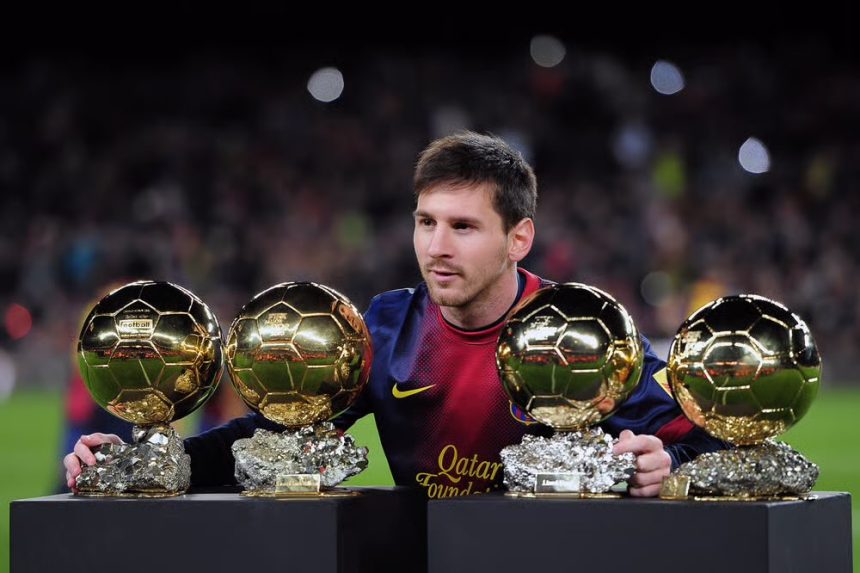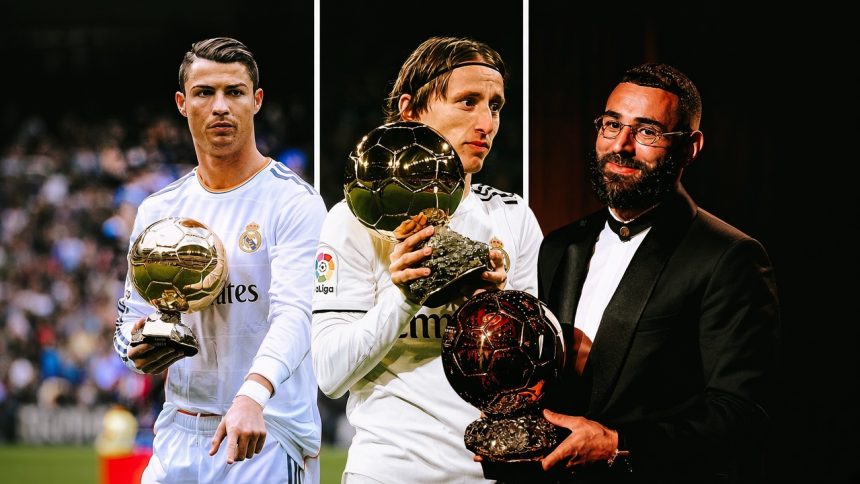





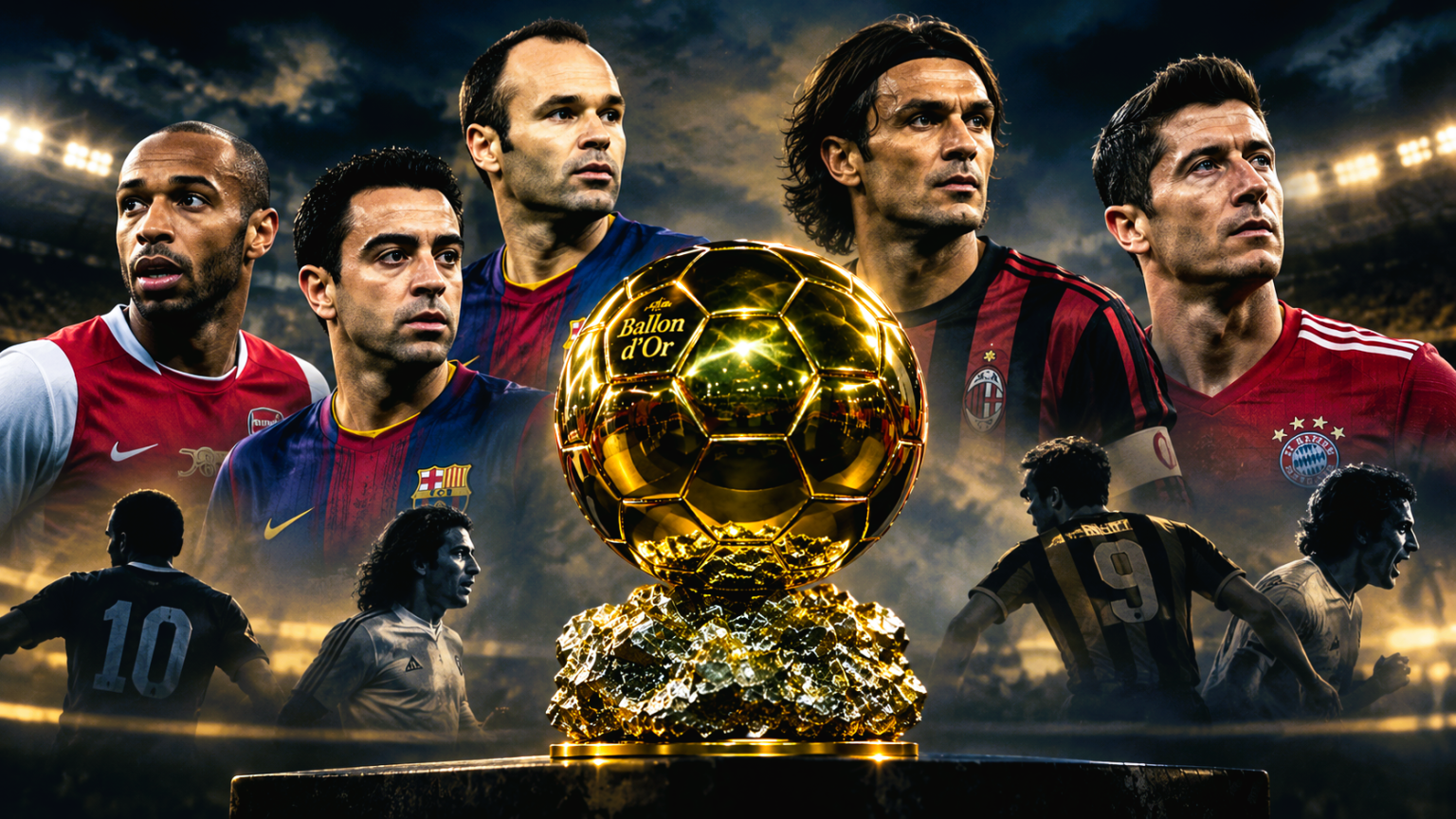

Some of football’s most celebrated players have lifted World Cups, European Cups or Champions League titles yet never claimed the men’s Ballon d’Or.
Thierry Henry, Xavi Hernández, Andrés Iniesta, Paolo Maldini and Robert Lewandowski all produced careers of the highest standard without winning the award.
The list below is a considered selection rather than an official ranking. Missing out on the Ballon d’Or does not make a player less important to football history; the award reflects voting in a particular year, not a complete verdict on a career.
Greatest Footballers Who Never Won the Ballon d’Or
The players below were selected on individual ability, sustained excellence, major honours, influence on how the game was played and their history in the voting. No single factor decided inclusion.
1. Thierry Henry
Henry was one of the most complete forwards of his generation. He combined pace, finishing and an unusual willingness to drop deep and create.
He combined explosive pace, precise finishing and creative vision, becoming the focal point of Arsène Wenger’s side and a key figure in Barcelona’s 2008-09 treble campaign.
In 2003/04 he led Arsenal through an unbeaten Premier League season, scoring 30 league goals.
Henry finished second in the 2003 Ballon d’Or voting behind Pavel Nedvěd, then placed fourth in 2004 and third in 2006. His 2003 finish came during a period when he was becoming one of Europe’s most influential forwards.

Despite Arsenal’s unbeaten Premier League season in 2003/04 and his impact at Barcelona, Henry never won the award.
2. Xavi Hernández
Xavi was the midfield organiser at the heart of Barcelona’s greatest era and Spain’s dominant international side.
His ability to control tempo, find space and dictate play underpinned successive La Liga and Champions League titles as well as Spain’s victories at Euro 2008, the 2010 World Cup and Euro 2012.
Xavi finished third in the Ballon d’Or voting in 2009, 2010 and 2011. He never won the award, despite playing a central role in Barcelona’s success and Spain’s international dominance.
His career illustrates how difficult it can be to capture a deep-lying midfielder’s influence through individual award voting.
3. Andrés Iniesta
Iniesta was the quiet partner of Xavi in Barcelona’s midfield. His close control and timing made him one of the hardest players to dispossess.
His extra-time goal in the 2010 World Cup final against the Netherlands secured Spain’s first world title. It remains one of the most important goals in the national team’s history.
He finished second in the 2010 Ballon d’Or voting, behind Lionel Messi. That result came in the same year as his World Cup triumph.
Iniesta’s career shows how hard it is to measure midfield influence through an individual award. His best work changed matches without always appearing in the scorebook.
4. Paolo Maldini
Maldini spent his entire senior club career at AC Milan. His longevity at the top level was extraordinary, and he was still a leading defender late into his career.
He won major honours in Italy and Europe. His reading of the game and calm distribution from defence set a standard many full-backs have tried to match.
Maldini finished third in the 1994 Ballon d’Or voting, after helping AC Milan win the European Cup and reach the World Cup final with Italy later that year. He never won the award, despite a career that included multiple European Cup and Champions League titles.
His record also highlights the difficulty defenders can face in individual awards, where attacking statistics often attract greater attention. That is a tendency, not a rule: defenders have won the Ballon d’Or before.
5. Robert Lewandowski
Lewandowski was one of the most prolific finishers of his era. He scored heavily for Bayern Munich and later continued that record at Barcelona.
He won multiple domestic titles and a Champions League with Bayern. His record in front of goal made him a constant presence in award discussions.
The 2020 Ballon d’Or was cancelled because of the COVID-19 pandemic, despite Lewandowski’s outstanding season with Bayern Munich. He helped the club win the Bundesliga, DFB-Pokal and Champions League, finishing the campaign as one of the world’s most prolific scorers.
He finished second in the 2021 Ballon d’Or voting behind Lionel Messi. Lewandowski never officially won the men’s Ballon d’Or.
6. Neymar
Neymar was one of the most creative attackers of his time. He combined dribbling, close control and an eye for the final pass.
He was a key member of Barcelona’s 2014/15 treble-winning side. That season put him firmly among the leading players in the world.
He finished third in the Ballon d’Or voting in 2015 and again in 2017. Those results placed him consistently among the game’s elite, even when others took the top two places.
7. Dennis Bergkamp
Bergkamp was known for his technical ability and vision. He could control almost anything and turn a difficult pass into a chance.
At Arsenal he became one of the club’s defining players. Supporters still regard his years in London as among the most influential in the club’s modern history.
Dennis Bergkamp was renowned for his first touch, vision and ability to create chances in tight spaces. At Arsenal, he became a central figure in the club’s transformation under Arsène Wenger and helped the team win major domestic honours.
Bergkamp never won the Ballon d’Or. To strengthen this profile, include his highest verified finishing position and year from the official historical voting records rather than relying on the vague phrase “placed in the voting”.
8. David Beckham
Beckham’s achievements at Manchester United and Real Madrid are well documented. He was a central figure in United’s 1998/99 treble-winning team.
His crossing, passing and set-piece delivery were exceptional. Few players have struck a ball with such precision from distance.
Beckham finished second in the 1999 Ballon d’Or voting and fourth in 2001. His performances for Manchester United, including their 1998/99 treble-winning campaign, established him among the leading players of his generation. His worldwide fame was immense, but popularity alone does not determine the award.
9. Gianluigi Buffon
Buffon’s longevity was remarkable. He was widely regarded as one of the outstanding goalkeepers of his generation for more than two decades.
He was part of Italy’s 2006 World Cup-winning squad. He also helped Juventus dominate Italian football during his time in Turin.
Buffon finished second in the 2006 Ballon d’Or voting, behind Fabio Cannavaro, after helping Italy win the World Cup. It remains one of the strongest finishes by a goalkeeper in the award’s history.
10. Raúl González
Raúl was a central figure in Real Madrid’s successful European era. He was the club’s most reliable goalscorer and a recognised leader in the dressing room.
His goalscoring record at Real Madrid is among the club’s most impressive. He also captained the side for much of his career.
Raúl finished second in the 2001 Ballon d’Or voting, behind Michael Owen. He never won the award, despite his goalscoring record and central role in Real Madrid’s successful European era.
11. Franck Ribéry
Ribéry was a driving force for Bayern Munich’s 2012/13 treble-winning season. His direct running and dribbling gave the team an edge in attack.
He played a major role in Bayern’s Champions League triumph that year. That success made him one of the most talked-about players in Europe.
Ribéry finished third in the 2013 Ballon d’Or voting after helping Bayern win the Bundesliga, German Cup and Champions League. Despite his outstanding season, Cristiano Ronaldo won the award, with Lionel Messi finishing second.
12. Zlatan Ibrahimović
Ibrahimović scored prolifically across several of Europe’s top leagues. His career took in Ajax, Inter Milan, Barcelona, AC Milan and Paris Saint-Germain.
His individual style made him one of the most memorable players of his era. He combined physical power with unusual technical skill.
Ibrahimović never won the Ballon d’Or and did not finish second. His highest placing was fourth in 2013, when he was recognised among the leading players in world football.
Legendary Players Who Were Not Eligible for Much of Their Careers
Pelé and Diego Maradona are often included in these discussions. Their greatest years, however, largely fell outside the award’s eligibility rules.
The Ballon d’Or was originally open only to European players. From 1995 to 2006, players of any nationality playing for European clubs could qualify. Eligibility became worldwide from 2007.
Those rules matter. Pelé and Maradona built their reputations largely before they could have won the award, so they should not be compared directly with eligible players who finished second or third.
Honorary and retrospective recognition is a separate matter. Pelé received an honorary Ballon d’Or in 2013, but that is not a standard annual victory and should not be counted as one.
Which Player Came Closest to Winning the Ballon d’Or Without Winning It?
Second-place finishes are the simplest measure of proximity. They show who came nearest to the top in the voting.
They are not a definitive measure of the best player never to win. Timing, competition and voting trends all shape the result.
Thierry Henry finished second in the 2003 Ballon d’Or voting, making him one of the strongest candidates among players who never won the award.
Other notable runners-up include Paolo Maldini in 1994, David Beckham in 1999, Raúl in 2001, Gianluigi Buffon in 2006, Andrés Iniesta in 2010 and Robert Lewandowski in 2021.
There is no definitive answer to who came closest in terms of overall ability. Second-place finishes show voting proximity, while trophies, longevity and influence provide a broader basis for comparison.
Frequently Asked Questions
Who is the greatest footballer never to have won the Ballon d’Or?
There is no universally accepted answer. Thierry Henry, Xavi, Andrés Iniesta, Paolo Maldini and Robert Lewandowski are all strong candidates. Pelé and Diego Maradona are treated separately because eligibility rules limited their chances for much of their careers.
Did Thierry Henry ever win the Ballon d’Or?
No. Thierry Henry never won the Ballon d’Or. He finished second in 2003, fourth in 2004 and third in 2006.
Did Xavi or Andrés Iniesta ever win the Ballon d’Or?
Neither won the men’s award. Iniesta finished second in 2010, and Xavi reached the top three several times, including second place in 2011.
Why did Robert Lewandowski not win the 2020 Ballon d’Or?
The 2020 award was cancelled because of the COVID-19 pandemic. Lewandowski was not an official winner that year. He finished second in 2021.
Were Pelé and Diego Maradona eligible for the Ballon d’Or?
Not for most of their careers. The award was limited to European players until 1994, then extended to players of any nationality at European clubs from 1995 to 2006, and opened worldwide from 2007. Pelé later received an honorary Ballon d’Or in 2013, which is separate from standard annual awards.
Conclusion
The Ballon d’Or remains one of football’s most prestigious individual honours, but it cannot capture every aspect of a player’s quality, longevity or influence.
From Thierry Henry and Xavi to Paolo Maldini and Robert Lewandowski, these careers show that a player’s legacy extends beyond one award. Explore the full history in our Ballon d’Or winners list.