





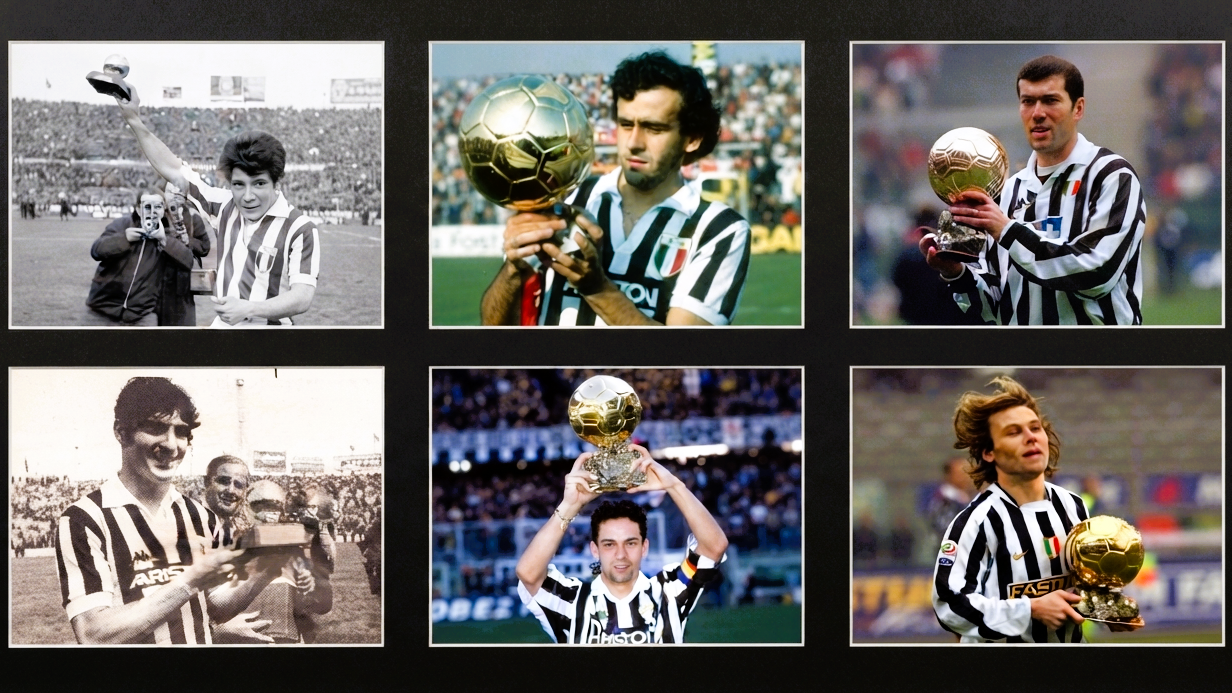

Juventus has eight Ballon d’Or-winning editions under the counting method used here. Those eight awards were shared by six different players.
Michel Platini won the award three years in a row, from 1983 to 1985. No other Juventus player has won it more than once.
The winners cover several generations of European football. They run from Omar Sívori in 1961 to Pavel Nedvěd in 2003.
Juventus Ballon d’Or Winners List
The table below lists every men’s Ballon d’Or won by a player who represented Juventus when the award was presented.
| Year | Player | Country |
|---|---|---|
| 1961 | Omar Sívori | Italy / Argentina |
| 1982 | Paolo Rossi | Italy |
| 1983 | Michel Platini | France |
| 1984 | Michel Platini | France |
| 1985 | Michel Platini | France |
| 1993 | Roberto Baggio | Italy |
| 1998 | Zinedine Zidane | France |
| 2003 | Pavel Nedvěd | Czech Republic |
Counting method: This list credits each Ballon d’Or to the club the player represented when the award was presented, rather than the club associated with his performances during the preceding season.
This distinction matters for players who changed clubs before the ceremony. Other lists may use a different method, which can produce a different total.
For the full roll of honour, see our Ballon d’Or winners list.
Every Juventus Ballon d’Or Winner Explained
Omar Sívori — 1961
Sívori was the first Juventus player to win the Ballon d’Or. He received it in 1961.
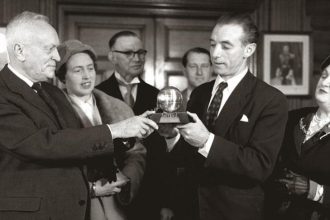

Born in Argentina, Sívori joined Juventus from River Plate in 1957. He represented Argentina internationally before later playing for Italy, reflecting his dual Argentine and Italian citizenship.
On the pitch, Sívori was a quick, inventive forward with outstanding dribbling skill. He was known for his close control and his refusal to be intimidated by defenders.
He formed a celebrated attacking trio with John Charles and Giampiero Boniperti. That group helped Juventus win several Serie A titles around the turn of the 1960s.
Paolo Rossi — 1982
Paolo Rossi won the 1982 Ballon d’Or after leading Italy’s attack during its World Cup triumph in Spain, finishing the tournament as its top scorer with six goals.
He returned from a ban linked to the Italian betting scandal shortly before the tournament, then transformed his World Cup campaign with a series of decisive performances.
He found form in the second group stage. His hat-trick against Brazil was the turning point of Italy’s run.
He scored six goals and won both the Golden Boot and the Golden Ball. He also scored in the final, a 3-1 win over West Germany.
Rossi was a sharp, instinctive penalty-box finisher. He joined Juventus in 1981 and won major honours with the club before leaving in 1985.
Michel Platini — 1983, 1984 and 1985
Michel Platini is Juventus’s most successful Ballon d’Or winner and the only player in the club’s history to claim the award three times. His victories came in successive years: 1983, 1984 and 1985.
He arrived from Saint-Étienne in 1982 and quickly became the creative centre of the team. He played as an attacking midfielder but scored like a striker.
He was Serie A’s top scorer in three consecutive seasons, which was rare for a midfielder in a league known for tight defending.
His passing, vision and set-piece delivery set the standard for playmakers of the era. He was also a reliable penalty taker.
The 1984 award followed his outstanding performances for France at Euro 1984, where he led the hosts to the title. His goals dominated that tournament.
With Juventus, Platini won Serie A titles in 1984 and 1986, the Coppa Italia in 1983, the European Cup Winners’ Cup and European Super Cup in 1984, and the European Cup in 1985. He also helped the club win the Intercontinental Cup that year.
That night is remembered mainly for the tragedy in the stands, which cost 39 lives. Juventus won the match, but the final remains inseparable from the Heysel disaster, in which 39 people died.
To see how his run compares with other multiple winners, read our guide to Ballon d’Or records.
Roberto Baggio — 1993
Baggio won the 1993 Ballon d’Or while representing Juventus, having joined the club from Fiorentina in 1990. His performances combined close control, creativity and an exceptional ability to create or finish chances.
Baggio was a forward of rare technical quality. His touch, balance and creativity made difficult actions look simple.
He could score from open play and from free kicks, and he created chances for others. His individual brilliance carried Juventus through a transitional period.
Juventus won the UEFA Cup in 1993, and Baggio was the club’s central attacking figure that year. He also won FIFA World Player of the Year in 1993, which is a separate award from the Ballon d’Or.
He left for AC Milan in 1995 after winning Serie A and the Coppa Italia with Juventus.
Zinedine Zidane — 1998
Zidane joined Juventus from Bordeaux in 1996. He spent five seasons in Turin before moving to Real Madrid in 2001.
His 1998 Ballon d’Or came after a remarkable year. Juventus reached the Champions League final that season, although they lost to Real Madrid.
Zidane’s year reached its peak at the 1998 World Cup. He scored twice with headers in France’s 3–0 final victory over Brazil, helping his country win the tournament on home soil.
His style was elegant but powerful. He combined close control, vision and a graceful turn that let him escape pressure in midfield.
Zidane also won FIFA World Player of the Year in 1998. That is a different award, and this article counts only the Ballon d’Or.
Pavel Nedvěd — 2003
Nedvěd joined Juventus from Lazio in 2001 and became one of the most important players of the club’s early 2000s side.
He was a tireless left-sided midfielder with a fierce long-range shot. His stamina allowed him to attack and defend for the full match.
Nedvěd’s 2003 Ballon d’Or followed a season in which Juventus won Serie A and reached the Champions League final. His performances in midfield helped Juventus reach the final in Manchester, although a suspension prevented him from playing in the match.
A booking in the semi-final against Real Madrid ruled him out of the final. Juventus lost to AC Milan on penalties without him.
Under this article’s counting method, Nedvěd is Juventus’s most recent Ballon d’Or winner as of October 2026. No later winner has been credited to the club.
Which Juventus Player Has Won the Most Ballon d’Or Awards?
Michel Platini has won the most Ballon d’Or awards of any Juventus player, with three. His wins came in consecutive years: 1983, 1984 and 1985.
Juventus’s other five winners—Omar Sívori, Paolo Rossi, Roberto Baggio, Zinedine Zidane and Pavel Nedvěd—each won the award once.
For wider context, see our guide to football clubs with the most Ballon d’Or wins.
Why Isn’t Fabio Cannavaro Included in Juventus’s Total?
Fabio Cannavaro won the 2006 Ballon d’Or after transferring from Juventus to Real Madrid in the summer of 2006. Because the award was presented after that move, this article credits his win to Real Madrid.
Other lists may take a different approach. Some credit the club the player represented during the season that earned the award.
Neither method is necessarily wrong. Totals differ because the rules for assigning the award differ.
Frequently Asked Questions
How many Ballon d’Or awards have Juventus players won?
Eight winning editions under this article’s counting method, shared by six different players.
Which Juventus player has won the most Ballon d’Or awards?
Michel Platini, with three consecutive wins from 1983 to 1985.
Did Roberto Baggio win the Ballon d’Or as a Juventus player?
Yes. Baggio won the 1993 Ballon d’Or while representing Juventus.
Did Cristiano Ronaldo win the Ballon d’Or at Juventus?
No. Although he played for Juventus from 2018 to 2021, he did not win the Ballon d’Or during that period.
Who was Juventus’s last Ballon d’Or winner?
Pavel Nedvěd, who won in 2003, under the counting method used in this article.
Conclusion
Juventus’s Ballon d’Or history includes eight winning editions across six players, with Michel Platini’s three consecutive awards standing above the club’s other successes.
From Omar Sívori to Pavel Nedvěd, the winners reflect different eras of the club’s history. The total can vary across published lists, so the counting method matters when comparing Juventus with other clubs.
New to the award? Start with what the Ballon d’Or is and how Ballon d’Or voting works. You can also see how Juventus compares with Barcelona’s Ballon d’Or winners.