








The Ballon d’Or is decided by a global jury of specialist football journalists, but the voting process is more structured than simply choosing the player each journalist thinks is best.
Voters pick from an official shortlist. Each juror ranks 10 players in order of preference, and every ranking position carries a fixed number of points. The player with the highest combined total wins.
The modern men’s jury has one journalist representing each of the top 100 countries in the relevant FIFA men’s ranking.
The women’s award uses one representative from each of the top 50 countries in the relevant FIFA women’s ranking.
This guide explains who votes, how the nominees are chosen, how points are counted and what happens if two players finish level. For the basics of the trophy itself, see What Is the Ballon d’Or?
How Does Ballon d’Or Voting Work?
The modern Ballon d’Or voting system follows a clear sequence. Each stage is separate. The shortlist comes first. The international jury then ranks players from that list.
Step 1: The nominees are announced
The men’s Ballon d’Or shortlist contains 30 players. The shortlist is established before the international jury casts its votes, and the jurors then select their top 10 from those 30 nominees.



Step 2: The voting jury is established
One specialist football journalist represents each of the top 100 countries in the relevant FIFA men’s ranking for the men’s award.
The women’s Ballon d’Or uses one representative from each of the top 50 countries in the FIFA women’s ranking.
Each eligible country has one representative on the jury, and that journalist submits a ranked ballot rather than a single yes-or-no vote.
Step 3: Each journalist ranks 10 players
Every juror selects 10 players from the 30 nominees and places them in order of preference. Journalists do not rank all 30 players. They produce a ranked top 10 only.
Step 4: Points are awarded
Each ranking position carries a fixed number of points. The scale is as follows:
| Position | Points |
|---|---|
| 1st | 15 |
| 2nd | 12 |
| 3rd | 10 |
| 4th | 8 |
| 5th | 7 |
| 6th | 5 |
| 7th | 4 |
| 8th | 3 |
| 9th | 2 |
| 10th | 1 |
The points from all eligible ballots are added together.
Step 5: The player with the most points wins
For example, Player A might collect several first-place votes while also appearing near the top of many other ballots. Player B could receive fewer first-place votes but finish consistently among the top five.
Because every ranking position carries points, both types of support contribute to the final total.
Who Votes for the Ballon d’Or?
The voters are specialist football journalists. They are not fans, players or coaches.
For the men’s Ballon d’Or, that means 100 journalists. Each one represents a different country from the top 100 of the relevant FIFA men’s ranking.
For the women’s Ballon d’Or, 50 journalists vote. They represent the top 50 countries in the relevant FIFA women’s ranking.
This is a selected jury with one seat per eligible country. It is not an open ballot for every football writer in the world.
Ownership and organisation are separate matters. The Ballon d’Or brand remains owned by Groupe Amaury, and France Football continues to oversee the voting system. UEFA and Groupe Amaury co-organise the awards, but UEFA does not select the winner.
What Criteria Do Ballon d’Or Voters Consider?
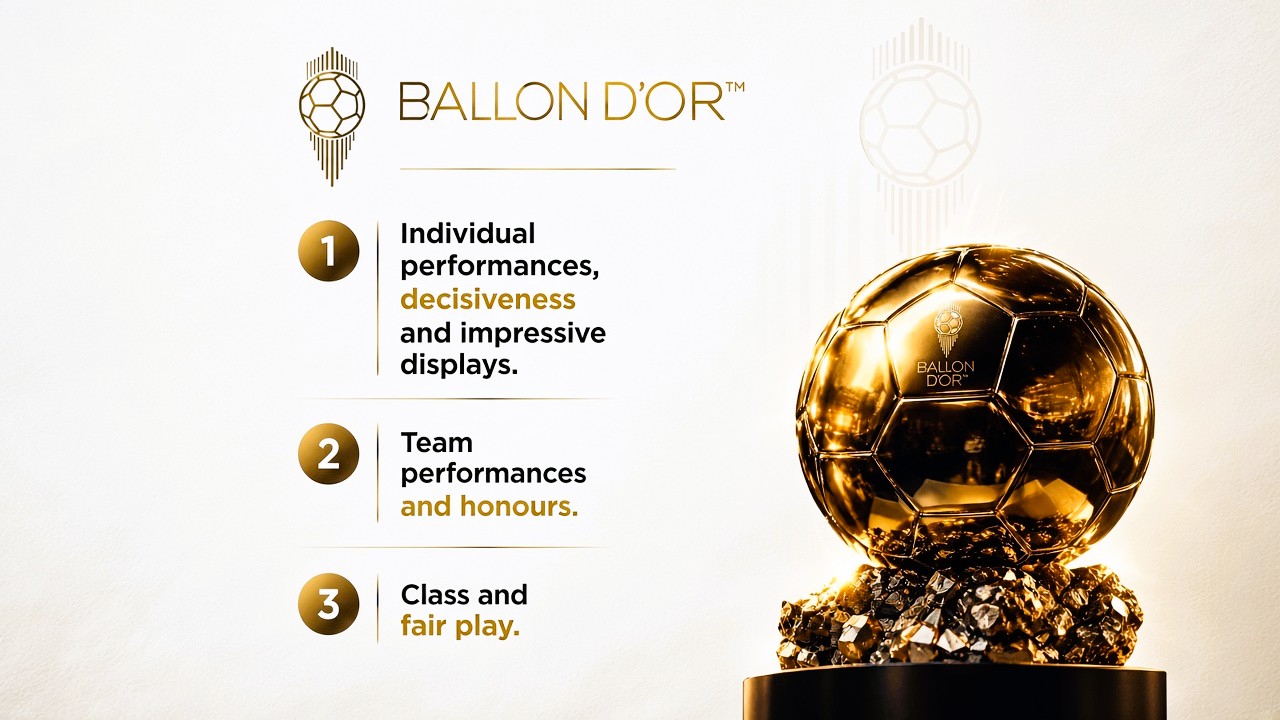
France Football sets out three principal criteria for voters. The published criteria cover individual performances, team performances and achievements, and class and fair play. No fixed numerical weighting is published for each criterion.
1. Individual performances
Voters assess the quality of a player’s performances, consistency across the reference period, decisive moments in matches, influence on results, and overall individual level. The emphasis is on decisive and impressive character.
2. Team performances and achievements
Voters also consider what the player achieved with club and country. Trophies, major competitions and collective success form part of the assessment. Winning a trophy does not automatically make a player the Ballon d’Or winner. Team success is one factor among the three official criteria.
3. Class and fair play
Sporting conduct is part of the official criteria. Voters are asked to consider a player’s class and fair play alongside what he or she did on the pitch.
The reference period is based on the season rather than simply the calendar year, and international competitions are included.
How Are Ballon d’Or Points Calculated?
Every juror chooses 10 players from the shortlist. The first-ranked player on each ballot receives 15 points. Second place receives 12 points. Third receives 10 points. The remaining positions receive 8, 7, 5, 4, 3, 2 and 1 point respectively.
All points from every eligible ballot are totalled. The player with the highest overall score wins.
A simple fictional illustration shows the arithmetic. If a player is ranked first on 20 ballots, that alone produces 300 points (20 × 15).
Appearances in lower positions on other ballots add further points. A rival who collects fewer first-place votes but appears more often in the top five can still close the gap or overtake through consistent lower rankings.
The system rewards both strong first-place support and broad recognition across the jury.
What Happens If There Is a Tie in Ballon d’Or Voting?
If two or more players finish level on total points, the official tie-break procedure applies in this order:
- Number of first-place votes
- Number of second-place votes
- Number of third-place votes
- Continue through the ranking positions if necessary
The tie is not decided by comparing trophies or any other external factor. The ranking positions on the ballots themselves provide the separation.
Who Selects the Ballon d’Or Nominees?
Being shortlisted and receiving the final vote are two different stages. The 30-player men’s shortlist is established before the international jury votes.
According to the published rules, the shortlist is prepared by France Football and L’Équipe editorial representatives, at least one juror from the previous edition, and designated UEFA ambassadors.
Journalists on the final voting jury do not create the shortlist themselves. They receive the completed list of 30 and then rank 10 players from it.
This distinction matters. A player must first appear on the shortlist before any juror can award points.
Do Players Vote for the Ballon d’Or?
No. Players do not cast the official Ballon d’Or vote for the men’s or women’s award. The winners are decided by the designated journalist juries.
Other individual awards within the same ceremony may use different voting bodies, but the main Ballon d’Or titles remain journalist-only decisions.
Do Fans Vote for the Ballon d’Or?
No. Fan polls and social-media votes do not determine the official Ballon d’Or winner. Official voting is restricted to the international jury of specialist journalists.
Fan polls, media predictions and public opinion may generate discussion, but they carry no weight in the official points total.
Does Winning Trophies Guarantee the Ballon d’Or?
No. Team achievements form one of the three official criteria, but they sit alongside individual performances and class and fair play.
A player can enjoy major team success without automatically winning the individual award.
Voters consider the quality and decisive nature of individual performances alongside team achievements and sporting conduct.
Has Ballon d’Or Voting Changed Over Time?
Yes. Both the eligibility rules and the organisation behind the award have changed several times. The main milestones are these:
- 1956: the original award was restricted to European players.
- 1995: eligibility expanded to players of any nationality playing for European clubs.
- 2007: the award became global, open to players from around the world regardless of where they played.
- 2010 to 2015: the Ballon d’Or was combined with the FIFA World Player of the Year award as the FIFA Ballon d’Or.
- 2016: France Football resumed control of its own Ballon d’Or award.
The modern 100-journalist jury and 15-to-1 points scale did not exist in 1956. Eligibility, voters and the organisation of the award have all changed over time.
That makes comparisons between voting records from different eras more complicated.
A player judged against European rivals in the 1960s faced a very different field from one judged against the world in the 2010s.
For a broader look at the award’s historical milestones and statistical records, see our Ballon d’Or Records guide.
How Is the Ballon d’Or Different From a Popularity Vote?
The Ballon d’Or is not a fan popularity contest. Social-media following, fan polls, transfer value, market value, goals alone or trophies alone do not determine the official result.
They are not listed as independent official voting criteria. Journalists are asked to apply the three published criteria: individual performances with decisive and impressive character, team performances and achievements, and class and fair play.
Ballon d’Or Voting vs Ballon d’Or Nominations
Fans often use these terms interchangeably, but each describes a different stage:
- Nomination: inclusion on the official shortlist.
- Vote: a juror places a player in their personal ranking.
- Points: the numerical value assigned to that ranking.
- Podium: finishing among the top three in the final standings.
- Win: finishing first overall.
Being shortlisted does not guarantee a high finish in the final voting. A player can appear on the 30-player shortlist but finish outside the top 10 overall.
Frequently Asked Questions About Ballon d’Or Voting
Who votes for the Ballon d’Or?
An international jury of specialist football journalists decides the award. For the men’s Ballon d’Or there is one representative from each of the top 100 countries in the relevant FIFA men’s ranking. The women’s award uses representatives from the top 50 countries in the FIFA women’s ranking.
How many points does first place get in the Ballon d’Or?
First place on a juror’s ballot is worth 15 points.
How many players does each Ballon d’Or voter rank?
Each juror ranks 10 players from the 30-player shortlist.
Do fans vote for the Ballon d’Or?
No. Fan polls do not determine the official winner.
Do football players vote for the Ballon d’Or?
No. The main Ballon d’Or is decided by the designated journalist jury.
What are the Ballon d’Or voting criteria?
The three official criteria are individual performances and decisive/impressive character, team performances and achievements, and class and fair play.
What happens if two players tie in Ballon d’Or points?
The number of first-place votes is used first as the tie-breaker. If the players remain level, second-place votes are considered, followed by third-place votes and so on.
Is the Ballon d’Or based on the calendar year?
The modern Ballon d’Or uses a defined season-based reference period rather than simply January through December. International competitions falling within the relevant period are also considered.
Conclusion
The Ballon d’Or is decided through a structured points-based vote rather than a simple popularity contest.
An international jury of specialist journalists ranks 10 players from the 30-player shortlist, with points awarded according to each position. The published criteria cover individual performances, team achievements, and class and fair play.
The final result is determined by the combined points from the jury, with first-place votes and then lower ranking positions used to separate players in the event of a tie.
For the full list of past winners, see the Ballon d’Or Winners List. Further context on the award itself is available in What Is the Ballon d’Or? and the broader Ballon d’Or Records.