








Every summer and winter, football fans watch the same scene play out. A club pays an eye-watering sum for a player, pundits argue about whether the fee is fair, and casual supporters are left wondering how a number that large was ever agreed in the first place.
Transfer fees confuse people because they sit outside normal life. Nobody pays €180 million for an employee in any other industry, yet in football it happens most windows.
Some of the confusion comes from language. Terms like release clause, sell-on percentage, solidarity payment and loan with obligation to buy get thrown around on transfer deadline day without much explanation.
Some of it comes from the numbers themselves. Neymar’s move to Paris Saint-Germain in 2017 still stands as the most expensive transfer in history, and price tags above €100 million are now common for players in their early twenties who have barely won a major trophy.
At the same time, some of the biggest transfers in football history have cost nothing at all. Free transfers happen when a player’s contract simply runs out, and clubs can land world-class talent without paying a cent to a selling club.
Understanding why some deals are worth fortunes and others cost nothing comes down to a handful of ideas: contract length, market demand, a player’s age and ability, and the rules that FIFA and UEFA place around the system.
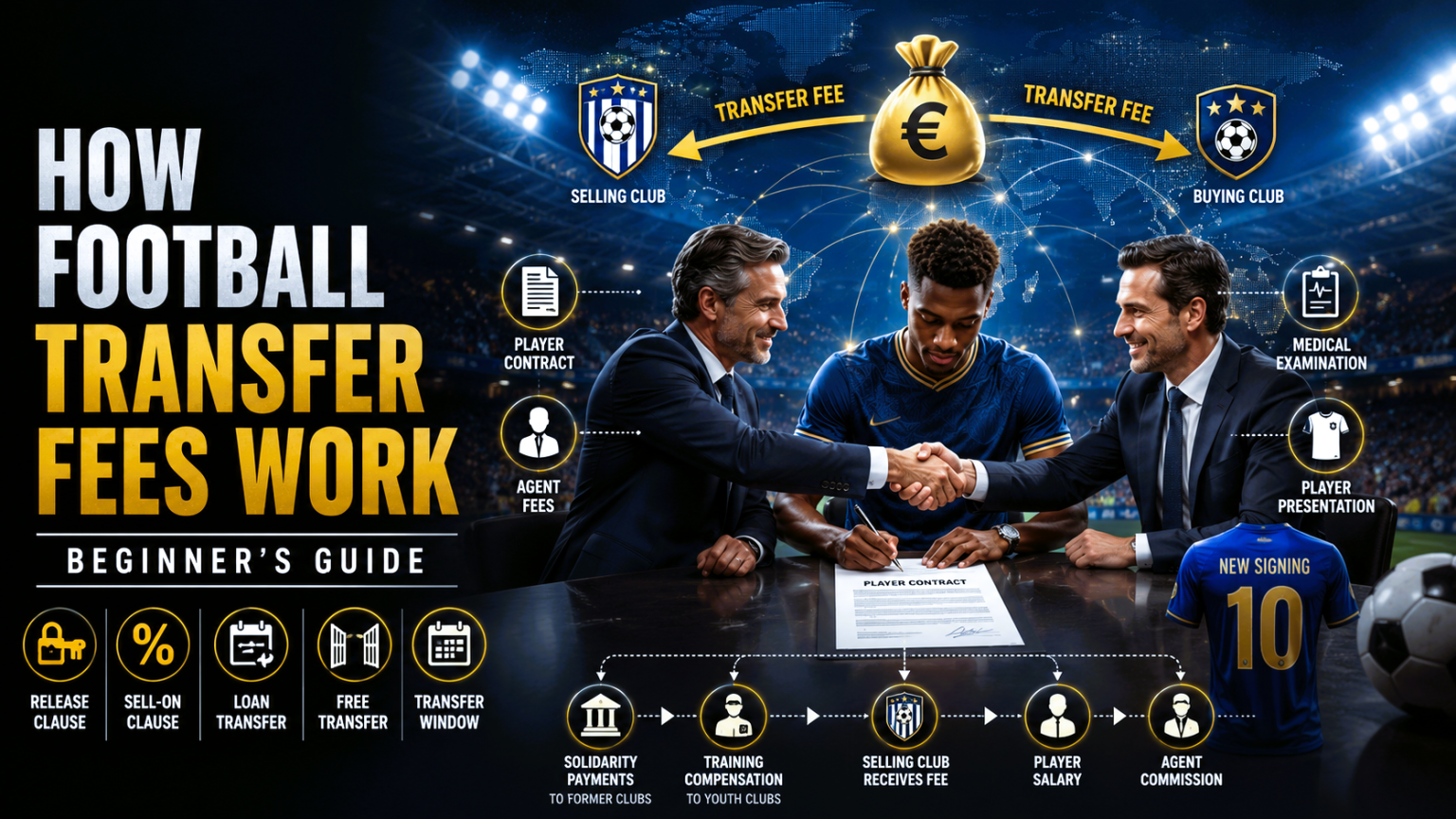
This guide breaks the entire transfer system down in plain English. You will learn what a transfer fee actually pays for, who decides it, how the money moves once a deal is signed, and what terms like buyout clause, sell-on clause and training compensation really mean.


By the end, transfer deadline day should make a lot more sense, and reading about a €100 million move will feel less like decoding a foreign language and more like understanding a system with clear, logical rules.
What Is a Football Transfer Fee?
A football transfer fee is the amount of money one club pays another club to buy out the remaining years of a player’s contract. It is not a payment to the player. It is compensation paid to the selling club for releasing a player who is still contractually tied to them.
The purpose of a transfer fee is simple. A player under contract is an asset that a club has invested in, whether through wages, coaching, facilities or the original transfer fee paid to sign that player.
If another club wants to take that asset away before the contract ends, the selling club is entitled to compensation. Without this rule, clubs could lose their best players at any moment for free, and long-term squad building would be impossible.
The buying club pays the fee. The selling club receives it. From there, the money is typically used to cover existing debts, fund new signings, pay off agents involved in the deal, or simply strengthen the club’s financial position.
A transfer fee is completely separate from a player’s salary. The transfer fee goes to the club that is losing the player.
The salary is what the buying club pays the player directly for his work, usually on a weekly or monthly basis, for as long as his new contract lasts.
A club can pay a small transfer fee but a huge salary, or a record transfer fee but a modest salary relative to the rest of the squad. The two numbers are negotiated separately and serve completely different purposes.
How Does a Football Transfer Work?
A transfer looks simple from the outside. A player is announced, a fee is reported, and the story moves on. In reality, most deals pass through the same sequence of stages, some of which take weeks or even months of quiet background work before anything reaches the press.
| Step | Stage | What Happens |
| 1 | Player identified | Scouts and recruitment staff identify a target based on data, live scouting and squad needs |
| 2 | Club contacts selling club | The buying club makes informal or formal contact to gauge interest in selling |
| 3 | Permission to negotiate | The selling club grants permission for the buying club to speak with the player’s agent |
| 4 | Transfer fee negotiations | The two clubs negotiate the fee, structure and any add-ons or sell-on clauses |
| 5 | Personal terms | The buying club agrees wages, contract length, bonuses and image rights with the player |
| 6 | Medical examination | The player undergoes a full medical to confirm fitness before the deal is finalised |
| 7 | Contract signing | The player signs his new contract, and the clubs sign the transfer agreement |
| 8 | Official announcement | Both clubs confirm the deal publicly, usually with a statement and official photos |
| 9 | Player registration | The new club registers the player with the relevant league and federation so he is eligible to play |
The fee negotiation and personal terms stages often run at the same time, which is why deals can collapse late even after a fee has been agreed.
A club might agree a fee with a rival but fail to convince the player on wages, or the medical might uncover a fitness concern that changes the terms of the deal entirely.
Deadline day chaos usually comes from clubs trying to complete every one of these steps within a matter of hours.
Who Decides the Transfer Fee?
There is no fixed price list in football. A transfer fee is decided through negotiation between the buying club, the selling club, and the player’s contract situation all pulling in different directions at once.
The selling club sets its starting valuation based on what it believes the player is worth and how much it wants, or needs, to keep him.
A club under no financial pressure can simply refuse to sell and wait for a higher offer.
The buying club brings its own valuation, based on scouting data, budget and how badly it wants the player compared with other targets available in the market.
The player’s contract situation has a huge influence on the final number. A player with three or four years left on his deal gives his club leverage to demand a high fee, since the buying club has no other way to sign him.
A player entering the final year of his contract is worth far less in fee terms, because his club risks losing him for free in twelve months if it does not sell now.
Market demand matters just as much as any of these factors. If two or three clubs are competing for the same player, the price tends to rise quickly, since the selling club can play interested parties off against each other.
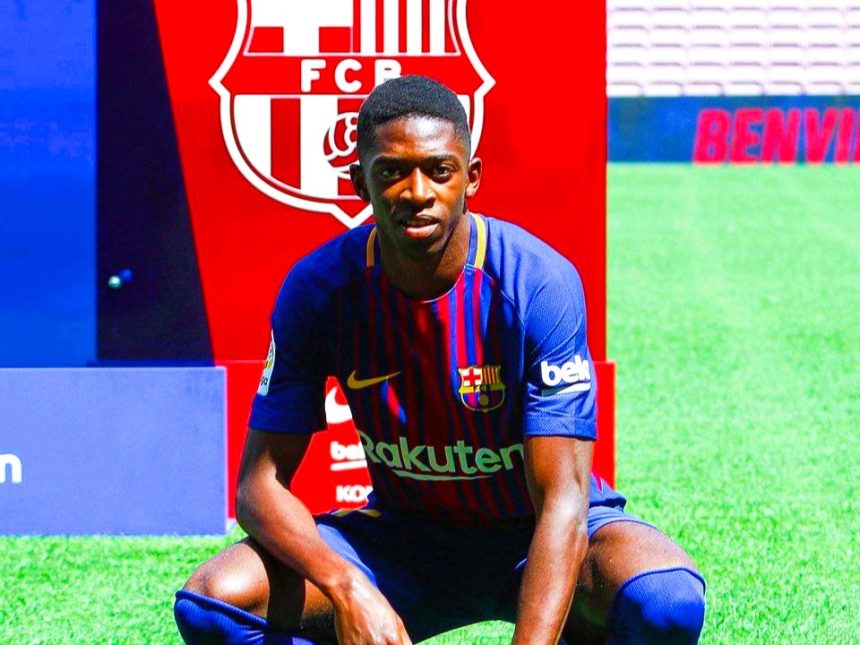
A move like Ousmane Dembélé’s switch from Borussia Dortmund to Barcelona in 2017, reported at around €148 million with add-ons, was driven partly by competition for a young, in-demand forward and partly by Barcelona needing a marquee replacement after selling Neymar.
Negotiations, in other words, rarely happen in isolation. Every fee is shaped by what else is going on in the market at the same time.
What Determines a Player’s Transfer Value?
Two players with similar statistics can carry wildly different price tags. Value in football is shaped by more than raw output on the pitch.
| Factor | Why It Matters |
| Age | Younger players carry more resale value and a longer prime, so clubs pay a premium for potential future growth |
| Ability | Current on-field performance level, measured through data, scouting reports and match impact |
| Potential | How much a club believes a young player can still improve under the right coaching |
| Contract length | More years remaining gives the selling club stronger leverage in negotiations |
| Position | Attacking players and creative midfielders usually command higher fees than defenders in the modern market |
| Commercial value | Shirt sales, social media following and marketing appeal, especially for global superstars |
| International experience | Proven performances at World Cups and continental tournaments raise a player’s profile and price |
| Injury history | A history of serious injuries can lower a fee due to perceived risk |
| Competition | Multiple interested clubs push the price upward through bidding pressure |
| Homegrown status | In leagues like the Premier League, homegrown players can command a premium due to squad quota rules |
| Market inflation | Broadcast revenue growth and rising overall spending push transfer prices higher across the board |
Market inflation deserves special attention because it explains why fees keep climbing decade after decade.
Premier League clubs alone now share billions of pounds in broadcast revenue every season.
That money flows into transfer budgets, and as more clubs compete with bigger wallets, the price of the same calibre of player rises across the entire market, not just for the biggest names.
How Are Football Transfer Fees Paid?
Transfer fees are rarely paid as one lump sum sitting in a bank account overnight. Clubs structure payments in several different ways, and the headline fee reported in the media is often just the base figure before bonuses are added.
| Payment Type | How It Works |
| One-time payment | The full fee is paid in a single transaction, most common for smaller deals |
| Installments | The fee is spread across two to five years, easing pressure on the buying club’s cash flow |
| Performance bonuses | Extra payments triggered by the player hitting agreed milestones, such as goals scored |
| Appearance bonuses | Payments unlocked once the player reaches a set number of matches for the new club |
| Champions League qualification bonuses | Additional fees paid if the buying club qualifies for the Champions League within an agreed period |
| Ballon d’Or bonuses | Rare but real clauses that trigger a payment if the player wins football’s top individual award |
| Percentage of future sale | A sell-on clause that pays the selling club a share if the player is transferred again later |
Installments are now standard practice for almost every major transfer. A club announcing a €100 million signing rarely pays that full amount immediately.
Instead, it might pay €20 million upfront and the rest across the following four seasons.
This is one reason clubs can appear to spend more than their actual annual budget would suggest, since fees are recorded and paid gradually rather than all at once.
What Are Add-ons in Football Transfers?
Add-ons are extra conditional payments layered on top of the base transfer fee. They allow both clubs to agree a deal even when their valuations do not perfectly match, since the selling club can still receive extra money if the player performs well or the buying club succeeds.
| Add-on Type | Trigger | Who Benefits |
| Goal bonuses | Player reaches a set number of goals scored | Selling club |
| Appearance bonuses | Player reaches a set number of matches played | Selling club |
| Trophy bonuses | Buying club wins a specific trophy with the player registered | Selling club |
| Qualification bonuses | Buying club qualifies for a competition such as the Champions League | Selling club |
| International recognition bonuses | Player is called up to a senior national team or wins individual awards | Selling club |
| Sell-on percentage | Player is transferred again in the future for a profit | Selling club |
Add-ons explain why the same transfer can be reported with two different figures. One outlet might quote the guaranteed base fee, while another quotes the fee including all possible add-ons. Neither figure is wrong.
They simply describe different scenarios, one being the minimum the selling club is guaranteed and the other being the maximum if every bonus condition is met.
What Is a Release Clause?
A release clause is a fixed price written into a player’s contract. If any club pays that exact figure to the selling club, the selling club is legally obliged to let the player leave, regardless of whether it actually wants to sell.
In Spain, release clauses are mandatory by law for every professional footballer, which is why La Liga transfer stories so often revolve around a specific, publicly known number.
In most other major leagues, including the Premier League, Serie A and the Bundesliga, release clauses are optional and only exist if a club chooses to include one when negotiating a contract.
Neymar’s 2017 move to Paris Saint-Germain remains the clearest example of a release clause in action. His Barcelona contract contained a release clause reportedly set at €222 million.
PSG paid that figure directly, and under Spanish law, Barcelona had no legal right to block the move once the full amount was met.
What Is a Buyout Clause?
Release clause and buyout clause are often used as if they mean exactly the same thing, and in everyday football conversation they usually do refer to the same idea.
Where a technical distinction is drawn, a release clause tends to describe the mandatory, legally defined figure found in Spanish contracts, while a buyout clause describes a similar mechanism privately negotiated into a contract elsewhere, without the same blanket legal requirement behind it.
| Release Clause | Buyout Clause | |
| Legal basis | Mandatory under Spanish law | Privately negotiated, not legally required |
| Common region | Spain (La Liga) | Any league, when a club agrees to include one |
| Selling club consent needed | No, payment alone forces the sale | Usually no, but terms vary by contract |
| Public knowledge | Often publicly reported due to legal registration | Frequently kept private between club and player |
What Is a Sell-on Clause?
A sell-on clause entitles the selling club to a percentage of any profit made if the player is transferred again in the future.
If a club sells a player for €20 million with a 20 percent sell-on clause, and that player is later sold for €40 million, the original club receives 20 percent of that later fee.
Sell-on clauses are especially valuable for smaller clubs and academies that regularly sell promising young talent for modest fees.
If the player later becomes a star and moves for a much larger sum elsewhere, the smaller club shares in that success even though it no longer owns the player.
This turns player trading into a long-term revenue strategy rather than a one-off payday, and it is one reason clubs with strong academies can stay financially competitive despite limited matchday and broadcast income.
What Is Training Compensation?
Training compensation is a FIFA rule designed to reward the clubs that developed a player during his youth, even long after he has moved on to bigger teams.
Under FIFA regulations, when a player signs his first professional contract, or moves between clubs in different countries before turning 23, the clubs that trained him between the ages of 12 and 21 are entitled to a payment.
The amount is calculated using set categories based on the confederation and division of the training club, multiplied by the number of years the player spent there. This system exists specifically to protect youth academies.
Without it, smaller clubs could develop a talented teenager for years, only to see him picked up on a professional contract by a bigger club with no financial return for the work already invested in his development.
What Are FIFA Solidarity Payments?
Solidarity payments work alongside training compensation but apply specifically to transfer fees paid for players once they are already established professionals.
Under FIFA rules, when a professional player moves between clubs in different countries during his contract, 5 percent of the transfer fee is distributed among every club that contributed to the player’s training between the ages of 12 and 23.
This means a youth academy that coached a future star for even one or two seasons as a teenager can still receive a small payment years later when that player moves for a nine-figure fee at a completely different club.
The system exists to keep youth development financially viable across the football pyramid, rewarding grassroots and academy clubs for talent they helped shape, long after that player has left their books.
How Do Loan Transfers Work?
A loan is a temporary transfer. The player moves to a new club for an agreed period, usually a single season, while his contract remains registered with his original club.
Loans give young or fringe players regular football elsewhere without a permanent transfer, and they let clubs offload wages temporarily without losing a player’s long-term rights.
| Loan Type | How It Works |
| Standard loan | Player moves temporarily, returns to his parent club when the loan ends |
| Loan fee | The borrowing club pays a fee to the parent club for the right to use the player |
| Loan with option to buy | The borrowing club can choose to sign the player permanently at an agreed price once the loan ends |
| Loan with obligation to buy | The borrowing club must sign the player permanently, often once specific conditions are met |
| Dry loan | No loan fee is paid, usually arranged to benefit the player’s development or offload wages |
| Salary-sharing loan | Both clubs split the player’s wages for the duration of the loan |
Loans with an obligation to buy have become increasingly common because they let a buying club spread a transfer fee across two seasons while giving the player time to settle before the deal becomes permanent.
It also gives the buying club a trial period of sorts, though once the obligation conditions are met, the permanent transfer must go through regardless of how the player has performed.
What Is a Free Transfer?
A free transfer happens when a player’s contract expires and he moves to a new club without any transfer fee changing hands.
The rules that make this possible trace back to the 1995 Bosman ruling by the European Court of Justice, which established that a player from the European Union is free to leave his club for nothing once his contract has run out, and clubs can no longer demand a fee for out-of-contract players moving within the EU.
Free transfers benefit the buying club enormously, since the entire transfer budget that would normally go toward a fee can instead be spent on wages or a signing bonus for the player.
This is why out-of-contract superstars can often negotiate much larger salaries than they would receive if a transfer fee was also part of the deal.
Some of the most significant transfers in football history have been free moves. Steve McManaman’s switch from Liverpool to Real Madrid in 1999 and Sol Campbell’s move from Tottenham to Arsenal in 2001 were both landmark free transfers of their era.
More recently, players approaching the final year of elite contracts routinely attract interest from Europe’s biggest clubs, since a top talent on a free transfer represents outstanding value even before wages are factored in.
What Is the Transfer Window?
The transfer window is the limited period during which clubs are allowed to register new players. Outside of these windows, clubs cannot sign or sell players except in specific emergency circumstances.
Most major European leagues operate two windows each season. The summer window is the longer of the two, typically running from early June to the start of September, and it is when the majority of major transfers take place.
The winter window is shorter, usually opening for the whole of January, and gives clubs a chance to strengthen or reshape their squad midway through the season.
Registration periods are set by each domestic league and by FIFA at an international level, and a player cannot play competitive matches for his new club until he has been officially registered.
Emergency transfers, sometimes called emergency loans, are a rare exception that allow clubs to sign a player outside the window, usually limited to goalkeepers, in cases of a genuine injury crisis.
Who Gets the Transfer Money?
The headline transfer fee does not go entirely to one place. By the time a deal is finalised, several parties have usually taken a share.
| Party | What They Receive |
| Selling club | The bulk of the negotiated transfer fee |
| Agents | A commission, often a percentage of the fee or the player’s wages, for arranging the deal |
| Tax authorities | Applicable taxes on the transaction depending on the country involved |
| Clubs owed solidarity payments | 5 percent of the fee, shared among clubs that trained the player as a youth |
| Former clubs with a sell-on clause | An agreed percentage of the fee if a sell-on clause applies |
| Player | No share of the transfer fee itself, but often a signing bonus paid separately by the new club |
Agent fees can be substantial, particularly on the biggest deals, and clubs increasingly disclose these figures as part of financial transparency requirements introduced by football’s governing bodies.
A signing bonus, sometimes called a loyalty bonus if it is paid in stages over the length of the contract, is a separate payment made directly to the player by his new club to reward him for agreeing to sign.
Do Players Receive Their Transfer Fee?
No. The transfer fee is a payment between two clubs, not a payment to the player. This is one of the most common misunderstandings in football, and it is worth stating plainly.
| Payment | Paid By | Paid To |
| Transfer fee | Buying club | Selling club |
| Salary | New club | Player |
| Bonuses | New club | Player |
| Signing bonus | New club | Player |
| Image rights | New club or sponsors | Player, usually through a separate company |
The confusion usually comes from headlines that report a transfer fee and a new salary in the same breath, making it sound as if one large number is being handed to the player.
In reality, the player’s actual financial reward comes through his weekly wage, any performance bonuses written into his personal contract, a signing bonus for completing the move, and separate image rights income, none of which is drawn from the transfer fee paid between the clubs.
Why Are Some Players Worth Over €100 Million?
A nine-figure transfer fee looks extreme until it is broken down into the same factors that shape every deal, just at the most extreme end of the scale.
These transfers usually combine several premium qualities at once rather than any single factor alone.
Neymar’s 2017 move to Paris Saint-Germain combined proven elite ability, a young age relative to his production, and enormous global commercial appeal, all wrapped inside a release clause that forced Barcelona’s hand.
Kylian Mbappé’s 2018 transfer from Monaco to PSG, reported at around €180 million, reflected a similar mix, an outstanding young talent with a long career ahead and clear superstar potential.
More recent examples show how the modern midfield market has exploded in value.
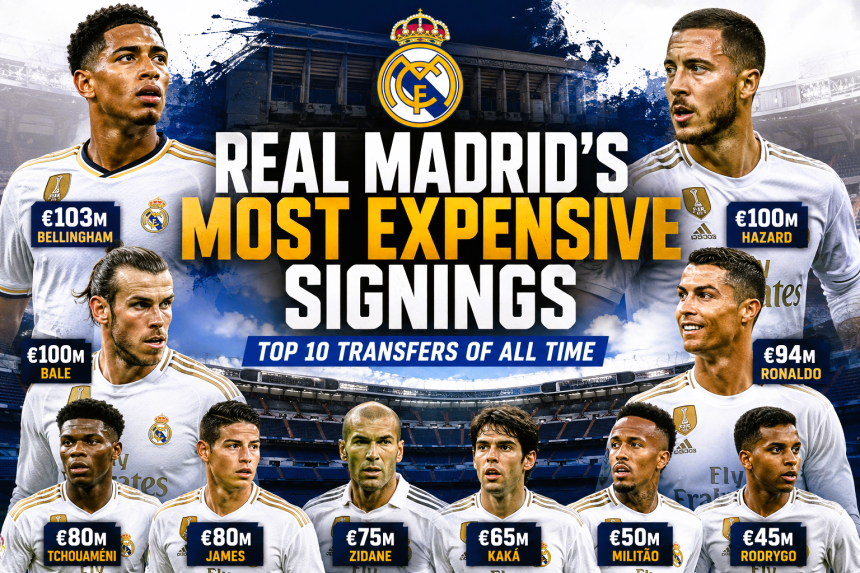
Jude Bellingham’s move to Real Madrid, Declan Rice’s transfer from West Ham to Arsenal, and the moves of Moisés Caicedo and Enzo Fernández to Chelsea all crossed or approached the €100 million mark for players prized as complete, physically dominant midfielders capable of controlling matches at the highest level.
Each of these deals reflected intense competition between top clubs for a small pool of players considered genuinely world class in a position where elite talent is scarce.
Scarcity is the thread connecting almost every nine-figure transfer. There are only so many players in the world capable of performing at the very top level of the Champions League and international football.
When several elite clubs chase the same small group of players, and all of those clubs have the broadcast and commercial revenue to compete, prices rise well beyond what pure footballing output alone would justify.
Most Expensive Football Transfers Ever
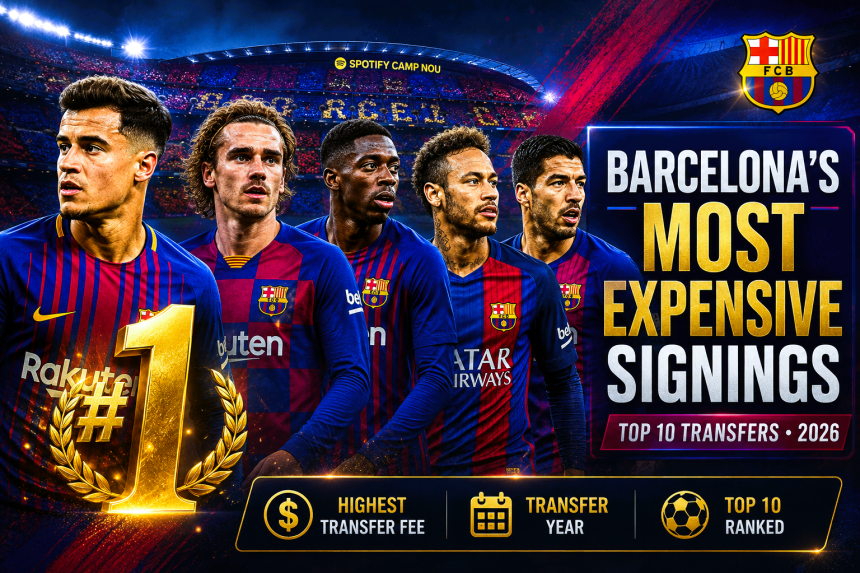
Transfer records rarely stand for long in the modern game. As of mid-2026, the following deals rank among the highest confirmed transfer fees in football history, based on widely reported figures.
| Rank | Player | Transfer Fee (approx.) | Year | From | To |
| 1 | Neymar | €222 million | 2017 | Barcelona | Paris Saint-Germain |
| 2 | Kylian Mbappé | €180 million | 2018 | AS Monaco | Paris Saint-Germain |
| 3 | Ousmane Dembélé | €148 million | 2017 | Borussia Dortmund | Barcelona |
| 4 | Alexander Isak | €145 million | 2025 | Newcastle United | Liverpool |
| 5 | Morgan Rogers | €137 million | 2026 | Aston Villa | Chelsea |
| 6 | João Félix | €126 million | 2019 | Benfica | Atlético Madrid |
| 7 | Enzo Fernández | €121 million | 2023 | Benfica | Chelsea |
| 8 | Antoine Griezmann | €120 million | 2019 | Atlético Madrid | Barcelona |
| 9 | Philippe Coutinho | €118.4 million | 2018 | Liverpool | Barcelona |
| 10 | Jack Grealish | €117.7 million | 2021 | Aston Villa | Manchester City |
Figures are approximate, converted to euros, and sourced from widely reported club and media figures. Some deals include add-ons that were not guaranteed at the time of signing, so exact totals can vary slightly between different reports.
Conclusion
Football transfers look chaotic from the outside, but the system underneath follows clear, consistent rules. A transfer fee compensates a selling club for releasing a player still under contract.
That fee is shaped by age, ability, contract length and market demand, then structured through installments, add-ons and clauses that protect both clubs involved.
Free transfers exist because of the Bosman ruling, loans give clubs flexibility without a permanent commitment, and rules like training compensation and solidarity payments make sure smaller clubs and academies are rewarded for developing talent.
Fees will keep rising as broadcast revenue grows and competition for elite talent intensifies among Europe’s wealthiest clubs.
Understanding how the system works, rather than just the headline number, makes it far easier to judge whether a transfer actually represents good business or simply reflects a market willing to pay whatever it takes for the players it wants most.
For a deeper look at how these numbers stack up in practice, explore our full breakdown of the most expensive football transfers of all time and our guide to the most expensive Premier League transfers in history.