







England head coach Thomas Tuchel has officially announced his 26-man squad for the 2026 FIFA World Cup in North America.
High-profile absences include Phil Foden, Cole Palmer, Trent Alexander-Arnold and Harry Maguire, while Ivan Toni has been notably recalled.
Tuchel has insisted on selecting a balanced, committed group of “specialists for different scenarios” rather than the 26 most talented individuals.
The squad mixes established stars such as Harry Kane, Jude Bellingham and Declan Rice with a mix of experienced campaigners and exciting youngsters or players in form.
England will enter the tournament with high expectations, aiming to end their longest wait for a major trophy since 1966.
England Predicted XI for the 2026 World Cup
Following Tuchel’s official 26-man squad announcement – which surprisingly left out high-profile players such as Phil Foden, Cole Palmer, Trent Alexander-Arnold and Harry Maguire – our tactical analyst predicts the main starting 11 will look like this:
England Predicted Starting XI: 4-2-3-1
| Position | Player(s) |
| Goalkeeper | Jordan Pickford |
| Right-Back (RB) | Reece James |
| Centre-Back (CB) | Marc Guéhi |
| Centre-Back (CB) | Ezri Konsa / John Stones |
| Left-Back (LB) | Nico O’Reilly |
| Defensive Midfield | Declan Rice |
| Defensive Midfield | Elliot Anderson |
| Attacking Midfielder (No. 10) | Morgan Rogers / Jude Bellingham |
| Right Winger (RW) | Bukayo Saka |
| Left Winger (LW) | Marcus Rashford / Anthony Gordon |
| Striker | Harry Kane |
England’s Best Formation for the 2026 World Cup
England will primarily use a flexible 4-2-3-1 or 4-3-3 tactical formation at the 2026 World Cup under head coach Thomas Tuchel.
Why the 4-2-3-1 Works Best
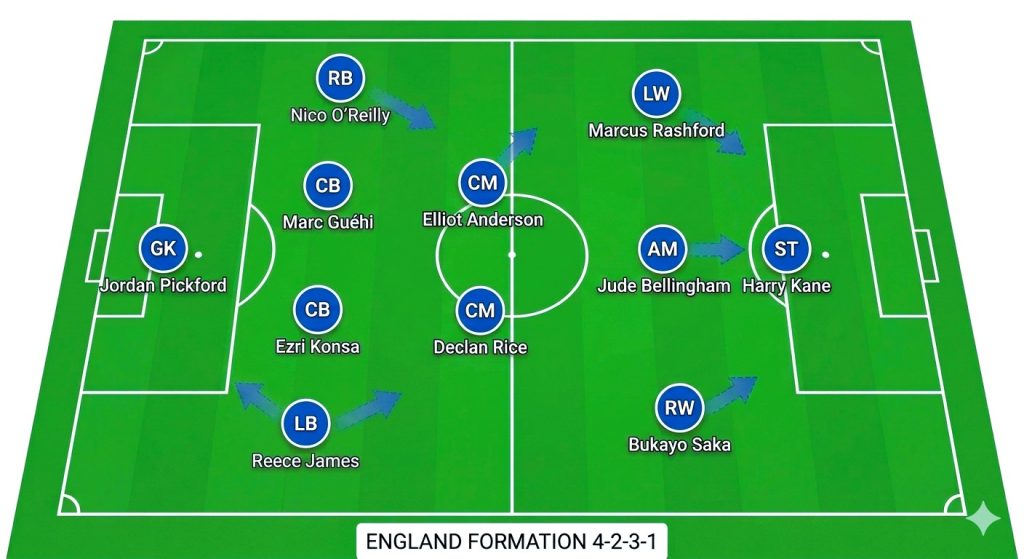
England will be able to line up in a nominal 4-2-3-1 on paper, as Tuchel’s modern system changes dynamically depending on the phase of the game.



When attacking, the formation fluidly transforms into a highly offensive 2-3-5.
The two centre-backs hold the line, while both full-backs (such as Reece James) will move in or up into midfield to flank a lone holding midfielder.
This will leave five advanced players to fill the opposition box and half-spaces.
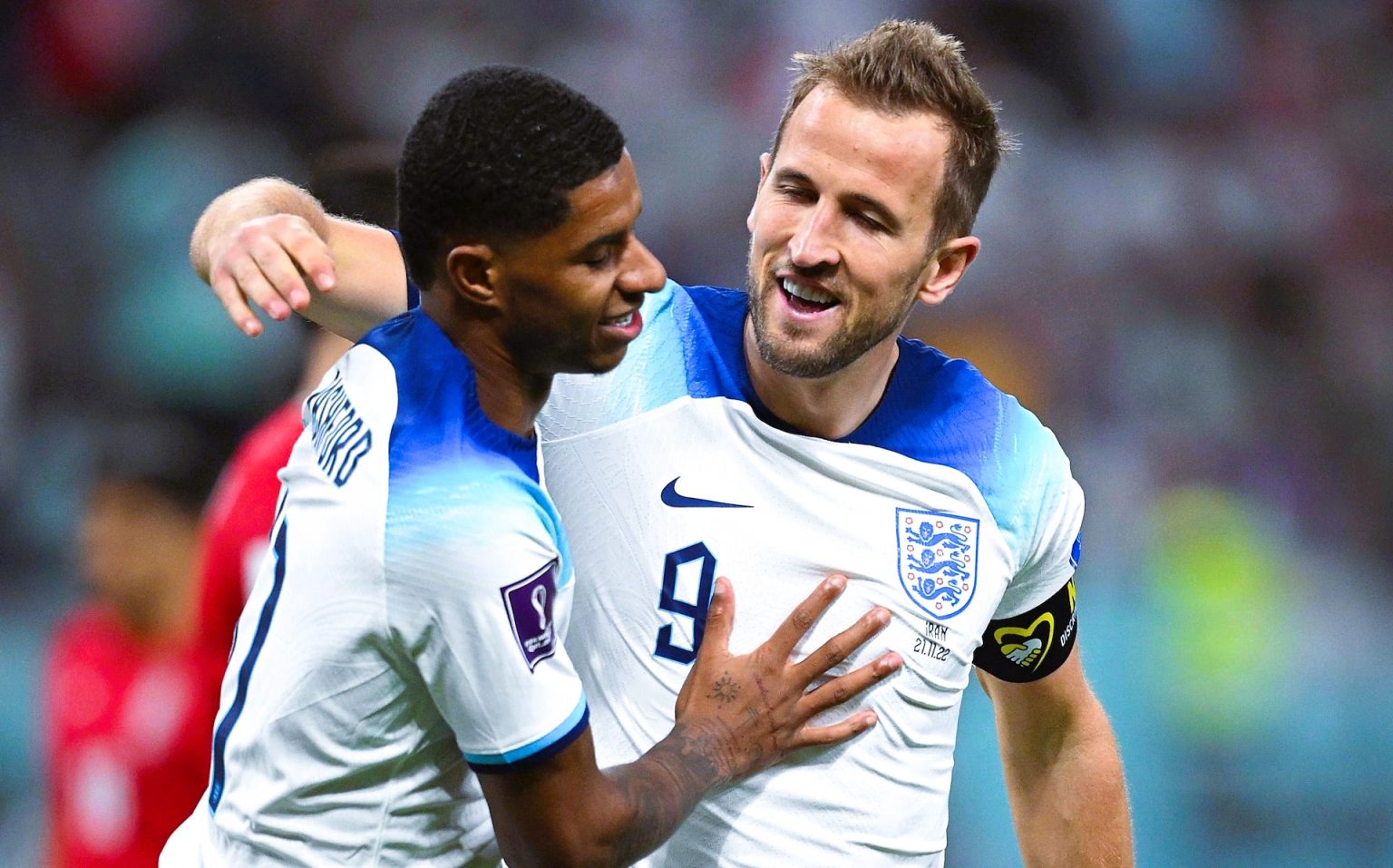
Captain Harry Kane will naturally drop deep as a playmaker up front, transitioning to a 4-4-2, helping to draw the centre-backs out of shape.
While fast wingers such as Marcus Rashford and Bukayo Saka will pin down the opposition backline, opening up explosive running lanes for Jude Bellingham to attack from midfield.
Compared to previous conservative eras, this is a risk-heavy, high-intensity approach. It maximises central overloads but can leave England vulnerable to quick counter-attacks down the flanks.
Tactical Analysis of England’s Predicted XI
Attack
Kane arrives at the World Cup in arguably the best club form of his career. His goal tally for Bayern is extraordinary.
But the constant question is whether he can repeat that consistency in an England shirt at a major tournament? It remains unanswered.
His link play, his ability to create space for runners, his ability to hold-up in difficult moments – all of these will be assessed by Thomas Tuchel.
But when it comes to the knockout rounds, England will need goals from their captain, not just assists.
Bellingham will be the creative focal point for England. His movement between the lines is really hard to defend.
Few midfielders in world football attack space with the same aggression and timing. At 22, this is probably his first truly statement match on the biggest stage.
Saka is relentless. Direct, intelligent, composed under pressure. He will give England a steady right-hand threat that opponents will have to respect.
The inclusion of Barcelona forward Rashford has raised eyebrows given his inconsistent recent form. But Tuchel wants pace, direct running and a real counter-attacking weapon.
If Rashford finds his best form, England will be very difficult to stop.
Midfield
The partnership of Declan Rice and Elliot Anderson acts as the structural heartbeat of Thomas Tuchel’s tactical formation, carefully engineered to provide defensive stability while facilitating rapid offensive transitions.
Rice will act as the primary defensive screen, dropping in between the centre-backs during build-up play and forming a secure three-man defensive base or anchoring a midfield solo when the full-backs are reversed.
His exceptional reading of the game will allow him to break up opposition counters, sweep up loose balls, and re-use possession efficiently, ensuring that England’s hyper-aggressive five-man attacking frontline does not leave the backline completely open to direct vertical attacks.
Similarly, Anderson becomes a dynamic connector, linking the defensive third with the attacking line, leveraging his elite engine and ball-carrying abilities.
Tuchel will give Anderson the freedom to operate as a box-to-box number eight, using explosive bursts to carry the ball through crowded half-spaces and release pressure.
While his high defensive work rate ensures that he can quickly recover to a solid mid-block when he loses possession.
Their coordination in possession is what gives England midfield control. With the inverted full-backs stepping inside, Rice and Anderson can create central overloads that make it difficult for opponents to play through pressure.
With Rice holding the central pivot, Anderson’s slow runs on the edge of the penalty box add an extra layer of unpredictability, which will force opposition midfielders to drop deep and create pocket space for creative players like Jude Bellingham to exploit.
That balance allows England to sustain pressure higher up the pitch without constantly exposing the centre-backs.
Defence
Jordan Pickford has become the undisputed cornerstone of the defensive unit, providing significant match experience alongside exceptional long-range distribution that will serve as England’s primary weapon in launching quick counterattacks.
His elite shot-stopping ability and active communication are crucial in keeping the defensive line in order during high-pressure transitions.
His comfort on the ball will allow England to play confidently from the back, even when facing aggressive opposition pressure.
Guéhi will operate as a primary, front-footed stopper who will aggressively break out of the defensive line to contest aerial duels, block passing lanes and press opposition forwards before they can turn towards goal.
Meanwhile, Konsa will perfectly complement this attacking style by using his excellent recovery speed and positional intelligence to sweep behind Guéhi, dropping deep to cover structural gaps and sliding into wide channels to secure the flanks when the full-backs are caught up the pitch.
Reece James and Nico O’Reilly will inject vital tactical flexibility into the wide defensive areas, operating as low and fluid, reverse playmakers like traditional full-backs.
James often drifts in from the right flank during possession phases to bolster the midfield engine room alongside Declan Rice, using his physical dominance and crisp passing to help England establish numerical overloads in the central corridors.
On the opposite side, O’Reilly will use his natural midfield technical skills to seamlessly alternate between overlapping down the touchline and underlapping into the left half-space to provide crossing width.
This twisting movement consistently distracts opposition backlines and creates open driving lanes for wingers.
John Stones brings experience and passing ability from deep — his absence from the first-choice XI (when fit) is probably the most genuinely debatable call here.
Tuchel seems to prefer the Guéhi-Konsa axis, but don’t be surprised if Stones earns his way back into the starting XI during the tournament.
Key Players for England at the 2026 FIFA World Cup
Jude Bellingham
England’s talisman. Their most complete footballer. At Real Madrid he’s played under the brightest lights imaginable — Champions League nights, Clásicos, title races — and emerged bigger and better every time.
For England, he’s the player who makes everything more dangerous just by being on the pitch.
His box-to-box impact, his leadership mentality at 22, his ability to be both a defensive contributor and an attacking threat — there’s no one else in this squad quite like him. If England win the World Cup, Bellingham will be the reason.
Harry Kane
Third World Cup. Captain. One of the best strikers on the planet. Kane’s determination to get this ending — the trophy, the moment — is written all over every interview he gives.
At 32, this is likely his last real shot. The weight of that doesn’t seem to burden him. It seems to fuel him.
In knockout football, you need a striker who can win you a game by himself. Kane has that capability. He’s done it at club level repeatedly. The 2026 World Cup is the opportunity to prove it for England.
Bukayo Saka
Twenty-three years old and already a cornerstone of this England team. His directness, his creativity, his ability to draw defenders and create space — Saka is the kind of player that disrupts defensive structures just by running at people.
His decision-making in the final third has matured dramatically. He’s a genuine match-winner.
Declan Rice
The engine room. Under Tuchel, Rice functions almost as a quarterback — dictating the tempo, shielding the centre-backs, picking out progressive passes to get England up the pitch.
At Arsenal, he’s become one of the best midfielders in Europe. That form needs to transfer to July in North America.
England’s Full 26-Man Squad for the 2026 World Cup
Goalkeepers
- Jordan Pickford (Everton)
- Dean Henderson (Crystal Palace)
- James Trafford (Man City)
Defenders
- Reece James (Chelsea)
- Ezri Konsa (Aston Villa)
- Jarell Quansah (Bayer Leverkusen)
- John Stones (Man City)
- Marc Guéhi (Man City)
- Dan Burn (Newcastle)
- Nico O’Reilly (Man City)
- Djed Spence (Tottenham)
- Tino Livramento (Newcastle)
Midfielders
- Declan Rice (Arsenal)
- Elliot Anderson (Nottingham Forest)
- Kobbie Mainoo (Man Utd)
- Jordan Henderson (Brentford)
- Morgan Rogers (Aston Villa)
- Jude Bellingham (Real Madrid)
- Eberechi Eze (Arsenal)
Forwards
- Harry Kane (Bayern Munich)
- Ivan Toney (Al-Ahli)
- Ollie Watkins (Aston Villa)
- Bukayo Saka (Arsenal)
- Marcus Rashford (Barcelona)
- Anthony Gordon (Newcastle)
- Noni Madueke (Chelsea)
The Omissions Tuchel Will Be Judged On
This squad will be remembered as much for who’s missing as who’s in it.
Phil Foden is the biggest omission to swallow. Tuchel issued public warnings about his inability to replicate club form in an England shirt, and ultimately followed through on them.
Two Wembley friendlies before the tournament — a 1-0 defeat to Japan and a draw against Uruguay — left questions unanswered, and Tuchel clearly felt he couldn’t take the risk. Debatable? Absolutely. Defensible? On his terms, yes.
Cole Palmer feels cruel. One of the Premier League’s most creative players, dropped entirely. The logic appears to be a preference for physical intensity and defensive contribution over pure creativity.
Trent Alexander-Arnold is another contentious absence. The hybrid midfielder-right back has divided opinion for years, and Tuchel has simply decided the Reece James version of that role is more reliable.
Harry Maguire publicly described himself as “shocked and gutted” at being left out. Luke Shaw’s omission is arguably easier to understand given his injury record.
These are bold calls. They’ll either look visionary in July, or they’ll be dissected for years.
England’s Biggest Strengths
The attacking talent in this squad is genuinely elite. Four forwards who could each start for most nations at this tournament.
A midfield anchored by one of Europe’s best in Rice, with Bellingham operating at a level that makes him one of the ten best players in the world right now.
Premier League football gives this group a shared understanding of high-intensity, high-tempo football.
The squad is young in the right places — Guéhi, Saka, Bellingham, Anderson, O’Reilly — and experienced in the ones that matter — Kane, Rice, Pickford, James.
Tuchel’s tactical flexibility is a genuine asset. England can set up to control games or to counter. They can press aggressively or sit in a low block and absorb. That adaptability is what you need across seven games at a World Cup.
England’s Potential Weaknesses
Injuries are a constant anxiety. Reece James’s fitness record — brilliant when available, frequently unavailable — is a real concern. If he goes down early, Spence or Livramento step in, and that’s a significant drop in quality.
The left back situation is unresolved. O’Reilly is exciting but inexperienced at this level. Against a quality left winger — a Leao, a Mbappé, a Vinicius — there are questions.
England’s recent Wembley results — that defeat to Japan, the draw against Uruguay — showed a team that can still be tactically stifled when opponents crowd central areas and force play wide. Tuchel needs answers he hasn’t fully provided yet.
And then there’s the oldest question in English football: can they handle the pressure in a knockout game when the whole country is watching and it’s still nil-nil in the 80th minute?
Picture England protecting a one-goal lead against France in a quarter-final. That’s where this structure will truly be tested.
Can England Win the 2026 FIFA World Cup?
Yes, England can realistically win the 2026 FIFA World Cup. They are one of the top favorites with a strong squad, a friendly group, and a way to avoid early clashes with absolutely great teams.
England have one of the best (if not the best in some ways) teams on paper and a realistic path to the final.
With the support of a home nation in North America and no major injury crisis in sight, they are real contenders.
A semi-final or better is the basic expectation; it would take a peak at the right time, clinical finishing from Kane and Co., and some luck in the knockout stages to win it all.
It’s not guaranteed (nobody in the 48-team tournament is), but England can and should be in the running to lift the trophy at MetLife Stadium on July 19, 2026. It would be their best chance in decades.
Final Thoughts
Something shifted in English football’s relationship with expectation somewhere around 2018. The Southgate generation made hoping feel possible again.
They went deep in tournaments, played with dignity, and reminded everyone that wearing that shirt is a privilege, not a curse.
Tuchel’s England feels like the next chapter — more direct, more tactically demanding, less apologetic about its ambitions. The squad announcement alone was an act of conviction. He’s telling you exactly what kind of team he wants to build.
Whether this becomes England’s defining generation or another painfully close one will be decided in North America this summer. For the first time in a very long time, the optimism doesn’t feel naive. It feels earned.
FAQs
Who is England’s best player for the 2026 World Cup?
Jude Bellingham is widely considered England’s most important player. His all-round ability — goals, creativity, defensive work rate, mentality — makes him irreplaceable in this squad.
What formation will England use at the 2026 World Cup?
Thomas Tuchel’s primary structure is a 4-2-3-1, with the option to shift to a more compact 4-3-3 against elite opposition in the knockout rounds.
Who will captain England at the 2026 World Cup?
Harry Kane captains England and heads into the tournament on his third World Cup appearance — equalling a record set by Billy Wright.
Can England win the 2026 FIFA World Cup?
England are genuine contenders. The squad talent, tactical setup under Tuchel, and depth of options in attack make them one of the credible favourites for the tournament.
Who could be England’s breakout star?
Elliot Anderson is the intriguing wildcard — Tuchel has talked him up consistently, and if he delivers in a holding midfield role on the biggest stage, he could emerge as one of the tournament’s revelations. Anthony Gordon provides a similar narrative from the forward line.