




The UEFA Champions League remains the ultimate test for football managers. It demands tactical brilliance, squad management under intense pressure, and the ability to deliver in high-stakes knockout ties.
While domestic leagues reward consistency, the Champions League defines legacies. One or two triumphs can immortalize a coach; multiple wins separate the greats from the all-time elites.
Only a select few have lifted the trophy more than once. As of the 2026 ranking, Paris Saint-Germain follows in the footsteps of its back-to-back triumphs under Luis Enrique in 2025 and 2026.
Carlo Ancelotti stands alone at the summit. His record highlights both longevity and adaptability in modern football’s most demanding competition.
Which Manager Has Won the Most Champions League Titles?
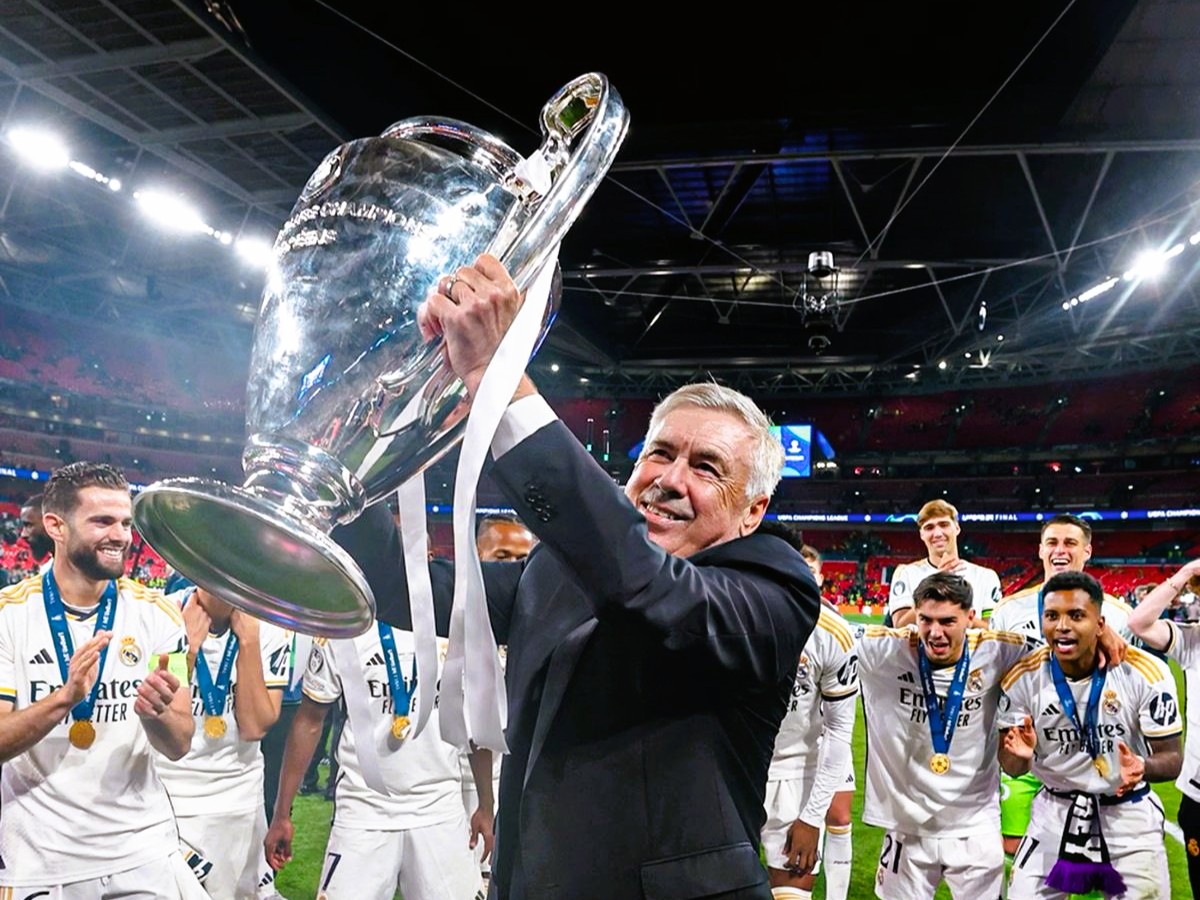
Carlo Ancelotti has won the most Champions League titles as a manager, with five victories.
He achieved this with AC Milan (2003, 2007) and Real Madrid (2014, 2022, 2024). No other coach comes close, and his record looks increasingly untouchable.
No other manager comes close to that tally. Ancelotti’s five titles are two more than the next group of managers, who each have three.
His achievement is especially remarkable because he won the competition with two entirely different clubs, in two different eras, over the span of more than two decades.
In May 2025, Ancelotti departed Real Madrid to take charge of the Brazilian national team ahead of the 2026 FIFA World Cup, leaving behind a legacy that will take generations to surpass.
Managers With the Most Champions League Titles in History
The table below includes every manager to have won the European Cup or UEFA Champions League more than once, updated to reflect results through the 2025–26 season final.
| Rank | Manager | Titles | Clubs |
| 1 | Carlo Ancelotti | 5 | AC Milan (2003, 2007), Real Madrid (2014, 2022, 2024) |
| 2 | Luis Enrique | 3 | Barcelona (2015), PSG (2025, 2026) |
| 2 | Bob Paisley | 3 | Liverpool (1977, 1978, 1981) |
| 2 | Zinedine Zidane | 3 | Real Madrid (2016, 2017, 2018) |
| 2 | Pep Guardiola | 3 | Barcelona (2009, 2011), Man City (2023) |
| 6 | Ernst Happel | 2 | Feyenoord (1970), Hamburg (1983) |
| 6 | Jupp Heynckes | 2 | Real Madrid (1998), Bayern Munich (2013) |
| 6 | Ottmar Hitzfeld | 2 | Borussia Dortmund (1997), Bayern Munich (2001) |
| 6 | José Mourinho | 2 | Porto (2004), Inter Milan (2010) |
| 6 | Helenio Herrera | 2 | Internazionale (1964, 1965) |
Note: Managers ranked equally by title count are listed in order of most recent achievement.
The 2026 final between PSG and Arsenal, won by Luis Enrique’s side on penalties in Budapest, has been factored into this ranking.
Carlo Ancelotti
There are great Champions League managers, and then there is Carlo Ancelotti.
The Italian arrived at AC Milan in 2001 and immediately made a name for himself on the European stage.
His first Champions League triumph came in 2003, when Milan edged Juventus in a brutal all-Italian final decided entirely on penalties after a goalless draw.
Four years later, he returned Milan to the summit of European football with a sweet 2–1 victory over Liverpool in Athens.
sweet because it avenged the infamous 2005 Istanbul final, one of the most improbable defeats in Champions League history.
At Real Madrid, he did it again, La Decima, Real Madrid’s tenth Champions League title in 2014, Ancelotti delivered it in his very first season.
He returned to the Bernabéu in 2021 after stints with Bayern Munich, Napoli and Everton.
proceeded to win the competition in 2022 and then again in 2024, defeating Borussia Dortmund 2–0 at Wembley to become the first manager in history to win five European Cups.
Bob Paisley
Before Ancelotti, before Zidane, before Guardiola, there was Bob Paisley.
The quiet Geordie who transformed Liverpool into a major force in European football in the late 1970s and early 1980s.
Paisley succeeded the legendary Bill Shankly in 1974 and inherited a club that was already on the rise.
What followed was one of the most decorated spells in British football history.
In thirteen years as manager, Paisley won six First Division titles, three League Cups and three European Cups – in 1977, 1978 and 1981.
His 1977 triumph helped establish Liverpool as the dominant force in European football. He continued his success by beating Club Brugge in London in 1978.
Then Alan Kennedy’s goal against Real Madrid in Paris in 1981 completed the hat-trick, one of the most romantic moments in Liverpool’s history.
His three European Cups now place him joint-second on the all-time list, alongside Zinedine Zidane, Pep Guardiola and, until 2026, Luis Enrique.
Zinedine Zidane
When Zinedine Zidane was appointed as Real Madrid manager in January 2016, succeeding the sacked Rafa Benitez, many expected more than they expected.
He had never managed a senior team. He had no coaching CV. What followed was one of the most astonishing managerial runs in football history.
Zidane led Real Madrid to three consecutive Champions League titles in 2016, 2017 and 2018.
An unprecedented achievement in the Champions League era and one unlikely to be repeated.
His team beat Atletico Madrid on penalties in Milan in 2016, Juventus in Cardiff in 2017, and Liverpool in Kyiv in 2018.
Different coaches, different clubs, different tactical approaches win the competition every year. Repeating three times in a row is extraordinarily difficult.
Three times in a row has never been done before. Zidane did it in his first three full seasons in charge.
Pep Guardiola
Pep Guardiola is the most influential football thinker of his generation and one of the two or three greatest managers football has ever produced.
His Champions League record of three titles is remarkable. Guardiola’s first two came with the Barcelona team he built between 2008 and 2012.
His third title took a long time to come. After a long wait, he added a third with Manchester City in 2023, beating Inter Milan 1-0 in Istanbul, completing a historic treble.
Whether he can add a fourth is one of the most intriguing questions in world football.
But surpassing Ancelotti’s five would require a near-miraculous career finale that even his biggest fans would hesitate to predict.
The Forgotten Giants: Historical Double-Winners Who Shaped the Competition
Any serious ranking of the greatest Champions League managers must reach back before 1992 — before the rebrand, the anthem, and the group stage format that defines the modern era.
The European Cup, as it was known from 1955, was arguably a harder competition to win: a pure knockout format with no safety nets, in an era when squad depth and transfer markets bore no resemblance to modern football.
The managers who won it twice in those conditions deserve far more recognition than they typically receive.
Béla Guttmann – Benfica’s European Pioneer (1961, 1962)
Of all the double-winners on this list, Béla Guttmann may be the most consequential figure in European Cup history.
The Hungarian-born manager guided Benfica to back-to-back titles in 1961 and 1962, pioneering the 4-2-4 formation that would reshape football across two continents, and mentoring Eusébio into one of the most devastating forwards the game has ever seen.
Guttmann’s story is inseparable from one of football’s most enduring legends.
After the 1962 triumph, he approached the Benfica board seeking a pay rise commensurate with the success he had delivered.
They refused. He walked — and allegedly cursed the club never to win another European title.
In the sixty-plus years since, Benfica have reached eight European finals without winning one. Football is a rational sport. The curse is not.
Helenio Herrera – The Wizard of Inter Milan (1964, 1965)
Helenio Herrera arrived at Internazionale in 1960 and built what Italian football historians call La Grande Inter.
His side won the European Cup in 1964 and 1965 using a catenaccio system built on defensive organisation, collective pressing, and deadly counter-attacks.
The Argentine-born Herrera was among the first managers to treat football as a total lifestyle discipline — regulating players’ diets, sleep and social lives with an intensity that would not look out of place in modern elite sport.
His two European Cups remain the only such trophies in Internazionale’s history until José Mourinho’s arrival forty-five years later.
The continuity of that legacy — from Herrera’s Grande Inter to Mourinho’s treble winners — says everything about how rarely that club has scaled those heights.
Nereo Rocco – Milan’s Catenaccio Master (1963, 1969)
Where Herrera popularised catenaccio, Nereo Rocco invented it.
The Trieste-born manager guided AC Milan to their first-ever European Cup in 1963, defeating Benfica 2-1 at Wembley and returned to do it again in 1969, this time demolishing a young Ajax side 4-1 in the final in Madrid, with Pierino Prati scoring a hat-trick.
Rocco’s two stints at Milan were separated by spells at Torino and other clubs, but both ended in European glory.
His catenaccio was not merely defensive philosophy; it was built on tactical discipline, player intelligence, and the ability to counter with sudden, lethal efficiency.
The 1963 and 1969 Milan sides rank among the finest club teams Italy has ever produced.
Miguel Muñoz – Real Madrid’s First Great Manager (1960, 1966)
Miguel Muñoz is the first person ever to win the European Cup both as a player and as a manager, having been part of Real Madrid’s all-conquering 1950s sides before guiding the club to glory in 1960 and 1966 as head coach.
The 1960 final — a 7-3 victory over Eintracht Frankfurt at Hampden Park in front of 127,000 spectators — is widely regarded as the greatest single match in the competition’s history.
Muñoz managed that side. He then rebuilt Madrid without the retired Di Stéfano and guided them to a sixth title in 1966, a feat that underscores his ability to adapt and regenerate.
His 14-year tenure as Real Madrid manager remains one of the longest at any elite European club.
Vicente del Bosque
Vicente del Bosque is the only manager in football history to win the UEFA Champions League, the FIFA World Cup and the UEFA European Championship.
Yet his club success at Real Madrid is frequently undervalued beside the national team glory that followed.
Del Bosque won back-to-back Champions League titles with Madrid in 2000 and 2002, defeating Valencia and Bayer Leverkusen respectively, while managing a dressing room that simultaneously contained Ronaldo, Zidane, Figo, Roberto Carlos and Raúl.
His calm, consensus-driven approach was precisely what that squad required. Madrid rewarded him by declining to renew his contract in 2003, a decision that ranks among the most bewildering in the club’s history.
Managers Who Won the Champions League With Multiple Clubs
Winning the Champions League once is the work of a lifetime. Winning it with two different clubs is evidence of something even rarer: managerial genius that transcends squad and context.
The following managers have achieved this extraordinary feat:
- Luis Enrique – Barcelona (2015) and Paris Saint-Germain (2025, 2026). The Spaniard’s PSG side became the dominant force in European football in the mid-2020s, winning back-to-back titles in a style that drew comparisons to Guardiola’s Barcelona.
- Ottmar Hitzfeld – Borussia Dortmund (1997) and Bayern Munich (2001). The German manager stands as one of the most complete coaches of his era, winning the competition with two clubs from the same country.
- Jupp Heynckes – Real Madrid (1998) and Bayern Munich (2013). Heynckes was famously sacked by Madrid days after winning La Séptima in 1998, then returned to the summit of European football fifteen years later with Bayern’s iconic treble.
- José Mourinho – Porto (2004) and Inter Milan (2010). The Special One achieved the near-impossible by turning Porto into Champions League winners before doing it again with Inter in his final season at the San Siro.
This group of managers represents the absolute pinnacle of European coaching achievement. Every name on this list is a legitimate contender for the title of greatest manager of all time.
Can Anyone Break Carlo Ancelotti’s Record?
Ancelotti’s five titles set the record high. The most likely candidate to challenge that is Pep Guardiola. With three titles already, he will need two more.
A realistic goal only if he continues to manage at the top level for the next five to eight years. At age 55, it’s possible.
An inspired Guardiola remains one of the few managers capable of repeating Champions League success.
Luis Enrique, buoyed by his consistent success with PSG, is another name to consider.
At 56, he sits on three titles and manages one of the most expensively assembled squads in European football.
Young managers – Xabi Alonso, Julian Nagelsmann, Mikel Arteta – could eventually challenge Ancelotti’s record, but the mathematics of European football make it almost impossibly difficult.
You need time at elite clubs, elite squads, elite Champions League runs, and a degree of luck that even the best coaches can’t quite engineer.
For now, Carlo Ancelotti has five records. Not just in terms of numbers, but as a monument to consistency, adaptability and longevity that the game won’t see again for a very long time.
Interesting Champions League Manager Records
- Most titles: Carlo Ancelotti with 5 (AC Milan and Real Madrid)
- Most finals reached: Carlo Ancelotti with 6 — a record that reflects both his longevity and success rate
- Most consecutive titles: Zinedine Zidane with 3 (Real Madrid, 2016–2018)
- Most titles with one club: Zidane (3 with Real Madrid) and Ancelotti (3 with Real Madrid) are tied
- Only manager with 5 titles: Carlo Ancelotti — the first and, so far, only member of this club
- Most titles with multiple clubs: Ancelotti (5 across 2 clubs), Luis Enrique (3 across 2 clubs), Guardiola (3 across 2 clubs)
- Youngest winning manager: José Villalonga won his first European Cup aged 36 years and 184 days on 13 June 1956
- Oldest winning manager: Jupp Heynckes won the 2013 Champions League with Bayern Munich, aged 68
- First manager to win it with two different clubs: Ernst Happel in Feyenoord (1970) and Hamburg (1983)
- First to win it as both player and manager: Miguel Muñoz with Real Madrid (1956–58 as player, 1960 and 1966 as manager)
The Managers Who Defined European Football’s Greatest Competition
The Champions League remains the pinnacle that defines managerial greatness. Domestic success builds reputations, but European glory cements them in history.
Carlo Ancelotti’s five titles place him atop the pantheon—a testament to adaptability, leadership, and enduring excellence across eras.
Whether his record of five will ever be broken remains one of football’s great open questions.
As football evolves with new formats, super squads, and tactical shifts, his record stands as the benchmark.
From Bob Paisley’s Liverpool dynasty to Zidane’s unprecedented three-peat and Guardiola’s tactical revolution, every era has produced iconic Champions League managers.
Yet no coach has matched the sustained excellence of Carlo Ancelotti. Five European Cups across two decades and two clubs have placed the Italian in a category of his own.
Until someone lifts a sixth trophy, Ancelotti’s name will remain synonymous with Champions League greatness.