





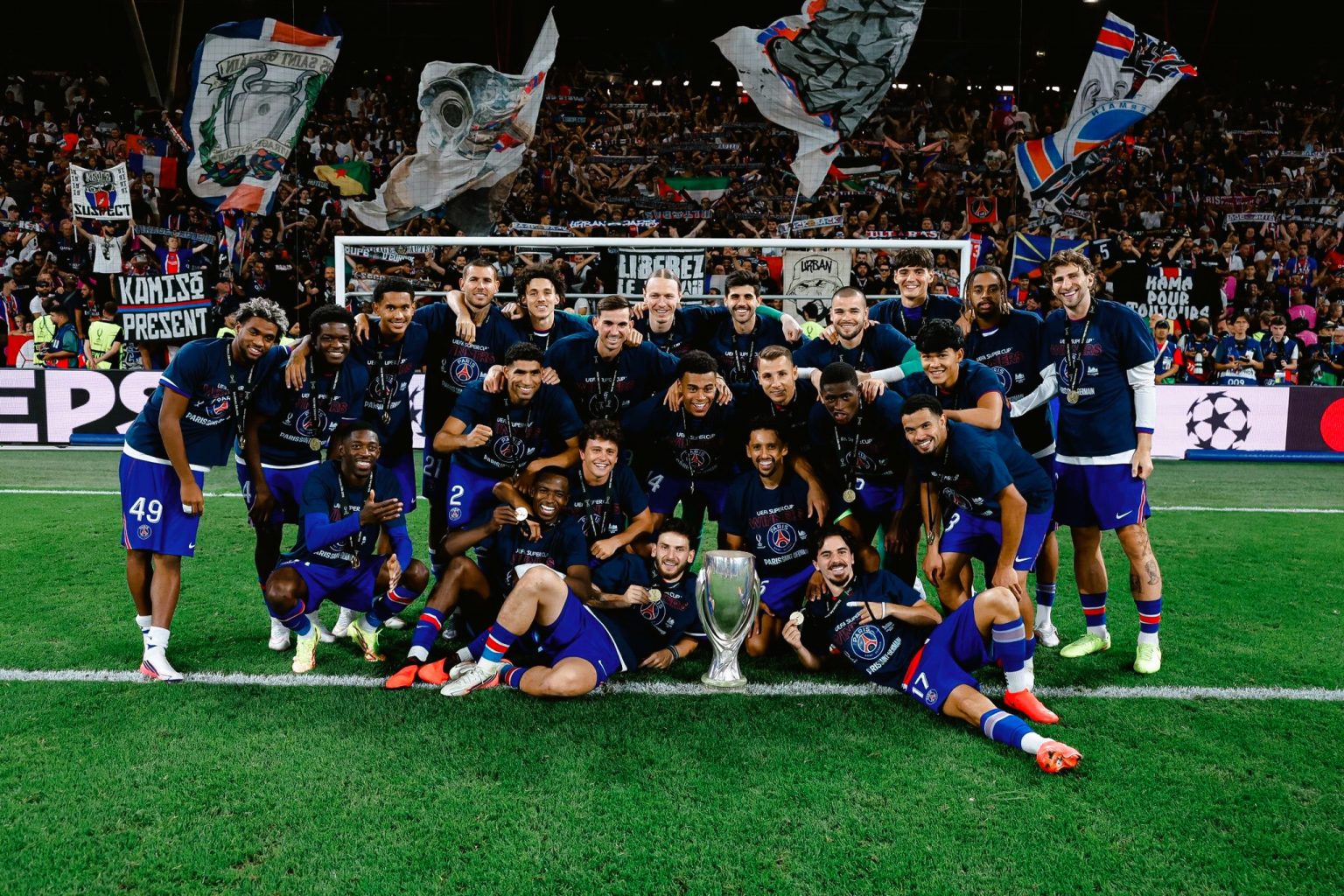

The UEFA Super Cup is European football’s season-opening trophy. It brings together the reigning UEFA Champions League winners and the reigning UEFA Europa League winners in a single match that kicks off the new campaign.
The competition began in 1973. Ajax became the first officially recognised champions after beating AC Milan. For its first 26 years, the Super Cup pitted the European Cup or Champions League winners against the winners of the UEFA Cup Winners’ Cup, a now-defunct trophy for domestic cup winners across Europe.
When the Cup Winners’ Cup was discontinued after the 1998-99 season, the Super Cup switched to its current format. Since 2000, it has matched the Champions League winners against the UEFA Cup, later renamed the UEFA Europa League, winners.
The format has also changed over time. Early editions were played over two legs, with each club hosting one match. Scheduling and political problems occasionally forced a single game instead. Since 1998, the Super Cup has been a one-off match at a neutral venue, most often in mid-August.
This guide lists every UEFA Super Cup champion from 1973 through the 2026 edition. It covers the winner and runner-up for each year, the most successful clubs and countries, the record holders among players and managers, and answers to the most common questions fans ask about the competition.
UEFA Super Cup Winners List by Year
The table below lists every edition of the UEFA Super Cup from 1973 to 2026. Aggregate scores are shown for two-legged finals. No competition was held in 1974, 1981 or 1985 for scheduling and political reasons, so those years are skipped.
| Year | Winner | Runner-up | Score | Format | Winning Competition |
| 1973 | Ajax | AC Milan | 6-1 (agg) | Two legs | European Cup |
| 1975 | Dynamo Kyiv | Bayern Munich | 3-0 (agg) | Two legs | Cup Winners’ Cup |
| 1976 | Anderlecht | Bayern Munich | 5-3 (agg) | Two legs | Cup Winners’ Cup |
| 1977 | Liverpool | Hamburger SV | 7-1 (agg) | Two legs | European Cup |
| 1978 | Anderlecht | Liverpool | 4-3 (agg) | Two legs | Cup Winners’ Cup |
| 1979 | Nottingham Forest | Barcelona | 2-1 (agg) | Two legs | European Cup |
| 1980 | Valencia | Nottingham Forest | 2-2 (agg, away goals) | Two legs | Cup Winners’ Cup |
| 1982 | Aston Villa | Barcelona | 3-1 (agg) | Two legs | European Cup |
| 1983 | Aberdeen | Hamburger SV | 2-0 (agg) | Two legs | Cup Winners’ Cup |
| 1984 | Juventus | Liverpool | 2-0 | Single match | Cup Winners’ Cup |
| 1986 | Steaua Bucuresti | Dynamo Kyiv | 1-0 | Single match | European Cup |
| 1987 | Porto | Ajax | 2-0 (agg) | Two legs | European Cup |
| 1988 | KV Mechelen | PSV Eindhoven | 3-1 (agg) | Two legs | Cup Winners’ Cup |
| 1989 | AC Milan | Barcelona | 2-1 (agg) | Two legs | European Cup |
| 1990 | AC Milan | Sampdoria | 3-1 (agg) | Two legs | European Cup |
| 1991 | Manchester United | Red Star Belgrade | 1-0 | Single match | Cup Winners’ Cup |
| 1992 | Barcelona | Werder Bremen | 3-2 (agg) | Two legs | European Cup |
| 1993 | Parma | AC Milan | 2-1 (agg) | Two legs | Cup Winners’ Cup |
| 1994 | AC Milan | Arsenal | 2-0 (agg) | Two legs | UEFA Champions League |
| 1995 | Ajax | Real Zaragoza | 5-1 (agg) | Two legs | UEFA Champions League |
| 1996 | Juventus | Paris Saint-Germain | 9-2 (agg) | Two legs | UEFA Champions League |
| 1997 | Barcelona | Borussia Dortmund | 3-1 (agg) | Two legs | Cup Winners’ Cup |
| 1998 | Chelsea | Real Madrid | 1-0 | Single match | Cup Winners’ Cup |
| 1999 | Lazio | Manchester United | 1-0 | Single match | Cup Winners’ Cup |
| 2000 | Galatasaray | Real Madrid | 2-1 (golden goal) | Single match | UEFA Cup |
| 2001 | Liverpool | Bayern Munich | 3-2 | Single match | UEFA Cup |
| 2002 | Real Madrid | Feyenoord | 3-1 | Single match | UEFA Champions League |
| 2003 | AC Milan | Porto | 1-0 | Single match | UEFA Champions League |
| 2004 | Valencia | Porto | 2-1 | Single match | UEFA Cup |
| 2005 | Liverpool | CSKA Moscow | 3-1 (a.e.t.) | Single match | UEFA Champions League |
| 2006 | Sevilla | Barcelona | 3-0 | Single match | UEFA Cup |
| 2007 | AC Milan | Sevilla | 3-1 | Single match | UEFA Champions League |
| 2008 | Zenit Saint Petersburg | Manchester United | 2-1 | Single match | UEFA Cup |
| 2009 | Barcelona | Shakhtar Donetsk | 1-0 (a.e.t.) | Single match | UEFA Champions League |
| 2010 | Atletico Madrid | Inter Milan | 2-0 | Single match | UEFA Europa League |
| 2011 | Barcelona | Porto | 2-0 | Single match | UEFA Champions League |
| 2012 | Atletico Madrid | Chelsea | 4-1 | Single match | UEFA Europa League |
| 2013 | Bayern Munich | Chelsea | 2-2, 5-4 pens (a.e.t.) | Single match | UEFA Champions League |
| 2014 | Real Madrid | Sevilla | 2-0 | Single match | UEFA Champions League |
| 2015 | Barcelona | Sevilla | 5-4 (a.e.t.) | Single match | UEFA Champions League |
| 2016 | Real Madrid | Sevilla | 3-2 (a.e.t.) | Single match | UEFA Champions League |
| 2017 | Real Madrid | Manchester United | 2-1 | Single match | UEFA Champions League |
| 2018 | Atletico Madrid | Real Madrid | 4-2 (a.e.t.) | Single match | UEFA Europa League |
| 2019 | Liverpool | Chelsea | 2-2, 5-4 pens (a.e.t.) | Single match | UEFA Champions League |
| 2020 | Bayern Munich | Sevilla | 2-1 (a.e.t.) | Single match | UEFA Champions League |
| 2021 | Chelsea | Villarreal | 1-1, 6-5 pens (a.e.t.) | Single match | UEFA Champions League |
| 2022 | Real Madrid | Eintracht Frankfurt | 2-0 | Single match | UEFA Champions League |
| 2023 | Manchester City | Sevilla | 1-1, 5-4 pens | Single match | UEFA Champions League |
| 2024 | Real Madrid | Atalanta | 2-0 | Single match | UEFA Champions League |
| 2025 | Paris Saint-Germain | Tottenham Hotspur | 2-2, 4-3 pens | Single match | UEFA Champions League |
| 2026 | Paris Saint-Germain | Aston Villa | 2-1 | Single match | UEFA Champions League |
Note on penalty finals: where a shootout was needed, the table shows the score after normal time or extra time, followed by the penalty result. The match score and the shootout score are two separate figures and should never be added together.
UEFA Super Cup Winners 2026
Winner: Paris Saint-Germain
Runner-up: Aston Villa
Date: 12 August 2026
Venue: Red Bull Arena, Salzburg, Austria
Final score: 2-1
Penalty shootout: Not needed
Champions League qualification: Paris Saint-Germain, winners of the 2025-26 UEFA Champions League
Europa League qualification: Aston Villa, winners of the 2025-26 UEFA Europa League

The 51st edition of the UEFA Super Cup was the first major European club final ever staged in Salzburg.
Khvicha Kvaratskhelia opened the scoring for Paris Saint-Germain in the 20th minute after being set up by Desire Doue.
Aston Villa debutant Brian Madjo equalised before half-time, becoming the youngest player to both start and score in a Super Cup final.
Doue then struck the winner in the 61st minute, confirmed after a video review overturned an initial offside call.
The result made Paris Saint-Germain only the fourth club to win the UEFA Super Cup in consecutive editions, following Real Madrid’s back-to-back wins in 2016 and 2017 and AC Milan’s in 1989 and 1990.
PSG’s own account of the achievement also traces the sequence back to Ajax, who won the unofficial 1972 European Super Cup before winning the first officially recognised edition in 1973, though UEFA itself does not credit the 1972 match as an official title.
The win gave head coach Luis Enrique his third UEFA Super Cup as a manager, adding to the trophy he won with Barcelona in 2015.
It also extended Paris Saint-Germain’s run of European silverware, following their 2024-25 and 2025-26 Champions League titles.
Explore more football records and rankings on FutbolUpdate, including our breakdowns of the most hat-tricks in football history, and the Most Free-Kick Goals in Football History.
Which Club Has Won the Most UEFA Super Cups?
Real Madrid are the most successful club in UEFA Super Cup history with six titles, won in 2002, 2014, 2016, 2017, 2022 and 2024.
AC Milan and Barcelona are next with five titles each, followed by Liverpool with four and Atletico Madrid with three.
The ranking below reflects every result through the 2026 final. Paris Saint-Germain’s second consecutive title moved them into a group of clubs with two Super Cup wins, but did not affect the clubs at the top of the all-time list.
UEFA Super Cup Most Wins: Club Ranking
| Rank | Club | Titles | Years Won | Runners-up | Appearances |
| 1 | Real Madrid | 6 | 2002, 2014, 2016, 2017, 2022, 2024 | 3 | 9 |
| 2 | Barcelona | 5 | 1992, 1997, 2009, 2011, 2015 | 4 | 9 |
| 2 | AC Milan | 5 | 1989, 1990, 1994, 2003, 2007 | 2 | 7 |
| 4 | Liverpool | 4 | 1977, 2001, 2005, 2019 | 2 | 6 |
| 5 | Atletico Madrid | 3 | 2010, 2012, 2018 | 0 | 3 |
| 6 | Ajax | 2 | 1973, 1995 | 1 | 3 |
| 6 | Anderlecht | 2 | 1976, 1978 | 0 | 2 |
| 6 | Valencia | 2 | 1980, 2004 | 0 | 2 |
| 6 | Juventus | 2 | 1984, 1996 | 0 | 2 |
| 6 | Bayern Munich | 2 | 2013, 2020 | 3 | 5 |
| 6 | Chelsea | 2 | 1998, 2021 | 3 | 5 |
| 6 | Paris Saint-Germain | 2 | 2025, 2026 | 1 | 3 |
Clubs with a single UEFA Super Cup title include Sevilla, Porto, Manchester United, Dynamo Kyiv, Nottingham Forest, Aston Villa, Aberdeen, Steaua Bucuresti, KV Mechelen, Parma, Lazio, Galatasaray, Zenit Saint Petersburg and Manchester City.
How Many Teams Have Won the UEFA Super Cup?
As of the 2026 final, 26 different clubs have won the UEFA Super Cup, representing 13 different countries.
Ajax were the first winners in 1973. Manchester City were the most recent club to win a first Super Cup title as a first-time champion, doing so in 2023, before Paris Saint-Germain claimed their own first title in 2025.
Two additional nations, Ukraine and the former Yugoslavia, have reached a final without ever winning, through Shakhtar Donetsk and Red Star Belgrade respectively.
First UEFA Super Cup Winner
Year: 1973
Winner: Ajax
Runner-up: AC Milan
Aggregate score: 6-1 (Ajax lost the first leg 1-0 in Milan, then won the second leg 6-0 at home)
Ajax’s win over AC Milan is recognised by UEFA as the first official Super Cup. An earlier match in 1972, also won by Ajax against Rangers, is not counted as official, since Rangers had been banned from European competition that year and UEFA refused to endorse the fixture.
Ajax’s dominance in the early 1970s, built around Johan Cruyff, made them the natural first champions of a competition created specifically to test the strength of the era’s best European Cup winners.
When Did the UEFA Super Cup Start?
The idea for the competition came from Anton Witkamp, a Dutch sports journalist at De Telegraaf, in 1971. He wanted a definitive match to settle which club was the best in Europe, at a time when Ajax’s Total Football side was the dominant force on the continent.
The first match, in 1972 between Ajax and Rangers, was not sanctioned by UEFA. The following year, UEFA formally endorsed the competition, and the 1973 final between Ajax and AC Milan became the first officially recognised UEFA Super Cup.
The competition has been played most years since, with three exceptions caused by scheduling conflicts and political circumstances in 1974, 1981 and 1985.
How Has the UEFA Super Cup Format Changed?
Early era: two-legged finals
From 1973 through 1997, the Super Cup was mostly played over two legs, one match at each club’s home stadium. The aggregate score across both matches decided the champion.
In cases of a tie on aggregate, the away goals rule was used to separate the sides, as it did in the 1980 final between Valencia and Nottingham Forest.
Transition period: single matches by necessity
Three finals were played as single matches before the format officially changed. Scheduling problems reduced 1984 and 1986 to one-off games, while the 1991 final between Manchester United and Red Star Belgrade was a single match because Red Star could not host a leg amid the outbreak of war in Yugoslavia.
Modern era: single match at a neutral venue
Since the 1998 final between Chelsea and Real Madrid, the Super Cup has always been a single match played at a neutral venue.
The Stade Louis II in Monaco hosted every edition between 1998 and 2012. Since 2013, the match has rotated between different stadiums across Europe, including Cardiff, Tbilisi, Trondheim, Skopje, Tallinn, Istanbul, Budapest, Belfast, Helsinki, Piraeus, Warsaw, Udine and, in 2026, Salzburg.
Champions League Winners vs Europa League Winners
Across the full history of the competition, the side representing the higher-ranked European trophy has generally had the upper hand, though the balance has shifted with each era.
- European Cup / UEFA Champions League winners: 31 Super Cup titles
- UEFA Cup Winners’ Cup winners: 12 Super Cup titles (competition discontinued after 1999)
- UEFA Cup / UEFA Europa League winners: 8 Super Cup titles (since 2000)
These three categories should not be confused. Editions before 2000 were contested between the European Cup or Champions League winners and the Cup Winners’ Cup winners, a trophy for domestic cup competition winners that no longer exists. Since 2000, the second side has always been the UEFA Cup, later renamed the Europa League, winners.
UEFA Super Cup Records and Statistics
- Most titles by a club: Real Madrid, 6
- Most appearances by a club: Real Madrid and Barcelona, 9 each
- Most titles by a manager: Carlo Ancelotti, 5
- Most titles by a player: Dani Carvajal and Luka Modric, 5 each
- Most consecutive titles: AC Milan (1989-90), Real Madrid (2016-17) and Paris Saint-Germain (2025-26) have each won two in a row
- Most successful country: Spain, 17 titles
- Fastest goal: Diego Costa, 50 seconds, for Atletico Madrid against Real Madrid in 2018
- Only hat-trick in a two-legged final: Terry McDermott, for Liverpool against Hamburger SV in 1977
- Only hat-trick in a single-match final: Radamel Falcao, for Atletico Madrid against Chelsea in 2012
- Biggest aggregate winning margin: Juventus, 9-2 (7-goal margin) against Paris Saint-Germain in 1996
Most UEFA Super Cup Titles by Manager
Carlo Ancelotti is the most successful manager in Super Cup history with five titles: two with AC Milan (2003, 2007) and three with Real Madrid (2014, 2022, 2024). He has also contested the most editions of any manager, with five.
Pep Guardiola is the only manager to win the Super Cup with three different clubs: Barcelona (2009, 2011), Bayern Munich (2013) and Manchester City (2023), four titles in total.
Other managers with multiple titles include Zinedine Zidane, who won back-to-back Super Cups with Real Madrid in 2016 and 2017, and Luis Enrique, who won the 2015 title with Barcelona before adding two more with Paris Saint-Germain in 2025 and 2026.
Most UEFA Super Cup Titles by Player
| Player | Titles | Club |
| Dani Carvajal | 5 | Real Madrid |
| Luka Modric | 5 | Real Madrid |
Carvajal and Modrić have been part of five of Real Madrid’s six Super Cup-winning teams. Mateo Kovacic holds a separate record as the only player to win the Super Cup with three different clubs: Real Madrid (2016, 2017), Chelsea (2021) and Manchester City (2023).
Most Appearances in the UEFA Super Cup
| Club | Appearances | Wins | Losses |
| Real Madrid | 9 | 6 | 3 |
| Barcelona | 9 | 5 | 4 |
| AC Milan | 7 | 5 | 2 |
| Sevilla | 7 | 1 | 6 |
| Liverpool | 6 | 4 | 2 |
| Porto | 4 | 1 | 3 |
| Chelsea | 5 | 2 | 3 |
| Bayern Munich | 5 | 2 | 3 |
Sevilla have one of the competition’s poorest records among frequent participants: they have reached seven finals but won only once, losing their other six appearances.
UEFA Super Cup vs Champions League
| Competition | Purpose | Participants | Format | Trophy | Frequency |
| UEFA Champions League | Determine Europe’s top club over a full season | 36 clubs (league phase) | League phase plus knockout rounds | European Champion Clubs’ Cup | Annual, August to May/June |
| UEFA Super Cup | Open the new season with a single showpiece match | 2 clubs | One match at a neutral venue | UEFA Super Cup trophy | Annual, single match in August |
The Champions League is a season-long competition and the more prestigious trophy in European club football. The Super Cup is a single-match curtain raiser contested only by the previous season’s Champions League and Europa League winners, and it does not carry the same weight as a full continental campaign.
UEFA Super Cup vs UEFA Europa League
The UEFA Europa League is Europe’s second-tier club competition, played across a full season with clubs that either failed to qualify for the Champions League or dropped down from it. Its winner earns a place in the following season’s Champions League and a spot in that year’s UEFA Super Cup final.
The Super Cup gives the Europa League winner a rare chance to test themselves directly against the Champions League champions in a single, high-profile match, something the two competitions’ separate paths would not otherwise allow during the regular season.
Why Is the UEFA Super Cup Important?
The UEFA Super Cup carries genuine prestige as an official UEFA trophy contested by that season’s two European champions. It gives clubs and fans an early marker of form heading into a new campaign, and it carries real prize money and silverware.
It is not, however, equivalent to the Champions League in stature. It is a single match rather than a season-long test, and clubs sometimes treat it as a low-key season opener rather than a defining fixture. Its importance lies in the identity of the two competitions it connects, rather than in the difficulty of winning it.
Conclusion
The UEFA Super Cup has grown from a Dutch journalist’s idea into an official UEFA trophy spanning more than half a century of European football.
From Ajax’s first triumph in 1973 to Paris Saint-Germain’s back-to-back wins in 2025 and 2026, the competition has tracked the shifting balance of power in the European game.
Real Madrid’s record of six titles reflects their status as the most successful club in Champions League history, while AC Milan, Barcelona, Liverpool and Atletico Madrid round out a group of clubs with a genuine claim to Super Cup pedigree.
The format itself has changed as much as the list of winners. What began as a two-legged tie between champions in the winter months is now a single showpiece match played at a new neutral venue each August.
Despite sitting below the Champions League and Europa League in overall prestige, the Super Cup remains a meaningful piece of silverware and a fitting way to open each new European season.
Sources: UEFA.com official Super Cup history and records pages, official club statements, and match reports from UEFA-accredited broadcast partners. Figures reflect results confirmed through the 12 August 2026 final.