

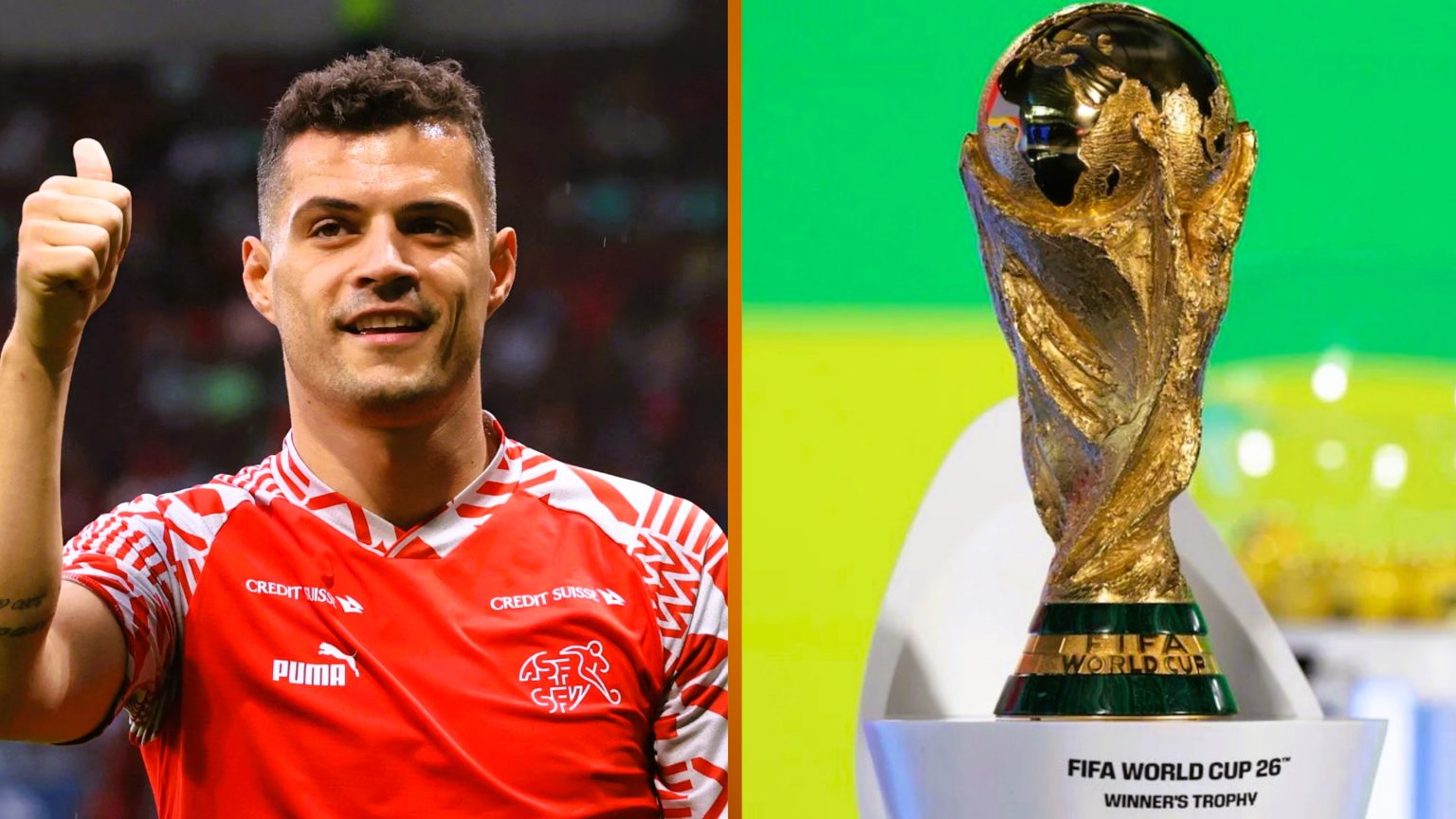
Can Switzerland finally turn consistency into a deep World Cup run? Can their disciplined structure, tournament experience, and rising stars deliver something special on the biggest stage? And in a newly expanded format, could this be the Swiss national team’s best chance yet to make history?
The 2026 FIFA World Cup, featuring 48 teams, runs from June 11 to July 19 across 16 host cities in the United States, Canada, and Mexico. The Nati have been drawn into Group B, where they will face Asian champions Qatar, the winner of UEFA Playoff A—potentially Italy—and co-hosts Canada.
Switzerland open their campaign on June 13 against Qatar at Levi’s Stadium in Santa Clara, followed by a June 18 fixture in Los Angeles, before concluding the group stage on June 24 against Canada at BC Place in Vancouver.
Below is a complete guide to Switzerland at the World Cup, including the squad, key players, head coach, tournament history, and a full preview of their ambitions in North America.
Qualification for 2026
Switzerland qualified directly by topping UEFA Group B unbeaten: 4 wins, 2 draws, 0 losses, scoring 14 goals and conceding 2.
They clinched qualification with a 1-1 draw against Kosovo on November 18, 2025, finishing ahead of Kosovo, Sweden, and Slovenia.
Key results included a 4-0 win over Kosovo and a 3-0 victory against Slovenia. Under coach Murat Yakin, this marks their sixth straight World Cup.
History
Switzerland’s national football team has a long World Cup history, with 12 appearances before 2026, making this their 13th tournament.
Their best performances came in the 1930s and 1950s, reaching the quarter-finals in 1934, 1938, and as hosts in 1954.
In modern times, they’ve been consistent qualifiers since 2006, advancing to the round of 16 in 2014, 2018, and 2022, but exiting there each time.
Overall, their record stands at 14 wins, 8 draws, and 17 losses in 39 matches, with 55 goals scored and 64 conceded.
Here’s a summary of their past performances:
| Year | Stage Reached | Key Result |
|---|---|---|
| 1934 | Quarter-finals | Lost 3-2 to Czechoslovakia |
| 1938 | Quarter-finals | Lost 4-2 to Hungary (after replay) |
| 1950 | Group stage | Eliminated with 1 win, 1 draw, 1 loss |
| 1954 | Quarter-finals | Lost 7-5 to Austria |
| 1962 | Group stage | Eliminated with 3 losses |
| 1966 | Group stage | Eliminated with 3 losses |
| 1994 | Round of 16 | Lost 3-0 to Spain |
| 2006 | Round of 16 | Lost 3-0 on penalties to Ukraine (after 0-0 draw) |
| 2010 | Group stage | Eliminated with 1 win, 1 draw, 1 loss |
| 2014 | Round of 16 | Lost 1-0 (a.e.t.) to Argentina |
| 2018 | Round of 16 | Lost 1-0 to Sweden |
| 2022 | Round of 16 | Lost 6-1 to Portugal |
| 2026 | TBD | TBD |
Switzerland Group Stage Schedule
June 13, 2026: Qatar vs. Switzerland
June 18, 2026: Switzerland vs. UEFA Path A Winner
June 24, 2026: Switzerland vs. Canada
Switzerland Coach and Key Players
Head Coach
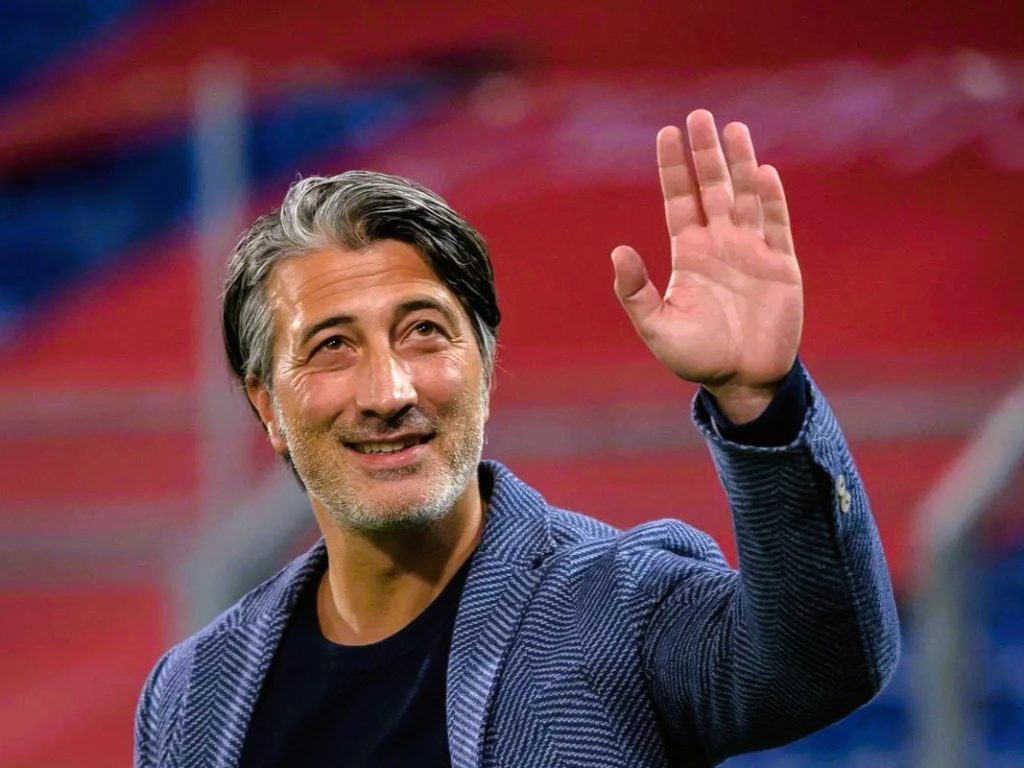
The Switzerland national team is led by Murat Yakin, the tactical mastermind who has steered the Rossocrociati through one of the most successful periods in their history.
Since his appointment in August 2021, Yakin has transformed the Swiss side into a “giant-killer” on the global stage, characterised by a sophisticated defensive structure and a disciplined, possession-based approach.
Yakin’s coaching philosophy centres on tactical flexibility and a “resilient mid-block” that has frustrated the world’s elite, including historic results against France, Italy, and Germany.
Yakin is known for his fluid 3-4-2-1 or 4-3-3 systems, prioritizing defensive solidity and rapid vertical transitions. His teams are particularly praised for their “pressing triggers” and ability to neutralize elite playmakers.
Key Players
Manuel Akanji (Defender, Manchester City)
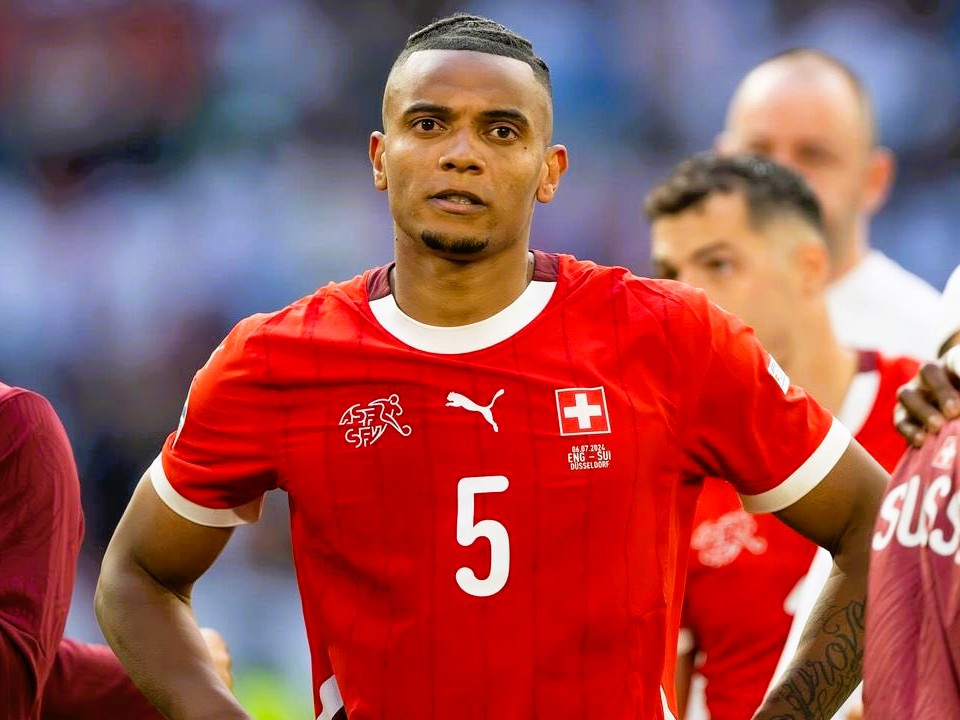
The Manchester City star has developed into the undisputed leader of the Swiss backline and one of the world’s leading “ball-playing” defenders. He is currently on loan at Serie A side Inter Milan.
His excellent recovery speed and tactical intelligence allow Switzerland to maintain a high defensive line, while his composure under pressure is crucial to launching attacks from deep.
In Yakin’s fluid 3-4-2-1 system, Akanji operates as a defensive “quarterback”, a role he performed flawlessly during the undefeated qualifying campaign.
Granit Xhaka (Midfielder, Sunderland)
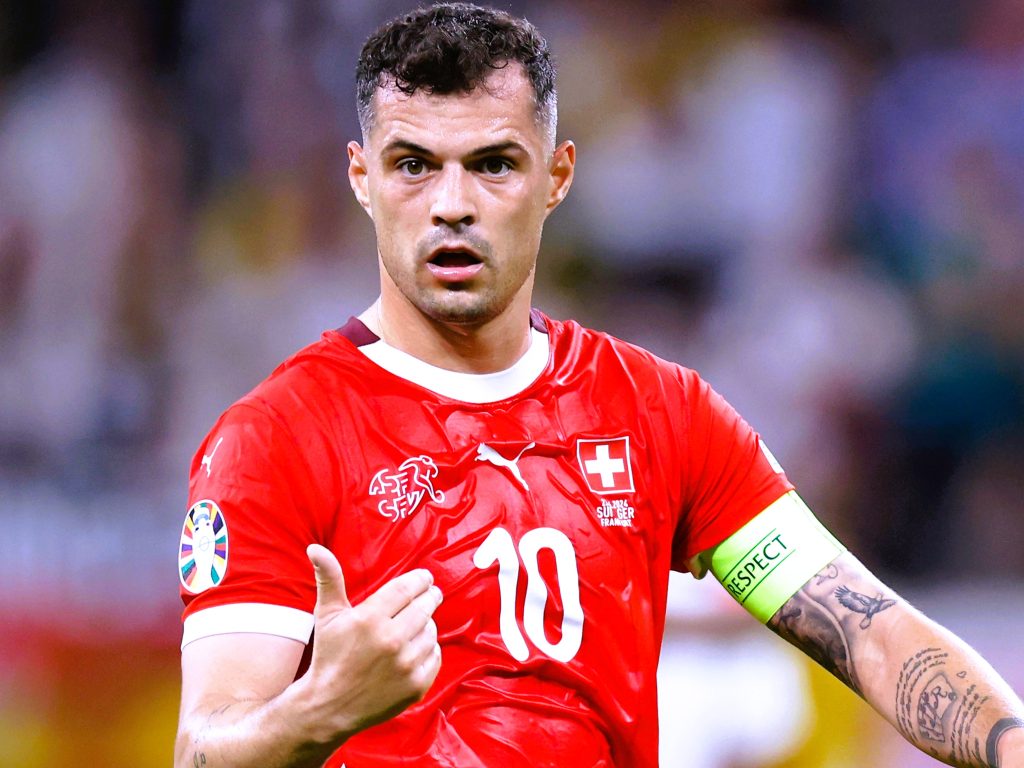
Granit Xhaka is the most important member of Switzerland’s world-class midfield engine in North America.
Since making his debut in 2011, Xhaka has led Switzerland’s midfield at three World Cups and four European Championships. He is the midfield anchor, the conductor, the voice that refuses to be silenced.
Xhaka controls games by controlling the tempo—slowing down when Switzerland needs composure, picking up speed when gaps appear.
He has the ability to stretch defenses with passing range, switching play from congested areas to open spaces with metronomic precision.
Defensively, Xhaka understands the threat before it fully develops, positioning himself to block counterattacks before they gain momentum.
But his greatest contribution may be organizational. Xhaka can organize those around him, point out triggers that put pressure on, and ensure that the eleven men work as a unit.
So when Switzerland needs someone to take control of chaotic moments, he calls for strength. Switzerland’s rhythm flows through him. When he plays well, they rarely lose.
Gregor Kobel (Goalkeeper, Borussia Dortmund)
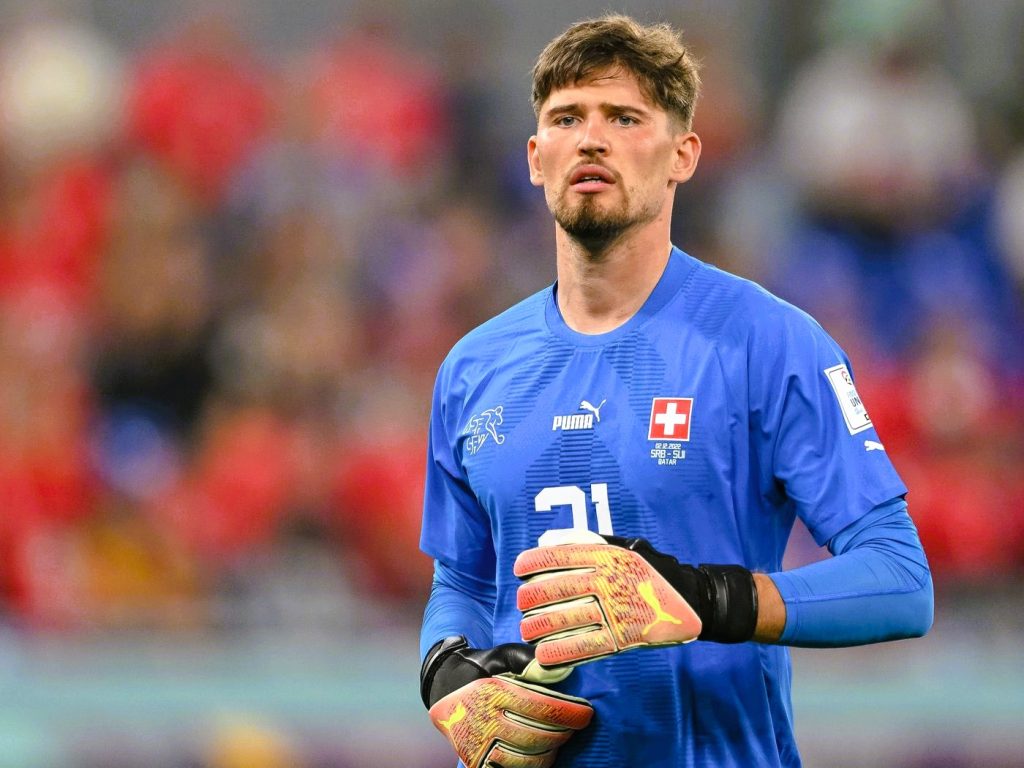
Gregor Kobel arrives in North America as Switzerland’s undisputed No. 1, having taken over the starting role following Yann Sommer’s international retirement in August 2024.
Under Murat Yakin, Switzerland typically operate in a 3-4-2-1 or 4-2-3-1 system built on defensive organisation, man-oriented pressing, and compact central control. Kobel plays a vital role as the last line of defence, using his vocal leadership to organise a backline often featuring Nico Elvedi, Fabian Schär, or Ricardo Rodríguez.
An elite shot-stopper, Kobel is renowned for his reflexes, positioning, and ability to produce decisive saves in one-on-one situations. In possession, his reliable distribution supports Switzerland’s structured build-up, enabling quick transitions and reinforcing their adaptable, high-intensity pressing style.
Predicted Squad
As of February 2026, the final 26-man squad is yet to be announced, with the tournament in June. Based on recent call-ups, form, and projections, here’s a predicted squad.
Goalkeepers
- Gregor Kobel (Borussia Dortmund)
- Yvon Mvogo (Lorient)
- Marvin Keller (Winterthur)
Defenders
- Manuel Akanji (Inter Milan)
- Nico Elvedi (Borussia Mönchengladbach)
- Ricardo Rodriguez (Torino)
- Silvan Widmer (Mainz 05)
- Fabian Schär (Newcastle United)
- Eray Cömert (Nantes)
- Becir Omeragic (Montpellier)
Midfielders
- Granit Xhaka (Bayer Leverkusen)
- Remo Freuler (Bologna)
- Djibril Sow (Sevilla)
- Michel Aebischer (Bologna)
- Denis Zakaria (Monaco)
- Ardon Jashari (Club Brugge)
- Ruben Vargas (Augsburg)
Forwards
- Breel Embolo (Rennes)
- Noah Okafor (AC Milan)
- Zeki Amdouni (Benfica)
- Dan Ndoye (Bologna)
- Renato Steffen (Lugano)
- Andi Zeqiri (Standard Liège)
Preview
Team Strengths and Weaknesses
Switzerland’s greatest strength remains their highly organised defensive structure. During the 2026 World Cup qualifying campaign, they went unbeaten, conceding just two goals in six matches—a reflection of their tactical discipline and collective awareness. The backline is anchored by Manuel Akanji, whose calm distribution, positional intelligence, and ability to read danger early provide stability under pressure.
In midfield, the team is built around a dependable double pivot featuring Granit Xhaka and Remo Freuler. As the nation’s most capped player, Xhaka operates as a tactical “quarterback,” controlling tempo, directing build-up play, and setting the competitive tone, while Freuler adds balance through pressing and ball retention.
Switzerland’s consistency in tournament football is well established. They have reached the knockout stages at the last three World Cups and advanced to the quarter-finals at both Euro 2020 and Euro 2024, underlining their reliability in high-stakes environments. The successful transition from Jan Sommer to Gregor Kobel has also ensured elite shot-stopping and confident distribution from the back.
However, limitations remain. Switzerland lack a truly explosive, game-changing attacker capable of deciding matches single-handedly in the final third. While technically sound, they can struggle to sustain high intensity for the full 90 minutes against physically dominant opponents.
Chance creation has historically lagged behind defensive output, with the team often relying on set-pieces and efficiency rather than sustained attacking pressure. Additionally, key figures such as Xhaka and Ricardo Rodríguez are entering the latter stages of their careers, raising questions about durability across a demanding month-long tournament.
Expectations
A sixth consecutive World Cup appearance and three straight qualifications for the knockout stages underline Switzerland’s status as one of international football’s most reliable tournament sides.
Drawn into a balanced Group B, the Nati will rightly view themselves as credible contenders to advance and potentially reach the quarter-finals for the first time since 1954, even with co-hosts Canada and the eventual UEFA play-off winner—likely Italy—posing significant challenges.
For this cycle, the benchmark is clear. Progressing beyond the newly introduced Round of 32 is the minimum expectation, while a competitive showing deep into the knockout bracket would confirm Switzerland’s continued evolution from consistent qualifiers to genuine contenders.
Anything less than a strong knockout performance would be regarded as underachievement for a team that has earned a reputation as international football’s most feared “giant-killers”, capable of unsettling even the tournament’s elite on the biggest stage.