

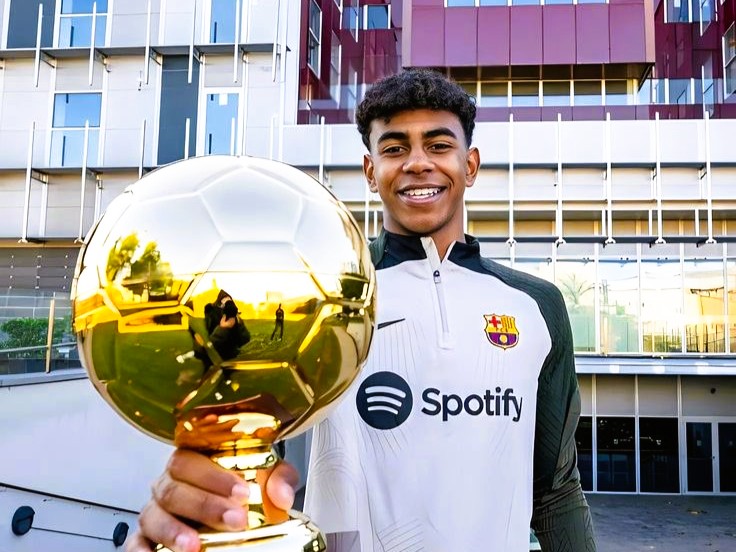
Few awards tell you where football is. The Golden Boy Award tells you where it’s going.
In the glittering world of football, few carry as much prophetic significance as the Golden Boy Award.
Since its inception in 2003, the award has highlighted the brightest young talents in European football, many of whom have gone on to dominate the global stage.
From the early brilliance of Lionel Messi to the record-breaking teenage prowess of Lamine Yamal and the crowning of Désiré Due in 2025.

That’s the true power of the Golden Boy Award. It doesn’t just celebrate rising stars, it predicts the future.
Below you’ll find the full list of Golden Boy Award winners from 2003 to 2025, as well as every record, statistic and story worth knowing about European football’s most pioneering individual honour.
What Is the Golden Boy Award?
The Golden Boy award was founded in 2003 by the Turin-based Italian sports daily Tuttosport.
It is awarded annually to the best male football player aged 21 or under.
More Read

Who competes in a top-division European league in the calendar year covering performances from January 1 to December 31.
Voting is conducted by a panel of journalists representing the leading European football publications.
These include L’Equipe (France), Bild (Germany), and The Times (England), among others.
Over the years, the voting panel has included more than 30 media outlets from across the continent, giving the award real cross-border credibility.
Two key rules define the award: players must be 21 or under at the time of selection, and no player can win the award more than once.
The second rule ensures a new name on the trophy each year and prevents the dynasties that can make other awards feel predictable.
From relatively modest beginnings, the Golden Boy has grown into the world’s most prestigious youth football award.
Even higher than FIFA’s Best Young Player award in major competitions, as it assesses the best club performances over a full 12 months, rather than a snapshot of a single competition.
Golden Boy Award Winners List (2003–2025)
| Year | Winner | Club(s) | Nationality | Age at Award |
|---|---|---|---|---|
| 2025 | Désiré Doué | Paris Saint-Germain | France | 20 years, 154 days |
| 2024 | Lamine Yamal | Barcelona | Spain | 17 years, 137 days |
| 2023 | Jude Bellingham | Borussia Dortmund / Real Madrid | England | 20 years, 159 days |
| 2022 | Gavi | Barcelona | Spain | 18 years, 77 days |
| 2021 | Pedri | Barcelona | Spain | 18 years, 362 days |
| 2020 | Erling Haaland | Borussia Dortmund | Norway | 20 years, 123 days |
| 2019 | João Félix | Benfica / Atlético Madrid | Portugal | 20 years, 17 days |
| 2018 | Matthijs de Ligt | Ajax | Netherlands | 19 years, 127 days |
| 2017 | Kylian Mbappé | Monaco / Paris Saint-Germain | France | 18 years, 307 days |
| 2016 | Renato Sanches | Benfica / Bayern Munich | Portugal | 19 years, 67 days |
| 2015 | Anthony Martial | Monaco / Manchester United | France | 20 years, 14 days |
| 2014 | Raheem Sterling | Liverpool | England | 20 years, 12 days |
| 2013 | Paul Pogba | Juventus | France | 20 years, 264 days |
| 2012 | Isco | Málaga | Spain | 20 years, 245 days |
| 2011 | Mario Götze | Borussia Dortmund | Germany | 19 years, 189 days |
| 2010 | Mario Balotelli | Inter Milan / Manchester City | Italy | 20 years, 13 days |
| 2009 | Alexandre Pato | Milan | Brazil | 20 years, 102 days |
| 2008 | Anderson | Manchester United | Brazil | 20 years, 237 days |
| 2007 | Sergio Agüero | Atlético Madrid | Argentina | 19 years, 188 days |
| 2006 | Cesc Fàbregas | Arsenal | Spain | 19 years, 212 days |
| 2005 | Lionel Messi | Barcelona | Argentina | 18 years, 173 days |
| 2004 | Wayne Rooney | Everton / Manchester United | England | 19 years, 50 days |
| 2003 | Rafael van der Vaart | Ajax | Netherlands | 20 years, 304 days |
Golden Boy Winners by Country
| Country | Winners | Players |
| Spain | 5 | Cesc Fàbregas, Isco, Pedri, Gavi, Lamine Yamal |
| France | 4 | Anthony Martial, Paul Pogba, Kylian Mbappé, Désiré Doué |
| England | 3 | Wayne Rooney, Raheem Sterling, Jude Bellingham |
| Argentina | 2 | Lionel Messi, Sergio Agüero |
| Brazil | 2 | Anderson, Alexandre Pato |
| Portugal | 2 | Renato Sanches, João Félix |
| Netherlands | 2 | Rafael van der Vaart, Matthijs de Ligt |
| Germany | 1 | Mario Götze |
| Italy | 1 | Mario Balotelli |
| Norway | 1 | Erling Haaland |
Spain leads the all-time Golden Boy table with five winners.
This is a testament to the exceptional production line at La Masia and the vast depth of Spanish youth football.
France is second with four winners, including two of the last three winners.
England’s tally of three winners (counting Bellingham) reflects the Premier League’s ability to provide young players with high-profile platforms to capture the attention of voters.
Golden Boy Winners by Club
| Club | Winners | Players |
| Barcelona | 4 | Lionel Messi, Pedri, Gavi, Lamine Yamal |
| Borussia Dortmund | 3 | Mario Götze, Erling Haaland, Jude Bellingham |
| Ajax | 2 | Rafael van der Vaart, Matthijs de Ligt |
| Manchester United | 2 | Wayne Rooney, Anderson |
| Atlético Madrid | 2 | Sergio Agüero, João Félix |
| Paris Saint-Germain | 2 | Kylian Mbappé (joined mid-year), Désiré Doué |
| Juventus | 1 | Paul Pogba |
| Liverpool | 1 | Raheem Sterling |
| AC Milan | 1 | Alexandre Pato |
| Real Madrid | 1 | Jude Bellingham |
Barcelona are the dominant force with four confirmed winners at the club, though Jude Bellingham’s win was collected while at Real Madrid.
Borussia Dortmund’s record of three winners is remarkable and underlines the Bundesliga club’s reputation as one of Europe’s premier developer clubs for elite young talent.
Ajax, another famous academy club, have produced two winners.
Youngest Golden Boy Winners Ever
- Lamine Yamal – 17 years, 137 days (2024) — The youngest winner in the award’s history by a considerable margin. No player had won before their 18th birthday until Yamal.
- Lionel Messi – 18 years, 173 days (2005) — The second youngest, and the first winner to become a genuine all-time great of the sport.
- Gavi – 18 years, 77 days (2022) — Won earlier in his life than Messi, though the age calculation varies by cutoff.
- Kylian Mbappé – 18 years, 307 days (2017) — Won as a teenager, fitting for a player who by then had already reached a Champions League semi-final.
- Mario Götze – 19 years, 189 days (2011) — Among the younger winners, claimed the award at Borussia Dortmund ahead of a World Cup-winning career.
The trend toward younger winners is striking. Yamal’s 2024 win at 17 shattered the existing record and reflected the increasing willingness of top clubs to hand genuine responsibility to teenagers.
Golden Boy Winners Who Became Global Superstars
The Golden Boy’s greatest legacy is its track record of identifying talent before the rest of the world catches up.
Several winners went on to not just fulfil their potential but to define their generation entirely.
Lionel Messi (2005) — Eight Ballon d’Or awards. Multiple Champions League titles. The 2022 World Cup. The Golden Boy was the starting gun on the most decorated individual career in football history.
Sergio Agüero (2007) — He became Manchester City’s all-time leading scorer, his 93:20 goal against QPR one of the most celebrated moments in Premier League history. The Golden Boy saw it coming.
Paul Pogba (2013) — His £89 million return to Manchester United in 2016 made him the world’s most expensive player at the time. A World Cup winner with France in 2018. Golden Boy at 20 felt like an understatement.
Kylian Mbappé (2017) — A World Cup winner at 19, multiple Champions League campaigns, and the most coveted forward on the planet for the better part of a decade. The Golden Boy picked him precisely right.
Erling Haaland (2020) — The most prolific goalscorer of his generation, Haaland set a Premier League record of 36 goals in a single season with Manchester City. His Golden Boy felt like the beginning of something unstoppable — because it was.
Jude Bellingham (2023) — A Champions League winner with Real Madrid, England’s most important player at his best, and a midfielder who has already played in two major European finals before turning 21.
Lamine Yamal (2024) — Still only 17 at the time of writing, in the context of his win, Yamal has already won a major international tournament and is widely regarded as the next generational talent of the sport.
Golden Boy Award Records and Statistics
- Most successful nation: Spain (5 winners — Fàbregas, Isco, Pedri, Gavi, Yamal)
- Most successful club: Barcelona (4 winners — Messi, Pedri, Gavi, Yamal)
- Youngest ever winner: Lamine Yamal (17 years, 137 days, 2024)
- First-ever winner: Rafael van der Vaart (2003)
- 2025 winner: Désiré Doué (Paris Saint-Germain)
- Ballon d’Or winners from Golden Boy list: Lionel Messi remains the only Golden Boy winner to have subsequently won the Ballon d’Or, although several others such as Kylian Mbappé, Erling Haaland and Jude Bellingham are widely considered future contenders.
- Biggest surprise winner: Anderson (2008) — now considered one of the more unlikely choices, though the context of the 2007-08 Champions League win made a strong case
- Most club switches during winning year: Several winners moved mid-year (Mbappé, Martial, Balotelli, Rooney), reflecting how January windows can transform a player’s profile
- No repeat winners: The rules prevent any player from winning twice, ensuring the list always grows with new names
2003: Rafael van der Vaart claims the inaugural award with Ajax, establishing the Dutch as early leaders in youth talent identification.
2004–2006: Three consecutive winners from the Premier League or Arsenal — Rooney, Messi (Barcelona but via a PL club shortlist era), Fàbregas — confirm English football’s pull in the early awards.
2005: Messi’s win signals the arrival of the player who will come to define the entire era.
2007–2009: A South American interlude — Agüero, Anderson, and Pato — as Latin American talent floods into European football.
2010–2013: Four diverse winners from Italy, Germany, Spain, and France show the award broadening its continental scope.
2013: Pogba wins despite leaving Manchester United for free — later costing £89 million to bring back. The irony aged beautifully.
2017: Mbappé wins at 18 after Champions League heroics with Monaco. The modern era of the award begins in earnest.
2020: Haaland, possibly the most inevitable winner since Messi.
2021–2022: Two consecutive Barça midfielders (Pedri and Gavi) confirm La Masia’s latest golden generation.
2023: Bellingham wins by a record margin, the biggest personality in European football under 21.
2024: Yamal rewrites history at 17, becoming the youngest winner in the award’s existence.
Golden Boy Award vs Kopa Trophy
| Category | Golden Boy Award | Kopa Trophy |
| Founded | 2003 | 2018 |
| Organiser | Tuttosport (media) | France Football / Ballon d’Or |
| Age Eligibility | Under 21 | Under 21 |
| Evaluation Period | Calendar year (Jan–Dec) | Season-based |
| Voters | 30+ European journalists | Former Ballon d’Or winners |
| Repeat Winners | Not permitted | Not permitted |
| Prestige | Independent, long-established | Tied to Ballon d’Or ceremony |
| Geographic scope | Players in European leagues | Players in European leagues |
Both awards target the same demographic, but they operate independently and sometimes produce different decisions.
The Golden Boy has a 15-year history behind it, giving it a greater credential and a deeper legacy than the Kopa trophy, which only launched in 2018.
The Kopa’s association with the Ballon d’Or gives it a different kind of glamour, but the Golden Boy’s longer track record arguably carries more authority.
Frequently Asked Questions
Who won the first Golden Boy Award?
Rafael van der Vaart of Ajax won the inaugural Golden Boy Award in 2003.
Who won the Golden Boy Award in 2025?
Désiré Doué of Paris Saint-Germain won the 2025 Golden Boy Award, following a standout year that included a Champions League triumph with PSG.
Who is the youngest Golden Boy winner?
Lamine Yamal is the youngest ever Golden Boy winner, collecting the 2024 award at just 17 years and 137 days old.
Which country has the most Golden Boy winners?
Spain leads all countries with five Golden Boy winners: Cesc Fàbregas (2006), Isco (2012), Pedri (2021), Gavi (2022), and Lamine Yamal (2024).
Which club has the most Golden Boy winners?
Barcelona have produced the most Golden Boy winners of any single club, with four: Lionel Messi (2005), Pedri (2021), Gavi (2022), and Lamine Yamal (2024).
Conclusion
Twenty-three years. Twenty-three winners. And a record of talent recognition that no other football award can match.
From Rafael van der Vaart’s inaugural win in 2003 to Désiré Due’s Champions League-backed triumph in 2025, the Golden Boy award has consistently placed its faith in youth.
Youth have consistently repaid that faith. Messi has become the greatest player of all time. Mbappe has become the most iconic striker of his generation.
Haaland has become the most prolific goalscorer of the modern era. Bellingham became England’s most important player before he was 21.
Not every winner has become a global superstar – the Anderson and Renato Sanches chapters are important reminders that talent and projection are not the same thing.
But the hit rate is remarkable, and even the ones who missed out made sense in the context of the year they were awarded.
What makes the Golden Boy truly compelling is not just the names it has already proven, but the names it will prove next time.
Somewhere on a training ground right now, a teenager is building the kind of year that will land them on this list.
That is the enduring promise of the prize: the future of football, recognized before anyone else knows.
Related: Ballon d’Or Winners List | UEFA Champions League Winners | European Golden Boot Winners