








The FIFA World Cup Best Young Player Award is one of the most coveted individual honours in international football. Officially introduced by FIFA in 2006 at the Germany World Cup, this prestigious prize recognises the standout young talent of each tournament — a player who demonstrates exceptional skill, consistency, and impact far beyond their years.
Unlike the Golden Ball, which rewards the best overall performer regardless of age, the Best Young Player Award shines a spotlight exclusively on youth footballers at the World Cup, giving the world its first official look at the next generation of global superstars.
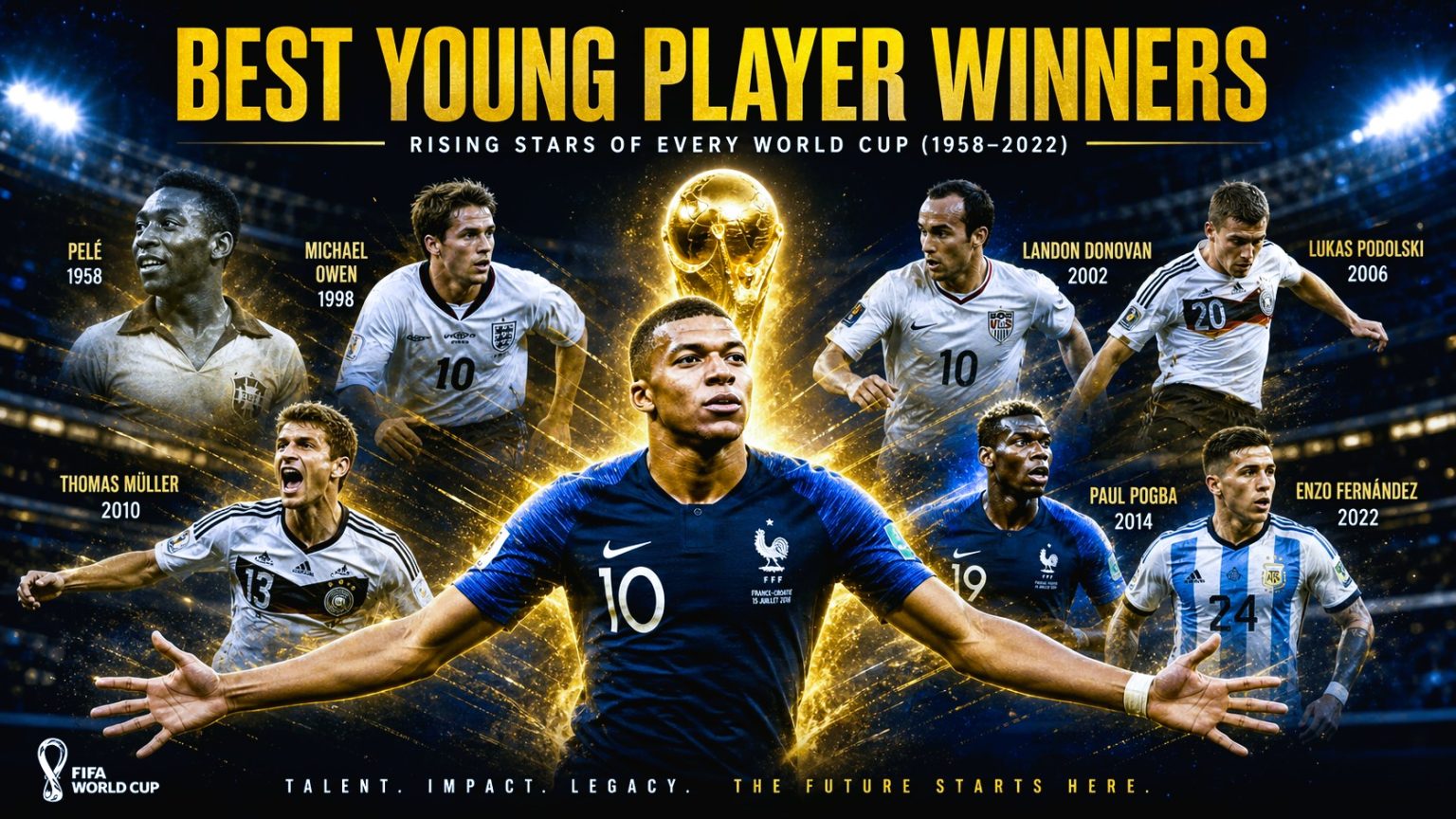
From Lukas Podolski’s electric debut in 2006 to Kylian Mbappé’s breathtaking campaign in 2018 and Enzo Fernández’s commanding midfield displays in 2022, this award has consistently been a launchpad for future legends.
This article provides the complete FIFA World Cup Best Young Player winners list from 1958 to 2022, including official and unofficial recipients.
FIFA World Cup Best Young Player Winners by Year (1958–2022)
The table below presents a complete chronological record of FIFA World Cup Best Young Player winners, including unofficial recognition for standout young talents before the award’s formal introduction in 2006.
| Year | Winner | Team |
|---|---|---|
| 2022 | Enzo Fernández | Argentina |
| 2018 | Kylian Mbappé | France |
| 2014 | Paul Pogba | France |
| 2010 | Thomas Müller | Germany |
| 2006 | Lukas Podolski | Germany |
| 2002 | Landon Donovan | USA |
| 1998 | Michael Owen | England |
| 1994 | Marc Overmars | Netherlands |
| 1990 | Robert Prosinečki | Yugoslavia |
| 1986 | Enzo Scifo | Belgium |
| 1982 | Manuel Amoros | France |
| 1978 | Antonio Cabrini | Italy |
| 1974 | Władysław Żmuda | Poland |
| 1970 | Teófilo Cubillas | Peru |
| 1966 | Franz Beckenbauer | West Germany |
| 1962 | Flórián Albert | Hungary |
| 1958 | Pelé | Brazil |
Player Spotlights – Best Young Player Winners
Each recipient of this award represents a unique story — of raw talent meeting the world’s biggest stage. Here is an in-depth look at the five official FIFA World Cup Best Young Player winners since 2006.
Enzo Fernández (2022 – Argentina)
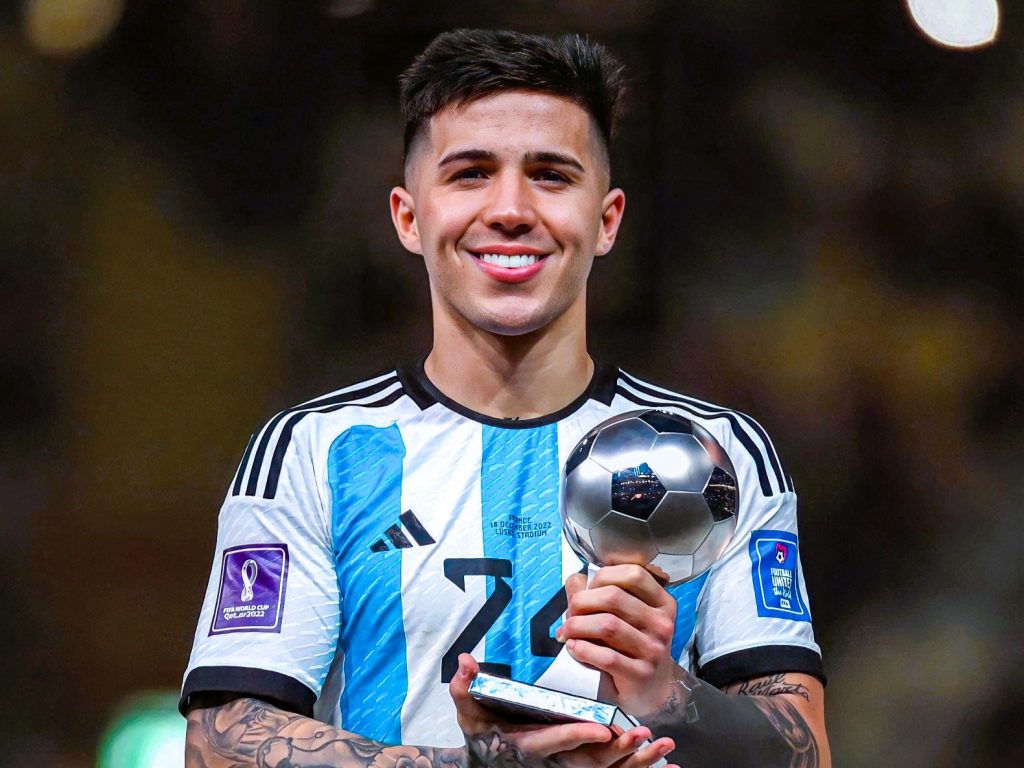
Few World Cup stories captured the football world’s imagination quite like that of Enzo Fernández at Qatar 2022.
Just 21 years old and barely months removed from joining Benfica, the Argentine midfielder arrived at the tournament as an emerging prospect and departed as a world champion and FIFA Best Young Player.

Fernández was instrumental in Argentina’s historic triumph — their third World Cup title and first since 1986.
His standout moment came in a virtuoso group-stage performance against Mexico, where his long-range goal swung a pivotal match in Argentina’s favour.
Throughout the tournament, his ability to control tempo, win duels, and drive forward gave Lionel Scaloni’s side an additional creative dimension in the engine room.
His combination of composure under pressure, technical excellence, and tactical intelligence made him the unanimous choice for the young player award.
The recognition triggered an immediate surge in transfer interest, with Chelsea eventually securing his signature for a then-British transfer record fee of around £107 million in January 2023 — a testament to the award’s power in accelerating a player’s career trajectory.
Kylian Mbappé (2018 – France)
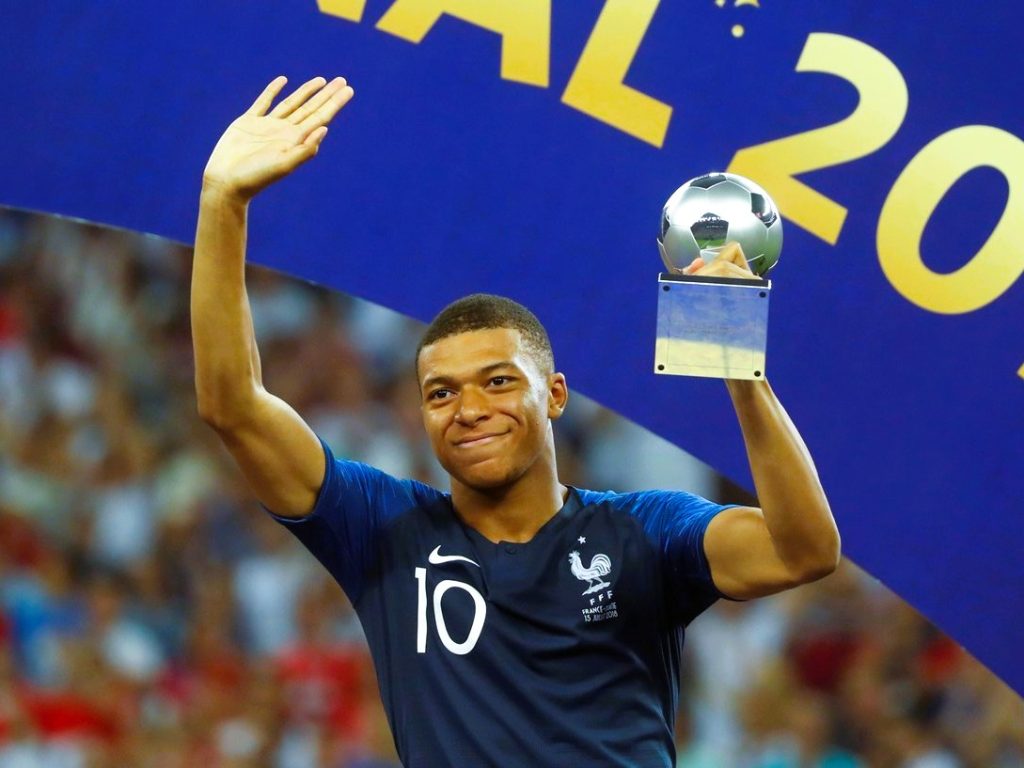
Perhaps no FIFA World Cup Best Young Player winner has made a bigger immediate impact than Kylian Mbappé at Russia 2018.
At just 19 years old, the PSG forward did not merely participate in France’s World Cup triumph — he was one of its defining forces, scoring four goals including a brace in the 4-2 final victory over Croatia.
Mbappé’s tournament was characterised by electric pace, clinical finishing, and an almost supernatural ability to perform under pressure on the sport’s greatest stage.
His performance against Argentina in the round of 16 — where he netted twice in a scintillating display — is widely regarded as one of the finest individual performances in World Cup knockout football in modern history.
Beyond the statistics, Mbappé’s 2018 campaign was historically significant: he became only the second teenager ever to score in a World Cup final, following in the footsteps of Pelé in 1958.
The Best Young Player award was the least he deserved. In the years since, he has gone on to become one of football’s two or three best players, validating every piece of praise heaped upon him in Russia.
Paul Pogba (2014 – France)
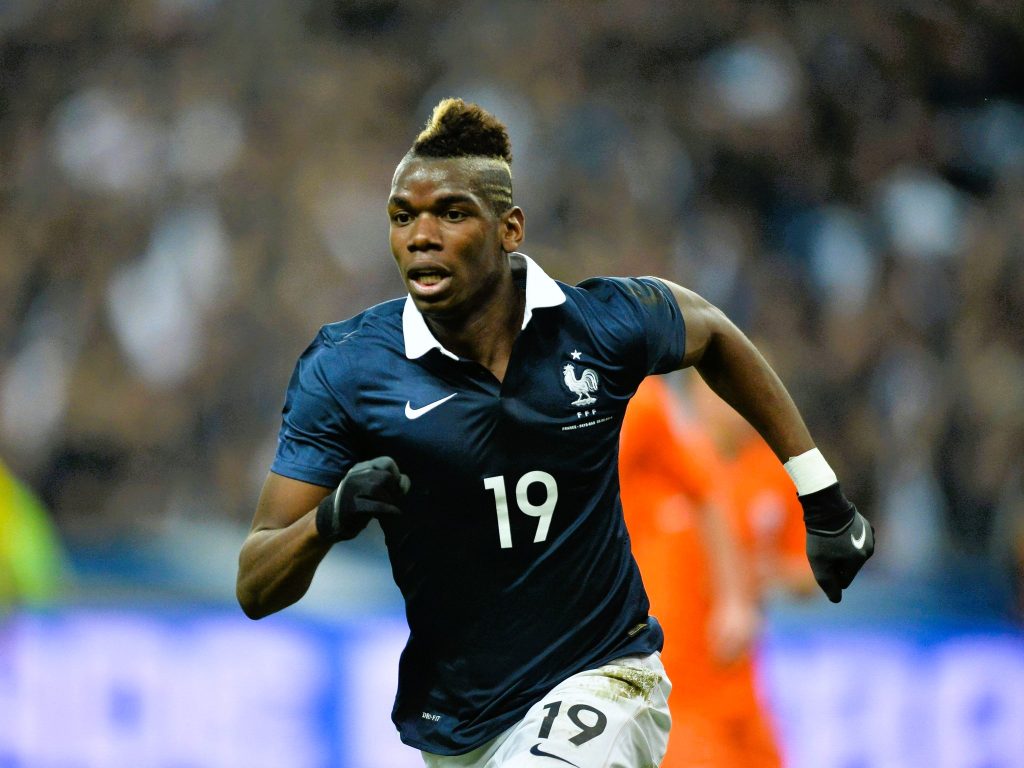
When Paul Pogba claimed the Best Young Player award at Brazil 2014, he was just 21 years of age and representing a French side that ultimately fell short of the title.
Yet within the confines of France’s campaign — which ended in a quarter-final defeat to Germany — Pogba was a commanding, physically dominant, and technically assured presence in central midfield.
Operating as a box-to-box midfielder, Pogba combined his imposing athleticism with genuine technical quality, dictating play and contributing a goal of his own in France’s group-stage dismantling of Switzerland.
His performances underscored the explosive potential that had made him one of the most sought-after young players in Europe following his early breakthrough at Juventus.
The award signalled to the world that Pogba was ready to step out of youth football’s shadow and into the elite global conversation — a transition that was eventually completed with his return to Manchester United and, later, his role in France’s 2018 World Cup triumph.
Thomas Müller (2010 – Germany)
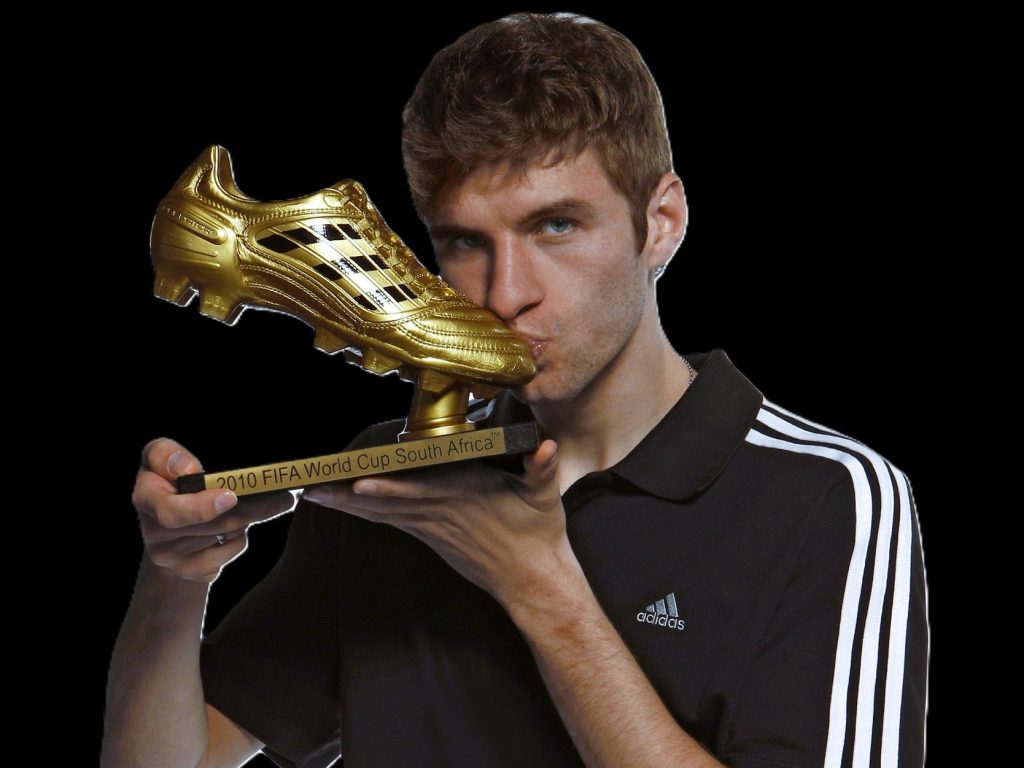
Thomas Müller’s performance at South Africa 2010 remains one of the most complete individual displays by any young player in World Cup history.
The Bayern Munich forward, aged just 20, finished the tournament as its leading scorer with five goals and three assists — a haul that earned him the prestigious Golden Boot alongside the Best Young Player honour.
He remains the only player in World Cup history to win both individual awards at the same tournament.
Müller’s unique footballing intelligence — what Germans call ‘Raumdeuter’ or ‘space interpreter’ — was on full display throughout the tournament.
He possessed an uncanny ability to drift into dangerous positions without the ball, making runs that opposition defenders consistently failed to track.
His hat-trick against England in the round of 16 was a masterclass in clinical, intelligent football.
Germany ultimately finished third, but Müller’s tournament transcended his team’s result.
He announced himself not just as one of the best young footballers in the world, but as a genuinely elite talent whose best years lay ahead — a prediction that proved entirely accurate over the following decade.
Lukas Podolski (2006 – Germany)
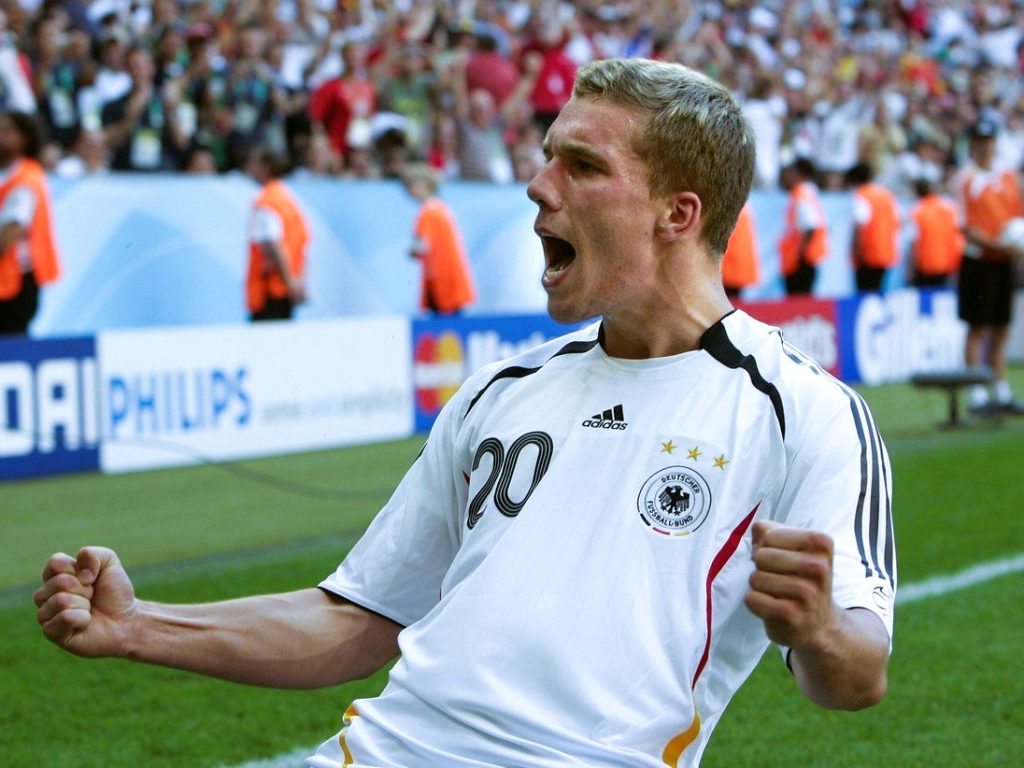
As the inaugural official recipient of the FIFA World Cup Best Young Player award, Lukas Podolski set the tone for the honour with a tournament that combined youthful energy with genuine clinical quality.
Just 21 and playing in front of his home crowd in Germany, Podolski brought flair, pace, and directness to Jürgen Klinsmann’s exciting side, scoring three goals as Germany finished third.
Podolski’s partnership with Miroslav Klose gave Germany one of the most dynamic attacking combinations at the tournament, and his left-footed finishing — powerful, accurate, seemingly effortless — made him one of the most talked-about young players on the planet.
His performances across the tournament, particularly his goals against Ecuador and Poland, demonstrated the clinical instincts that would define his long career for club and country.
In hindsight, his selection as the first ever Best Young Player World Cup winner feels entirely apt: Podolski represented everything the award was designed to celebrate — raw talent, fearlessness, and a stage-grabbing quality that made the world take notice of a new generation.
Unofficial Best Young Players Before 2006
Though the FIFA World Cup Best Young Player Award was formally introduced only in 2006, the history of the tournament is rich with young players who, had the award existed, would have been unanimous recipients.
Here we celebrate the most compelling unofficial winners in World Cup history.
Pelé (1958 – Brazil)
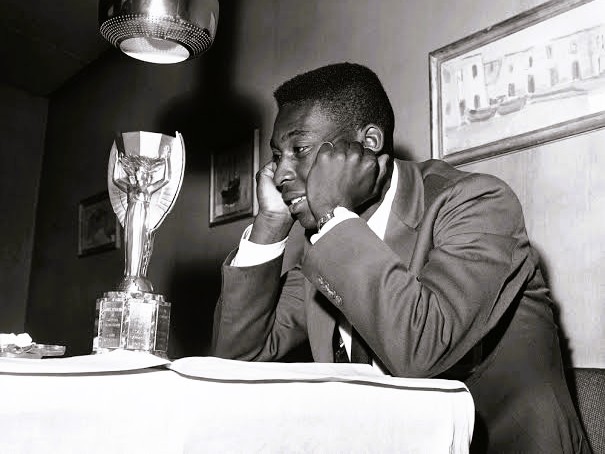
No discussion of young World Cup talent is complete without Pelé. The Brazilian forward was just 17 years old when he illuminated the 1958 tournament in Sweden — and what an illumination it was.
Pelé scored six goals in four matches, including a hat-trick in the semi-final against France and two more in a 5-2 final victory over the host nation. He became, and remains, the youngest player ever to score in a World Cup final.
His tournament was not merely statistically exceptional — it was historically unique.
No teenager before or since has dominated a World Cup with such authority, finishing the competition as one of its joint top scorers at an age when most players are still developing in youth football.
The fact that the Best Young Player Award did not exist in 1958 is one of football history’s most glaring oversights.
Michael Owen (1998 – England)
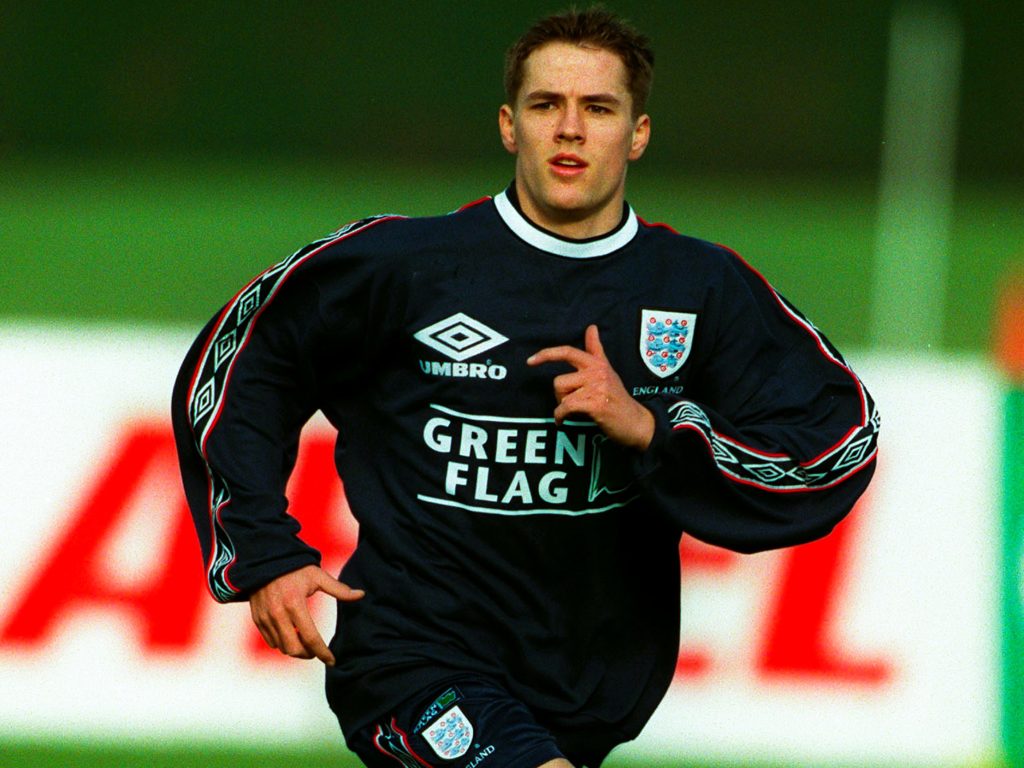
Michael Owen’s 1998 World Cup campaign in France remains one of English football’s most celebrated individual performances.
At 18 years old, the Liverpool striker burst into the tournament off the bench in England’s opening match before establishing himself as a startlingly effective starter.
His crowning moment — and one of the most memorable goals in World Cup history — came against Argentina in the round of 16.
Receiving the ball near the halfway line, Owen accelerated past Roberto Ayala and José Chamot before coolly slotting past Carlos Roa.
The goal was a statement of intent, a declaration that English football had found its next great hope.
He finished the tournament with four goals and boundless potential, and his 1998 campaign earned him the Ballon d’Or later that year — an award that serves as the strongest possible retrospective validation of his unofficial Best Young Player status
How Is the Best Young Player Selected?
The selection process for the FIFA World Cup Best Young Player Award is rigorous, expert-led, and deliberately insulated from public voting — ensuring that sporting merit, rather than popularity, determines the recipient.
Key Selection Criteria
While FIFA does not publish a precise scoring methodology, the TSG is understood to evaluate candidates across several core dimensions:
- Individual performance quality across all matches played
- Consistency of output throughout the tournament
- Influence in decisive or high-pressure matches
- Technical skill, tactical awareness, and footballing intelligence
- Ability to perform and elevate teammates on the world’s biggest stage
- Age relative to eligibility — younger winners are not inherently preferred, but precocity carries weight
Crucially, the award is not purely statistical. A midfielder who scores no goals but controls games and wins key moments can — and has — outscored prolific strikers in the TSG’s assessment.
Best Young Player vs Golden Ball vs Golden Boot
The FIFA World Cup presents three major individual player awards, each recognising a different dimension of excellence. Understanding the distinctions helps contextualise what the Best Young Player award truly represents.
Best Young Player
The age-restricted award for players 21 and under. Recognises the standout young talent of the tournament across all positions and playing styles.
The only major World Cup award with an eligibility threshold — making it unique in the FIFA awards ecosystem and the most forward-looking of the three honours.
Golden Ball
Awarded to the best overall player of the tournament regardless of age, the Golden Ball is the most prestigious individual honour at the World Cup.
Past winners include Diego Maradona (1986), Ronaldo (2002), and Lionel Messi (2014 and 2022).
Notably, Kylian Mbappé won the Golden Ball in 2022, demonstrating how a former Best Young Player can progress to claim football’s ultimate individual World Cup recognition.
Golden Boot
Presented to the tournament’s leading scorer, the Golden Boot is decided purely by goals scored, with assists used as a tiebreaker.
Thomas Müller’s dual achievement — winning both the Golden Boot and the Best Young Player award at South Africa 2010 — remains a unique piece of World Cup history, and a powerful illustration of the overlap that can occasionally exist between these awards.
Best Young Player Winners by Country
| Country | Wins | Winners (Year) |
|---|---|---|
| Germany | 3 | Franz Beckenbauer (1966), Lukas Podolski (2006), Thomas Müller (2010) |
| France | 3 | Manuel Amoros (1982), Paul Pogba (2014), Kylian Mbappé (2018) |
| Argentina | 1 | Enzo Fernández (2022) |
| USA | 1 | Landon Donovan (2002) |
| England | 1 | Michael Owen (1998) |
| Netherlands | 1 | Marc Overmars (1994) |
| Yugoslavia | 1 | Robert Prosinečki (1990) |
| Belgium | 1 | Enzo Scifo (1986) |
| Italy | 1 | Antonio Cabrini (1978) |
| Poland | 1 | Władysław Żmuda (1974) |
| Peru | 1 | Teófilo Cubillas (1970) |
| Hungary | 1 | Flórián Albert (1962) |
| Brazil | 1 | Pelé (1958) |
Who Could Win Best Young Player at World Cup 2026?
The 2026 FIFA World Cup, hosted jointly across the United States, Canada, and Mexico, promises to be the biggest in the tournament’s history — expanded to 48 teams and 104 matches. With more games comes more opportunity for young talents to shine, making the Best Young Player race potentially wider and more competitive than ever.
Top Contenders
To be eligible for the FIFA World Cup Young Player Award in 2026, a player must be 21 years old or younger on January 1, 2026. This effectively means candidates must be born on or after January 1, 2005.
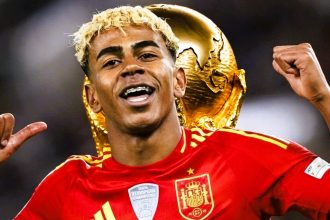
- Lamine Yamal (Spain): Widely considered the heavy favorite, the Barcelona sensation already has significant international experience and won the Young Player of the Tournament at Euro 2024.
- Endrick (Brazil): After making a high-profile move to Real Madrid, the young forward is expected to be a focal point for Brazil’s attack in 2026.
- Désiré Doué (France): The versatile PSG attacker is highlighted for his ability to handle pressure and decide matches single-handedly.
- Warren Zaïre-Emery (France): A mainstay in the PSG midfield, his physical power and tactical maturity make him a leading challenger for the award.
- Pau Cubarsí (Spain): The Barcelona center-back could become the first defender since 1982 to win the award, noted for his exceptional passing and composure.
- Estêvão (Brazil): Nicknamed “Messinho,” the Chelsea winger has shown elite goal-scoring ability and flair for both club and country.
- Nico Paz (Argentina): A creative midfielder thriving at Como (on loan from Real Madrid), he is viewed as a vital part of Argentina’s “next generation”.
Frequently Asked Questions (FAQ)
Who won Best Young Player in 2022 World Cup?
Enzo Fernández of Argentina won the FIFA World Cup Best Young Player Award at the 2022 tournament in Qatar. The then-21-year-old midfielder played a pivotal role in Argentina’s historic triumph, scoring a stunning long-range goal against Mexico and demonstrating exceptional technical quality and composure throughout the tournament.
When was the award introduced?
The FIFA World Cup Best Young Player Award was officially introduced in 2006 at the Germany World Cup, with Lukas Podolski becoming the inaugural winner. Before 2006, football historians and journalists have retrospectively identified players such as Pelé (1958), Michael Owen (1998), and Landon Donovan (2002) as unofficial holders of the spirit of the award.
What is the age limit for Best Young Player?
To be eligible for the award, players must generally be 21 years of age or under at the time of the World Cup. FIFA’s specific rule states that eligible players must be born on or after January 1 of the year that is 21 years before the start of the tournament. This strict threshold ensures the award recognises genuine youth talent.
Has anyone won both Golden Boot and Best Young Player?
Yes — Thomas Müller achieved this unique double at South Africa 2010. The German forward finished the tournament as its top scorer with five goals, winning the Golden Boot, while simultaneously earning the Best Young Player award at just 20 years of age. He remains the only player in World Cup history to have won both individual awards at the same tournament.
The Future of World Cup Rising Stars
The FIFA World Cup Best Young Player Award has, in the two decades since its official introduction, established itself as one of football’s most meaningful and prophetic individual honours.
From Lukas Podolski’s historic inauguration of the prize in 2006 to Enzo Fernández’s triumphant claim in 2022, each winner has gone on to confirm the award’s extraordinary ability to identify footballers destined for the game’s highest levels.
What makes this award truly special is its dual nature: it celebrates past achievement — the performances delivered on football’s grandest stage — while simultaneously pointing toward future greatness.
The FIFA World Cup Best Young Player winners list is not simply a record of excellent tournaments; it is a roadmap of modern football’s greatest generational talents.
As the world looks ahead to the 2026 FIFA World Cup — the largest, most ambitious tournament ever staged — the next chapter in this award’s history awaits.
Somewhere among the world’s emerging talents, a player is preparing to write their name into this list, to step onto the grandest stage in sport and announce themselves to the world.
That is the enduring magic of the FIFA World Cup Best Young Player Award, and it is why, tournament after tournament, it captures the imagination of football fans everywhere. Who will win in 2026? Drop your prediction