
The 2026 FIFA World Cup is the biggest yet — 48 teams, 12 groups, and a brand-new Round of 32 that turns the knockout phase into a high-stakes sprint to glory.
With the group draw long settled and the tournament kicking off in June, every team’s path is now locked into a fixed bracket.
Finish top of your group? Your opponent in the Round of 32 is already mapped.
Scrap in as one of the eight best third-placed teams? You slot into one of the pre-determined “best third” matchups. Here’s exactly who each team could face — and how the entire bracket unfolds.

Who Faces Who in World Cup 2026?
- Group winners usually get the softer opening: many face a best third-placed team or a runner-up from a nearby group.
- Group runners-up often clash against another runner-up right away (e.g., A2 vs B2).
- Best third-placed teams fill the remaining slots and are assigned dynamically based on which eight qualify, but the bracket has fixed “buckets” (e.g., 3rd from A/B/C/D/F).
How Opponents Are Determined in the 2026 World Cup
FIFA designed the 2026 knockout bracket with two goals: competitive balance and geographical sanity across three host nations.
The top two from each of the 12 groups (A–L) advance automatically. The eight best third-placed teams (ranked by points, goal difference, goals scored, fair play, then lots) fill the last eight spots.
To understand the full structure, see the full World Cup 2026 bracket and the detailed World Cup 2026 knockout format, which explain how teams are placed and how the bracket flows from Round of 32 to the final.
Crucially, the bracket splits into two balanced pathways to the semi-finals. The four highest-ranked teams at draw time (Spain, Argentina, France, England) were deliberately placed in opposite halves so the top seeds can only meet in the final or semis at the earliest.
More Read

Group winners are paired against either runners-up or best thirds from carefully chosen clusters, while runners-up often face tougher early matchups against similarly ranked teams.
No team can face its own group opponent again until the final. The result is a fixed bracket where every finishing position — 1st, 2nd, or 3rd — directly shapes a team’s path to glory.
Full World Cup 2026 Bracket
See the complete breakdown of every match in our full World Cup 2026 bracket guide.
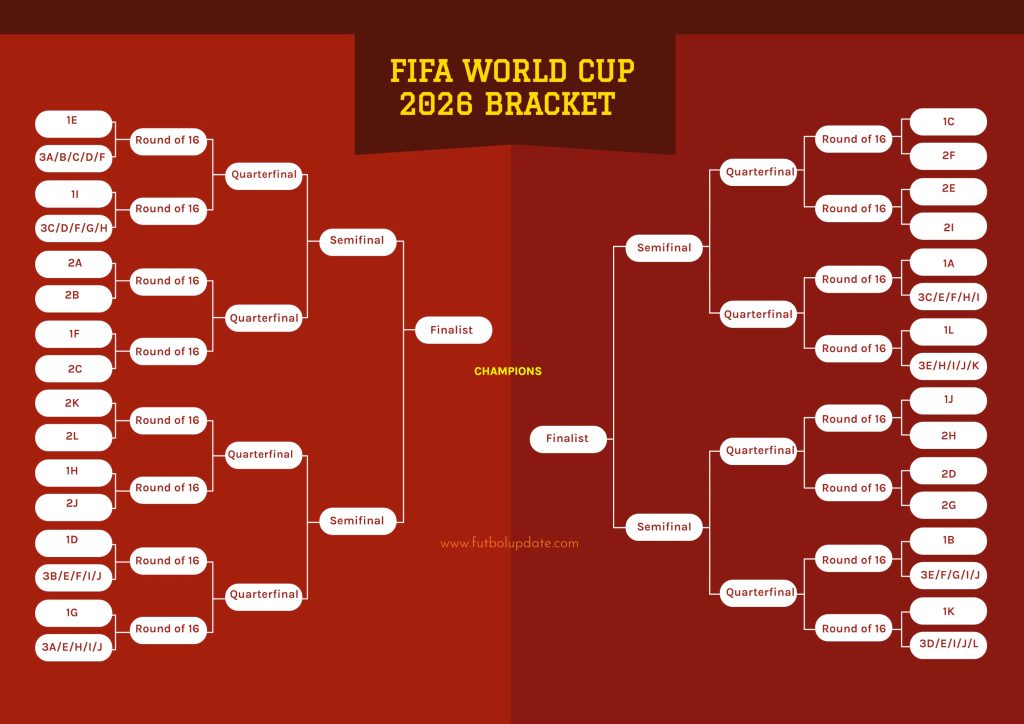
World Cup 2026 Knockout Opponents by Group
Group A Opponent Path
- 1st: Faces best 3rd from C/E/F/H/I
- 2nd: Faces B2
- 3rd (if best 8): Slots into one of four possible “best 3rd” matches (exact opponent depends on combination)
Group B Opponent Path
- 1st: Faces best 3rd from E/F/G/I/J
- 2nd: Faces A2
- 3rd: Possible slot in several best-3rd buckets
Group C Opponent Path
- 1st: Faces F2
- 2nd: Faces F1 (in Match 75)
- 3rd: Frequently feeds into I1 or A1 matches
Group D Opponent Path
- 1st: Faces best 3rd from B/E/F/I/J
- 2nd: Faces G2
- 3rd: Feeds multiple best-3rd slots
Group E Opponent Path
- 1st: Faces best 3rd from A/B/C/D/F
- 2nd: Faces I2
- 3rd: One of the most common “best 3rd” buckets
Group F Opponent Path
- 1st: Faces C2
- 2nd: Faces C1
- 3rd: Heavily used in early best-3rd assignments
Group G Opponent Path
- 1st: Faces best 3rd from A/E/H/I/J
- 2nd: Faces D2
- 3rd: Feeds several buckets
Group H Opponent Path
- 1st: Faces J2
- 2nd: Faces J1
- 3rd: Common in best-3rd pools
Group I Opponent Path
- 1st: Faces best 3rd from C/D/F/G/H
- 2nd: Faces E2
- 3rd: Frequent early opponent
Group J Opponent Path
- 1st: Faces H2
- 2nd: Faces H1
- 3rd: Multiple possible slots
Group K Opponent Path
- 1st: Faces best 3rd from D/E/I/J/L
- 2nd: Faces L2
- 3rd: Late best-3rd bucket
Group L Opponent Path
- 1st: Faces best 3rd from E/H/I/J/K
- 2nd: Faces K2
- 3rd: Late bucket
Biggest Possible Matchups Based on Bracket
Based on the official FIFA World Cup 2026 bracket and group stage draw, several high-profile matchups are either already scheduled for the group stage or potentially lined up for the early knockout rounds.
Confirmed Group Stage Matchups
- Brazil vs. Morocco (Group C): Five-time champions Brazil face 2022 semifinalists Morocco on June 13 in New Jersey.
- England vs. Croatia (Group L): A rematch of the 2018 semifinal, scheduled for June 17 in Dallas.
- France vs. Senegal (Group I): A repeat of the famous 2002 opener, set for June 16 in New Jersey.
- Norway vs. France (Group I): This match is expected to be a decisive “Group of Death” fixture, a high-stakes clash on June 26, 2026, at Foxborough, Massachusetts.
- Netherlands vs. Japan (Group F): Two tactically strong sides meet on June 14 in Dallas.
- Spain vs. Uruguay (Group H): A major clash of former world champions on June 26 in Guadalajara.
- Belgium vs. Egypt (Group G): A high-profile meeting between Kevin De Bruyne and Mohamed Salah on June 15 in Seattle.
Blockbuster Potential Knockout Clashes Fans Could See
Germany vs. France (Round Of 16)
A Round of 16 clash between Germany and France at the 2026 FIFA World Cup is a major potential matchup if both teams win their respective groups.
Matchup Conditions
- Germany’s Path: Must finish 1st in Group E (which includes Curaçao, Ivory Coast, and Ecuador) and win their Round of 32 match.
- France’s Path: Must finish 1st in Group I (alongside Senegal, Norway, and a playoff winner) and win their Round of 32 against a C/D/F/G/H best third-place team match.
- Bracket Logic: If both nations top their groups, they are on a collision course to meet in the Round of 16.
Potential Match Details
If both teams progress as group winners, the match is projected for:
- Date: Saturday, 4 July 2026
- Venue: This specific bracket path (Winner Match 74 vs. Winner Match 77) is slated at Lincoln Financial Field in Philadelphia.
Germany vs. Netherlands (Quarterfinal)
A quarterfinal matchup between Germany and the Netherlands at the 2026 FIFA World Cup is a potential outcome of the tournament bracket if one of these European giants finishes as their group winner.
Matchup Conditions
For this quarterfinal to take place, the following conditions must be met:
- Germany (Group E): Must finish 1st in Group E (which also includes Curaçao, Ivory Coast, and Ecuador) and win both their Round of 32 and Round of 16 matches.
- Netherlands (Group F): Must finish 1st in Group G (alongside Japan, Tunisia, and a playoff winner) and win their subsequent Round of 32 and Round of 16 matches.
Potential Match Details
If both teams successfully navigate their paths as described, the quarterfinal would take place in the later stages of the tournament:
- Date: Thursday, 9 July 2026.
- Venue: This specific bracket path (Winner Match 89 vs. Winner Match 90) is slated at Gillette Stadium in Boston.
Spain vs. Belgium (Quarterfinal)
A quarterfinal clash between Spain and Belgium at the 2026 FIFA World Cup is a major potential “heavyweight” matchup that could occur if both teams win their respective groups and advance through the early knockout rounds.
Matchup Conditions
For this quarterfinal to take place, the following conditions must be met:
- Spain: Must finish 1st in Group H (which also includes Uruguay, Saudi Arabia, and Cape Verde) and win both their Round of 32 and Round of 16 matches.
- Belgium: Must finish 1st in Group G (alongside Egypt, Iran, and New Zealand) and win their subsequent Round of 32 and Round of 16 matches.
- Bracket Alignment: Under this “favorites win” scenario, both teams are placed in the same quarter of the bracket (Path A), leading to a direct confrontation in the final eight.
Potential Match Details
If both teams top their groups and progress as expected, the match is projected for the following window:
- Dates: Friday, 10 July 2026
- Venue: This specific bracket path (Winner Match 93 vs. Winner Match 94) is slated at SoFi Stadium in Los Angeles.
Argentina vs. Portugal (Quarterfinal)
A quarterfinal clash between Argentina and Portugal is one of the most anticipated potential matchups of the 2026 World Cup, as it could mark the final competitive meeting between Lionel Messi and Cristiano Ronaldo.
Matchup Conditions
This “dream” quarterfinal is mathematically possible if both teams perform as follows:
- Argentina (Group J): Must finish 1st in Group J and win their Round of 32 and Round of 16 matches.
- Portugal (Group K): Must finish 1st in Group K and win their Round of 32 and Round of 16 matches.
- Bracket Logic: Under this scenario, both teams fall into the same quarter of the bracket, leading to a confrontation in Match 100.
Potential Match Details
If the conditions above are met, the match is scheduled as follows:
- Date: Saturday, July 11, 2026.
- Venue: This specific bracket path (Winner Match 93 vs. Winner Match 94) will take place at Arrowhead Stadium (GEHA Field), Kansas City, Missouri.
- Significance: This would be their first-ever meeting in a World Cup and potentially the final chapter of their two-decade rivalry.
Brazil vs. England (Quarterfinal)
A quarterfinal clash between Brazil and England is a high-probability matchup if both teams win their respective groups and successfully navigate their initial knockout rounds.
Matchup Conditions
- Brazil’s Path: Must win Group C and progress through the Round of 32 (likely against a runner-up from Group F) and the Round of 16.
- England’s Path: Must win Group L and advance through their Round of 32 (against a third-place team) and a potential Round of 16 clash, possibly against hosts Mexico.
- Bracket Alignment: Under the FIFA World Cup 2026 bracket logic, the winner of the Group C path is scheduled to meet the winner of the Group L path in the quarterfinals.
Potential Match Details
- Date: Saturday, July 11, 2026.
- Venue: Hard Rock Stadium in Miami Gardens, Florida.
- Historical Context: This would be a repeat of the iconic 2002 World Cup quarterfinal, where Brazil defeated England 2–1 on their way to winning their fifth title.
Argentina vs. Spain (The Final)
This is the most protected matchup in the tournament. As the No. 1 (Spain) and No. 2 (Argentina) seeds, they are placed on opposite sides of the bracket.
They can only meet in the Final on July 19 at MetLife Stadium, provided both win their groups and navigate their entire knockout paths.
The “Final Only” Condition
To ensure competitive balance, FIFA established two separate pathways to the semi-finals for the top four ranked teams:
- Seeding Protection: As the No. 1 (Spain) and No. 2 (Argentina) ranked teams, they were drawn into opposite sides of the bracket.
- Requirement: If both teams win their respective groups (Group H for Spain and Group J for Argentina) and continue to win their knockout matches, they are mathematically barred from meeting until the Final.
Easiest vs Hardest Knockout Paths
Based on the FIFA World Cup 2026 bracket and seedings, the knockout paths are designed to keep the highest-ranked teams apart. However, the actual difficulty depends heavily on whether favourites win their groups or finish as runners-up.
Easiest Path to the Final
Easiest early paths tend to belong to groups whose winners face the best third-placed teams (Groups A, B, D, E, G, I, K, L).
A top seed that finishes first often draws a third-placed side that may have scraped through on goal difference — a statistically softer opener than facing a group runner-up.
Hardest Path to the Final
Hardest early paths hit teams whose winners or runners-up meet other strong runners-up or winners immediately (Groups C & F swap 1st vs 2nd directly; A2 vs B2; K2 vs L2).
Finishing second in certain groups means an instant “two strong sides” matchup.
Later rounds are more balanced thanks to the two-pathway design, but the side containing Spain/Argentina is stacked with historical heavyweights, while the France/England side has its own landmines.
Which Teams Have the Best Route to the Final?
The teams with the best routes to the 2026 FIFA World Cup final are those that win their groups and land in bracket sections that delay matches against the top four global seeds: Spain (1), Argentina (2), France (3), and England (4).
FIFA’s seeding protection ensures these four nations are placed in separate quarters and opposite halves of the bracket, meaning they cannot meet until the semifinals if they all win their respective groups
Top Seeds with Favorable Paths
Spain national football team → most balanced path
Currently projected to have the least daunting path to the final. By winning Group H, they are scheduled to face a runner-up from Group J in the Round of 32. Their theoretical path through the quarterfinals could feature teams like Austria, Croatia, or Belgium, avoiding the other top three seeds until at least the semifinals.
Argentina national football team → toughest route
As the No. 2 seed, Argentina is placed on the opposite side of the bracket from Spain. If they win Group J, they face a runner-up from Group H in the Round of 32. Their “best” route involves a path where they avoid France and Spain until the final, though they may face a high-profile quarterfinal against Portugal.
Germany national football team → controlled bracket side
Germany’s route is considered strong due to their group placement alongside lower-ranked nations like Curaçao and Ecuador. Winning Group E provides a Round of 32 matchup against a third-place team (from Groups A/E/H/I/J).
What Happens If Teams Finish 1st, 2nd or 3rd?
- 1st place: Best scenario for most groups. You usually open against the best third-placed team or the runner-up from a weaker cluster. You also stay on the “winner” side of your mini-bracket, often avoiding the toughest runners-up until later.
- 2nd place: Tougher opener — you frequently face another runner-up straight away (A2 vs B2, for example). Your path can still lead to the final, but you’re on the “chaser” side and may meet a group winner sooner.
- 3rd place (best eight only): Highest risk, highest reward. You enter the bracket in a pre-assigned slot against a group winner. Miss the top-eight third-placed ranking by a single goal and you’re out. Make it and you get a shot at glory — but you’re immediately playing catch-up.
Predict Your Team’s Path to the Final
- Check your group and predicted finish (1st, 2nd or 3rd).
- Look up the exact Round of 32 matchup above.
- Trace the winner of that match through the Round of 16, quarters and semis using the bracket map.
- Factor in the two pathways — if your team is on the Spain/Argentina side or the France/England side, you know exactly when the other giants could appear.
Want to simulate? Pick your finish, assume the most likely third-placed combination, and follow the chain. One result changes everything.
FAQs World Cup 2026: Who Faces Who?
Can a third-placed team win the World Cup?
Yes — the bracket treats them identically once they qualify. History shows underdogs thrive in single-elimination.
Do group winners always have an easier route?
Not always, but statistically yes in the Round of 32. Later rounds depend on who else advances.
When do the top seeds (Spain, Argentina, France, England) meet?
Only in the semi-finals or final if they all win their groups — by design.
What if two teams from the same group both advance as 1st and 2nd?
They are placed on opposite sides of the full bracket and cannot meet again until the final.
Are venues fixed or could they change?
Venues and dates are locked. Every possible matchup already has its stadium assigned.
Who does Group A winner face in World Cup 2026?
The winner of Group A faces the best third-placed team from Groups C, E, F, H, or I in the Round of 32.
Is the World Cup 2026 bracket fixed?
Yes — the entire knockout bracket for the 2026 FIFA World Cup is completely fixed and predetermined.
The 2026 World Cup knockout stage is set. Now it’s up to the teams to write the story. Who’s your pick to navigate the bracket all the way to MetLife?