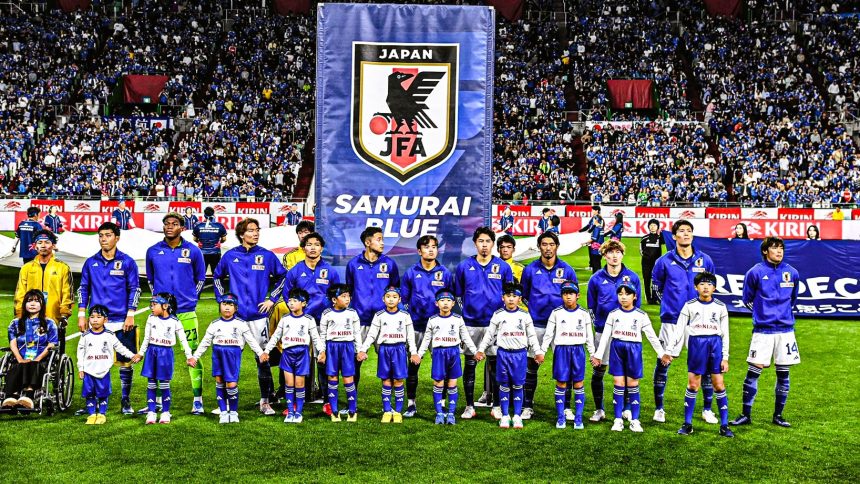
When the 2026 FIFA World Cup kicks off across North America, the Japan national football team will once again carry the expectations of an entire continent.
For decades, the Samurai Blue have been Asia’s benchmark at the global level—consistent qualifiers, tactically disciplined, and increasingly capable of challenging football’s traditional powers.
The biggest question surrounding Japan has never been qualification, but rather their ultimate ceiling. How far can they truly go on the world stage?
At the 2022 FIFA World Cup, Japan sent a powerful message by defeating both the Germany and Spain national football teams in the group stage, proving they can compete with the sport’s elite.
That campaign ended in the Round of 16, but it reinforced the belief that Japan is capable of something even bigger.
Guided by head coach Hajime Moriyasu and powered by stars such as Kaoru Mitoma, Takefusa Kubo, and Wataru Endo, the Samurai Blue arrive in 2026 aiming to break new ground.
With a squad filled with players competing in Europe’s top leagues, reaching the quarterfinals—or even beyond—is now a realistic ambition.
This guide explores Japan’s possible journey through the tournament, from the group stage to a potential appearance in the final at MetLife Stadium, analyzing their likely opponents and the most realistic routes to World Cup glory.
When Does Japan’s 2026 FIFA World Cup Journey Begin?
Japan’s campaign at the 2026 FIFA World Cup officially begins on Sunday, June 14, 2026, when the Samurai Blue take the field at AT&T Stadium in Arlington, Texas.
After their opening match in the United States, Japan will travel south to Mexico for their second group-stage fixture at Estadio BBVA in Monterrey on June 20.
The match will also mark a historic milestone as the 1,000th game in FIFA World Cup history.
Japan will then return to Arlington to conclude their group-stage campaign on June 25, once again playing at AT&T Stadium as they look to secure a place in the knockout stage.
Japan’s Group Opponents
Japan have been drawn in Group F of the 2026 FIFA World Cup, alongside the Netherlands, Tunisia, and Sweden.
The Samurai Blue will play across venues in the United States and Mexico as they aim to reach the knockout stage for a third consecutive tournament.
Netherlands
As the top seed in Group F, the Dutch represent Japan’s toughest challenge. The two sides last met at the 2010 FIFA World Cup, where the Netherlands secured a narrow 1–0 victory.
Japan will be eager to improve their head-to-head record, which currently stands at one draw and two defeats.
Tunisia
This fixture carries historical significance as it is set to become the 1,000th match in FIFA World Cup history. Japan enter the contest with confidence after defeating Tunisia 2–0 in their most recent meeting during the 2023 Kirin Challenge Cup.
Sweden
Japan faces a formidable challenge in Group F, with Sweden standing out as a disciplined and physically imposing opponent.
Led by manager Graham Potter, the Swedish side has transitioned into a more dynamic attacking threat, spearheaded by one of Europe’s most prolific strikers, Viktor Gyökeres.
Japan Group Stage Schedule
Competing in Group F, “Samurai Blue” will play at various venues in the United States and Mexico.
| Date (2026) | Opponent | Venue | Time (Local) |
|---|---|---|---|
| June 14 | Netherlands | AT&T Stadium | 3:00 p.m. |
| June 20 | Tunisia | Estadio BBVA | 9:00 p.m. |
| June 25 | Sweden | AT&T Stadium | 8:00 p.m. |
Japan Group Standings
The table below reflects the group standings before kickoff and will be updated after each matchday.
| Pos | Team | MP | W | D | L | GD | Pts |
|---|---|---|---|---|---|---|---|
| 1 | Netherlands | 0 | 0 | 0 | 0 | 0 | 0 |
| 2 | Japan | 0 | 0 | 0 | 0 | 0 | 0 |
| 3 | Tunisia | 0 | 0 | 0 | 0 | 0 | 0 |
| 4 | Sweden | 0 | 0 | 0 | 0 | 0 | 0 |
You may also like:
- Portugal’s Road to the 2026 FIFA World Cup Final
- USA’s Road to the 2026 World Cup Final
- England’s Road to the 2026 FIFA World Cup Final
How Japan Qualifies for the Knockout Stage
To reach the knockout rounds of the 2026 FIFA World Cup, Japan must navigate the tournament’s expanded 48-team format, which now includes a newly introduced Round of 32.
With 12 groups of four teams, the Samurai Blue have multiple routes to progress from Group F.
The most direct path is finishing among the top two teams in the group. If Japan secures either first or second place after their matches against the Netherlands national football team, the Tunisia national football team and the UEFA Playoff Path B winner, they will automatically qualify for the Round of 32.
However, finishing third could still be enough to advance. Under the updated format, the eight best third-placed teams across the 12 groups will also progress to the knockout stage.
These teams are ranked based on:
- Total points
- Goal difference
- Goals scored
- Disciplinary (fair-play) points
With 32 of the 48 teams advancing, Japan simply needs to avoid finishing among the bottom 16 sides in the group stage to remain in contention.
Once in the knockout rounds, the tournament switches to a single-elimination format. If a match is tied after 90 minutes, it proceeds to 30 minutes of extra time, followed by a penalty shootout if the score remains level, determining which team advances to the next round.
Japan Potential Knockout Stage Path
Japan’s potential route through the knockout rounds of the 2026 FIFA World Cup is closely linked to the outcome of Group C, which features the Brazil national football team, Morocco national football team, Scotland national football team and Haiti national football team.
Since Groups F and C are paired in the Round of 32, Japan’s opponent and travel schedule will depend entirely on their final position in the group standings.
As Group F Winners: If the Samurai Blue finish first in Group F, they will face the runner-up from Group C.
This route could help Japan avoid an early showdown with Brazil, although it would likely require travel to Mexico following their group-stage matches in Texas.
As Group F Runners-Up: If Japan end the group stage as runner-up, they would face the winner of Group C.
This path could be considerably tougher if Brazil top the group, but it may offer logistical advantages due to closer travel distances from their base in Dallas.
As a Best Third-Placed Team: Should Japan qualify as one of the eight best third-placed teams, their knockout route becomes far less predictable.
In most scenarios, they would be paired with a group winner, making the Round of 32 a particularly difficult challenge.
Under the tournament’s expanded format, the Samurai Blue would need to win five consecutive knockout matches—from the Round of 32 through to the final—to lift the World Cup trophy.
Japan as Group Winner
If Japan secures top spot in Group F, they will follow a knockout stage path that is generally considered more favorable.
If the “Samurai Blue” finish as the winner of Group F, they will advance to the Round of 32 to face the runner-up of Group C.
This knockout match, designated as Match 75, will take place on Monday, June 29, 2026, at the Estadio BBVA in Guadalupe, Mexico.
Winning the group also sets up a possible return to a familiar venue for the later rounds.
If Japan advances past the Round of 32, their Round of 16 match will take place at NRG Stadium in North Texas on July 4, 2026.
Having already played two group-stage matches at this stadium, the team will benefit from “home-field” familiarity and reduced travel stress during the most intense part of the tournament.
The Group F winner travels to the West Coast for the quarterfinals, which will be played at Gillette Stadium in Boston on July 9, 2026.
This side of the bracket could potentially keep several top-seeded favorites on the opposite side until the later rounds, giving Japan a realistic opportunity to reach the tournament’s final four.
| Round | Date (2026) | Potential Opponent | Venue |
|---|---|---|---|
| Round of 32 | June 29 | Runner-up of Group C | Estadio Monterrey |
| Round of 16 | July 4 | Winner of Group A runners-up vs. Group B runners-up | NRG Stadium |
| Quarterfinals | July 9 | Winner Match 89 | Gillette Stadium |
| Semifinals | July 14 | Winner Match 98 | AT&T Stadium |
| Final | July 19 | TBD | MetLife Stadium |
Japan as Group Runner-Up
If Japan finishes as runners-up in Group F, their knockout campaign at the 2026 FIFA World Cup will begin with a challenging Round of 32 clash against the winner of Group C.
Under the expanded 48-team tournament structure, they will advance to a high-stakes Round of 32 matchup against the winner of Group C. The match, designated as Match 76, is scheduled for Monday, June 29, 2026, at Houston Stadium (NRG Stadium) in Texas.
Potential opponents in Group C include five-time world champions Brazil, or potentially Morocco or Scotland.
This route is logistically convenient as it puts the “Samurai Blue” in the same region as their group-stage hub in Dallas.
If Japan emerges victorious in Houston, their journey continues through to the Round of 16 on Sunday, July 5, 2026. This match (Match 91) will see them travel to New York’s New Jersey Stadium (MetLife Stadium).
A path beyond the Round of 16 will see Japan advance to the quarterfinals at Miami Stadium (Hard Rock Stadium) on July 11, 2026.
This path is heavily focused on the Eastern and Southern United States, requiring the team to maintain a high level of performance against top-seeded giants in each round.
| Round | Date (2026) | Potential Opponent | Venue |
|---|---|---|---|
| Round of 32 | June 29 | Winner of Group C | NRG Stadium |
| Round of 16 | July 5 | Winner of Group E runners up vs Group I runners-up | MetLife Stadium |
| Quarterfinals | July 11 | Winner Match 92 | Hard Rock Stadium |
| Semifinals | July 15 | Winner Match 100 | Mercedes-Benz Stadium |
| Final | July 19 | TBD | MetLife Stadium |
Japan as Best Third-Placed Team
If Japan finishes third in Group F at the 2026 FIFA World Cup, they could still advance to the Round of 32 as one of the tournament’s eight best third-placed teams..
Under the expanded 48-team format, the third-place finisher from Group F would qualify if they finished in the top eight of all 12 groups.
This path is the most unpredictable, as Japan’s specific opponents and placement depend on which other third-place teams advance, creating a “bracket lookup” scenario.
According to the official FIFA bracket, the third-place finisher from Group F is scheduled to face the winner of Group A, Group B, Group D, Group E, or Group I.
These matches are scheduled to take place in prime locations such as Mexico City, Vancouver, Boston, the San Francisco Bay Area, or New Jersey in late June.
To secure this “best third-place” status, Japan’s goal difference and disciplinary record will be crucial.
FIFA ranks all twelve third-placed teams in a single table based on points, goal difference, goals scored and fair-play points, with only the top eight advancing to the knockout stage.
This route is likely the most difficult, as it will likely pit the “Samurai Blue” against the top-seeded giants in the first elimination round.
Furthermore, it could involve significant travel, potentially moving the team from their base in Texas and Mexico to the Pacific Northwest or East Coast in a matter of days.
That would require five consecutive upset victories to reach the final on July 19, 2026.
| Scenario | Date (2026) | Potential Opponent | Venue |
|---|---|---|---|
| Winner Group E | June 29 | Potential opponent such as Germany | Gillette Stadium |
| Winner Group A | June 30 | Potential opponent such as Mexico | Estadio Azteca |
| Winner Group I | June 30 | Potential opponent such as France | MetLife Stadium |
| Winner Group D | July 1 | Potential opponent such as USA | Levi’s Stadium |
| Winner Group B | July 2 | Potential opponent such as Canada | BC Place |
Japan’s Best Route to the 2026 FIFA World Cup Final
Japan’s most strategic path to the 2026 FIFA World Cup finals begins with winning Group F, which would allow the “Samurai Blues” to secure a more favorable bracket and avoid a premature clash with the tournament favorites.
As first-place finisher, Japan would advance to the Round of 32 in Monterrey, Mexico on June 29, 2026.
This path is ideal because it pits them against the Group C runner-up (likely Morocco or Scotland) rather than the group winner, which would give them a statistically superior chance of reaching the later stages.
The logistical advantages of winning the group are crucial to maintaining player fitness. A first-place finish sets up a trip to the Round of 16 (July 4) and Boston for the quarterfinals (July 9).
This path would see the team play primarily in the southern and eastern United States, returning to their group-stage hub in Dallas for the semifinals on July 14.
For a team that relies on high-pressure intensity and tactical discipline over the course of a seven-game tournament, reducing cross-continental travel fatigue is essential.
In contrast, qualifying as the runner-up or the best third-place team presents immediate high-stakes scenarios.
Finishing second in Group F would immediately and challengingly set up a Round of 32 match against Group C winners – historically five-time champions Brazil – in Houston.
Meanwhile, finishing third could be a “David vs. Goliath” match against Mexico at the high-altitude Estadio Azteca or in France in New Jersey.
For Japan, securing top spot in Group F would be the most effective way to manage the quality and physical demands of their opponents on the long road to the final in New York, New Jersey.