








From Geoff Hurst’s immortal hat-trick on a July afternoon at Wembley in 1966 to Harry Kane’s golden boot heroics in Russia, England’s FIFA World Cup goalscorers have written some of the most dramatic chapters in football tournament history.
The Three Lions have participated in the world’s biggest football tournament since 1950, producing a lineage of legendary strikers and midfield icons whose World Cup goals have defined careers, sparked national celebrations, and cemented football legacies that endure across generations.
The FIFA World Cup is where football legends are made — where individual brilliance is amplified on the grandest possible stage.
For England supporters, the names Lineker, Hurst, Owen, and Kane carry a near-mythological weight.
These are the men who delivered when the entire footballing world was watching, who rose in knockout football when the pressure was at its most suffocating.
Understanding England’s all-time World Cup scoring records not only celebrates those who came before but also frames what Harry Kane could achieve at the 2026 FIFA World Cup.
A tournament where England’s attacking depth looks more dangerous than at any point since their solitary World Cup triumph sixty years ago.
This article ranks and profiles every notable England World Cup top scorer, from the earliest heroes of the postwar era right through to the modern generation of Bukayo Saka, Marcus Rashford, and the captain who could rewrite England football history in North America.


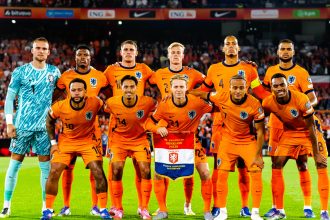
Who Has Scored the Most Goals for England at the FIFA World Cup?
The question of England’s greatest World Cup scorer has defined one of football’s most enduring debates for decades — and right now, the answer is changing in real time.
For nearly four decades, Gary Lineker has held the record as England’s all-time leading FIFA World Cup scorer with 10 goals across the 1986 and 1990 tournaments.
His performance at Mexico 1986 was one of the great individual World Cup campaigns of the 20th century.
Lineker scored six goals in a single tournament, claiming the World Cup Golden Boot and cementing himself as one of the most clinical finishers the game has ever produced.
His ability to ghost into the right position, his razor-sharp movement in the penalty area, and his composure under pressure made him almost impossible to defend against at the highest level of international football.
Lineker’s record has stood as an England football benchmark for so long that it seemed unassailable. No player in a white England shirt came particularly close — until Kane arrived.
Harry Kane enters the 2026 FIFA World Cup with 8 World Cup goals to his name, leaving him just two behind Lineker’s all-time England record.
Kane has already won a FIFA World Cup Golden Boot of his own, netting six times in Russia at the 2018 tournament — an achievement that immediately placed him in the elite tier of England World Cup scorers.
His two goals at Qatar 2022 further extended his tally, even though that tournament ended in heartbreak with England’s quarterfinal defeat.
Kane will captain England in 2026 at the age of 32 — still very much in the prime of a centre-forward’s scoring years, particularly one who has shown the technical evolution, strength, and positional intelligence of the Bayern Munich striker.
Two goals would see him draw level with Lineker; three would give England a new all-time FIFA World Cup top scorer.
The football world will be watching closely every time Kane steps into an opposition penalty area.
England Players with the Most World Cup Goals
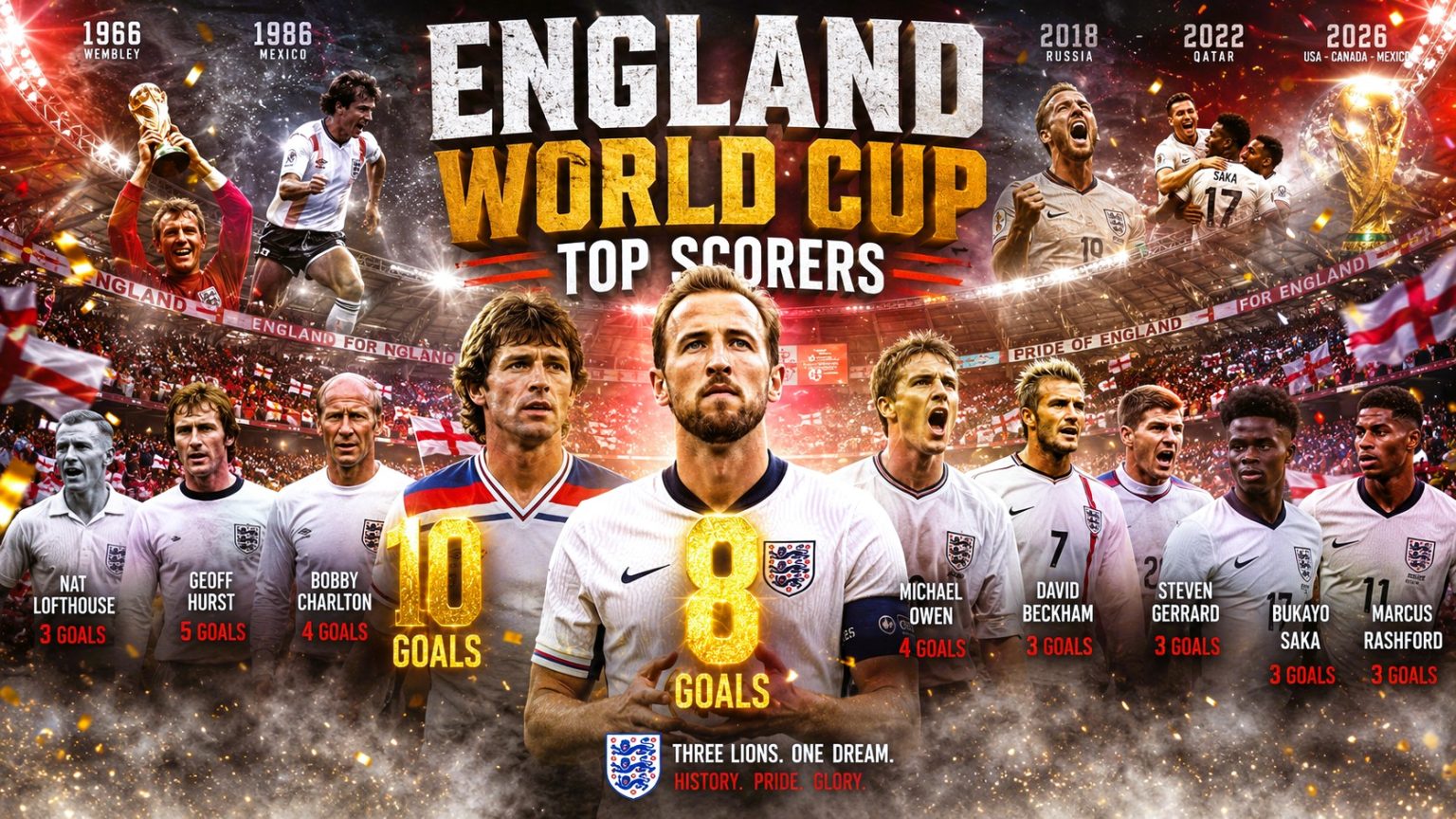
The following table reflects England’s all-time World Cup scoring leaders, based on FIFA World Cup finals matches only. Qualifying goals are excluded.
Players marked with an asterisk have the opportunity to extend their tallies at the 2026 FIFA World Cup in the United States, Canada, and Mexico.
| Rank | Player | Goals | World Cups | Years |
| 1 | Gary Lineker | 10 | 2 | 1986, 1990 |
| 2 | Harry Kane | 8 | 2 (+2026) | 2018, 2022 |
| 3 | Geoff Hurst | 5 | 1 | 1966 |
| 4= | Michael Owen | 4 | 3 | 1998, 2002, 2006 |
| 4= | Bobby Charlton | 4 | 4 | 1958, 1962, 1966, 1970 |
| 6= | Nat Lofthouse | 3 | 1 | 1954 |
| 6= | Bukayo Saka* | 3 | 1 (+2026) | 2022 |
| 6= | Roger Hunt | 3 | 1 | 1966 |
| 6= | David Platt | 3 | 2 | 1990, 1998 |
| 6= | Marcus Rashford* | 3 | 2 (+2026) | 2018, 2022 |
| 6= | Steven Gerrard | 3 | 3 | 2006, 2010, 2014 |
| 6= | David Beckham | 3 | 3 | 1998, 2002, 2006 |
Statistics include FIFA World Cup finals matches only, excluding qualifiers. Harry Kane, Bukayo Saka, and Marcus Rashford are eligible to add to their totals at the 2026 FIFA World Cup.
Top England World Cup Goalscorers Ranked
1. Gary Lineker — England’s Greatest World Cup Scorer
Ask any football historian to name the greatest England World Cup striker of all time and the answer, at least for now, remains Gary Lineker.
His record of 10 World Cup goals across two tournaments is one of the most impressive individual scoring achievements in Three Lions history, forged in the furnace of two of football’s most dramatic tournaments.
Lineker’s defining moment came in Mexico in 1986. Against a backdrop of extraordinary footballing theatre — including a certain Maradona-inspired Argentina — the Leicester-born striker carved his name into World Cup folklore by winning the Golden Boot with six goals.
He scored against Poland, Paraguay, and Argentina in a campaign that showcased every facet of his attacking game: his explosiveness off the mark, his precision in front of goal, and his near-invisible positioning that created space other strikers could only dream of.
England bowed out in the quarterfinals, but Lineker had made his mark on the tournament forever.
At Italia 90, he added four more goals, including a composed penalty in a semifinal shootout against West Germany that remains one of Wembley-era England football’s most emotionally charged moments.
His tournament total of 10 stands as the benchmark every England attacker since has been measured against — and only Kane has come close to threatening it.
Lineker’s legacy also extends beyond the numbers. He was a true World Cup legend who played the game with intelligence and integrity, a forward whose technical quality and reading of the game placed him alongside the finest strikers of his generation globally, not just in England.
2. Harry Kane — England’s Modern World Cup King
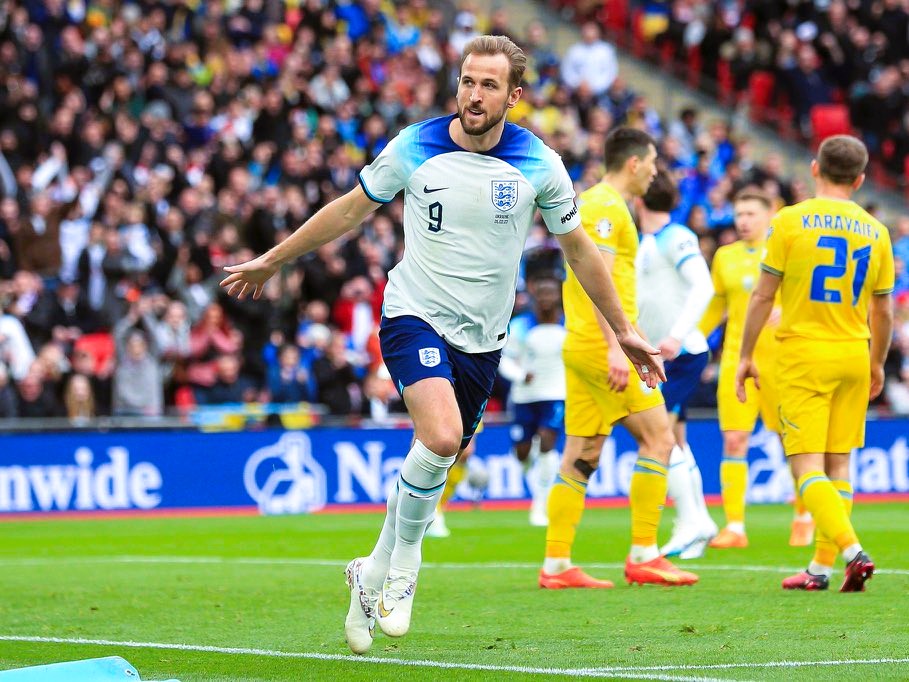
There is a compelling argument that Harry Kane is already the greatest England captain of his generation, and should he add to his eight World Cup goals in 2026, the case for him surpassing Lineker as England’s greatest World Cup player will be virtually unanswerable.
Kane’s World Cup story began in Russia in 2018. England went into the tournament with cautious expectations, but Kane turned it into a personal statement of the very highest order.
He scored six goals — including a hat-trick against Panama — to claim the 2018 World Cup Golden Boot, becoming only the second England player ever to win the award.
The goals were a masterclass in modern centre-forward play: powerful headers, penalties struck with ice-cold precision, clinical finishes from inside the area.
Kane did not just score goals in Russia; he carried England on his shoulders through every match.
At Qatar 2022, Kane added two more goals, though his penalty miss in the quarterfinal against France remains one of the most painful moments in recent England football history.
The heartbreak of that moment has, if anything, hardened his resolve. Those who know Kane best speak of a player driven by redemption, by the desire to complete the story — and 2026 represents the final, greatest chapter.
Kane arrives at the 2026 tournament as Bayern Munich’s leading scorer, a serial Bundesliga goals record-breaker, and arguably the most complete centre-forward in world football at his best.
His combination of aerial threat, technical ability, link-up play, and relentless goalscoring make him uniquely equipped to break Lineker’s record on the biggest stage.
Two goals in 2026. That is all England’s captain needs to become his country’s greatest World Cup scorer of all time.
3. Geoff Hurst — The Hero of 1966
No discussion of England’s World Cup goals history is complete without the full, magnificent story of Geoff Hurst — the man whose name is synonymous with the greatest moment in English football.
On 30 July 1966, at a packed Wembley Stadium, Hurst scored three goals in the World Cup final, a feat that has never been replicated in the history of the tournament.
His hat-trick against West Germany — including the famous shot that may or may not have crossed the line, and his emphatic late strike that prompted Kenneth Wolstenholme’s legendary commentary — gave England a 4-2 victory and their only FIFA World Cup title.
Those five World Cup goals in total (he also scored in the quarterfinal against Argentina) earned Hurst a place among the immortals of international football history, a place he will never vacate.
Hurst was not simply a beneficiary of England’s 1966 triumph. He was one of its architects — a physically imposing, technically astute centre-forward who held the ball up, brought teammates into play, and delivered when it mattered most.
England football legends rarely get a fairer definition than Geoff Hurst, hero of the World Cup final.
“They think it’s all over — it is now.” Four words that capture an entire nation’s greatest football moment, and they belong to Geoff Hurst.
4. Michael Owen — England’s Teenage Superstar
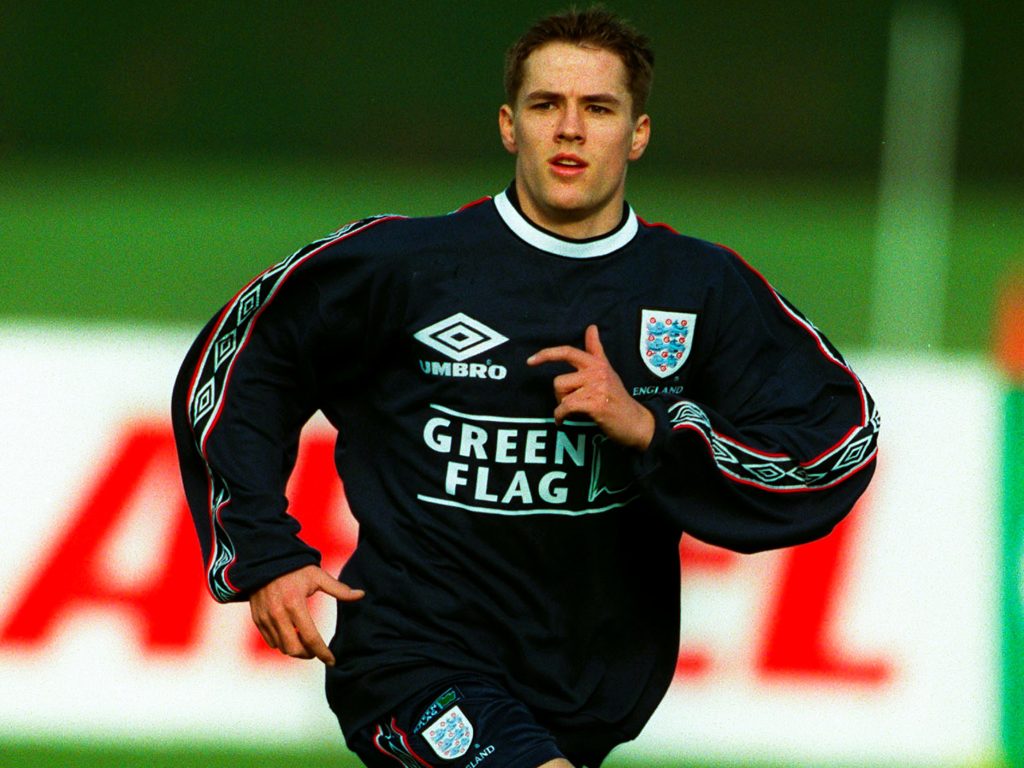
Michael Owen’s place in World Cup folklore was secured in a single, breathtaking moment on a June evening in Saint-Étienne in 1998.
At just 18 years old, Owen received the ball thirty yards from goal, burst past two Argentine defenders with the kind of terrifying acceleration that belonged to a different dimension of pace, and drilled a finish into the top corner of Carlos Roa’s net that left an entire stadium — and a watching world — completely speechless.
It was arguably the greatest individual goal ever scored by an England player at a World Cup.
In one moment, Owen announced himself as one of international football’s most exciting young talents and delivered what has become one of the most replayed goals in the history of the tournament.
England would ultimately lose that match on penalties, but Owen had provided a moment of pure footballing genius that transcends the result.
Over three World Cup tournaments (1998, 2002, 2006), Owen accumulated four goals for England at FIFA finals, though injuries and a gradual decline in pace meant he never quite recaptured that 1998 magic.
But the legacy of that Argentina goal ensures Michael Owen will forever be considered one of the greatest England players in World Cup history.
5. Bobby Charlton — England’s Midfield Genius
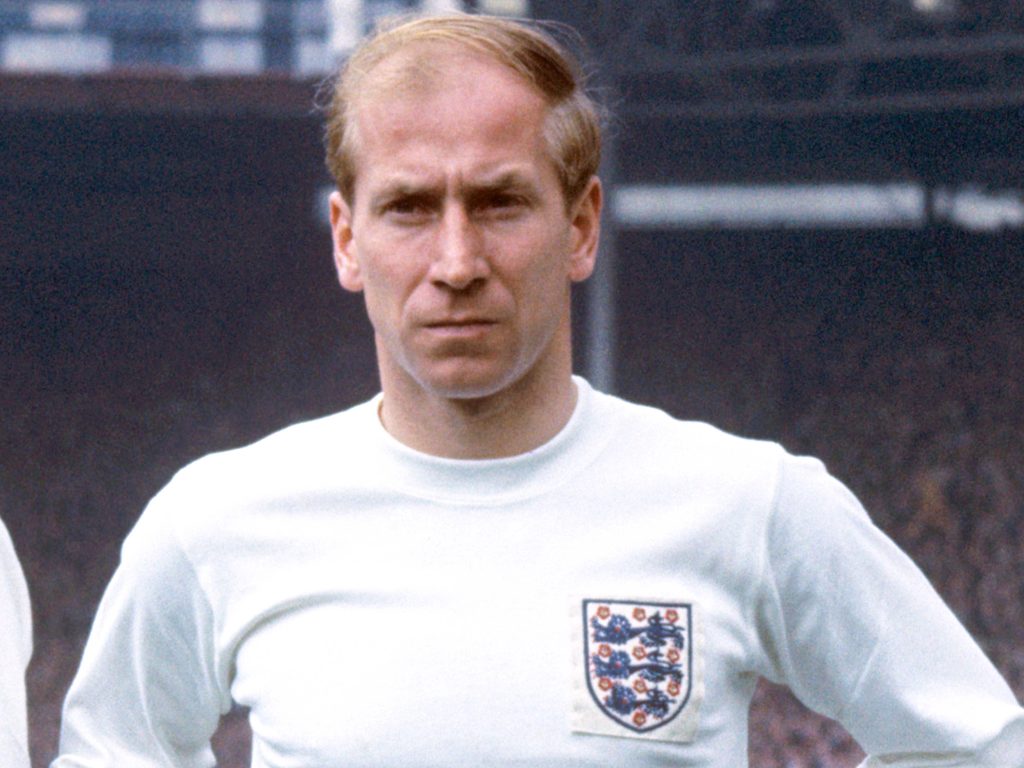
If Geoff Hurst was the hero of 1966, then Bobby Charlton was its soul.
The Manchester United midfielder — Ballon d’Or winner, European Cup champion, and one of the most technically gifted English footballers of any generation — brought grace, power, and leadership to four consecutive World Cup campaigns spanning 1958 to 1970.
His four World Cup goals barely reflect the full scope of his contribution.
Charlton was the engine of Alf Ramsey’s 1966 side, a player whose thunderous long-range shooting, precise passing, and tireless running gave England control in midfield that allowed their attack to flourish.
He scored both goals in the semifinal victory over Portugal in 1966, making him arguably the decisive player in England’s route to the final.
Charlton’s World Cup record stands as a reminder that England’s football legends are not always defined purely by goals.
His four goals across four tournaments tell only part of the story of a player who remains one of the greatest to have ever worn an England shirt.
6. Nat Lofthouse — England’s Early World Cup Hero
Long before the televised, global spectacle of the modern World Cup era, Nat Lofthouse was delivering for England on football’s biggest stage.
“The Lion of Vienna” — a nickname earned through an extraordinary individual goal for England against Austria — scored three goals at the 1954 FIFA World Cup in Switzerland, establishing himself as one of England’s earliest international football scoring heroes.
Lofthouse was the archetypal English centre-forward of his era: powerful, brave, physically dominant, and virtually impossible to knock off the ball.
His contribution to England’s early World Cup history is sometimes overlooked in the modern conversation, but his three goals in Switzerland represent a milestone achievement in England’s FIFA World Cup records.
7. Bukayo Saka — England’s New Generation Star
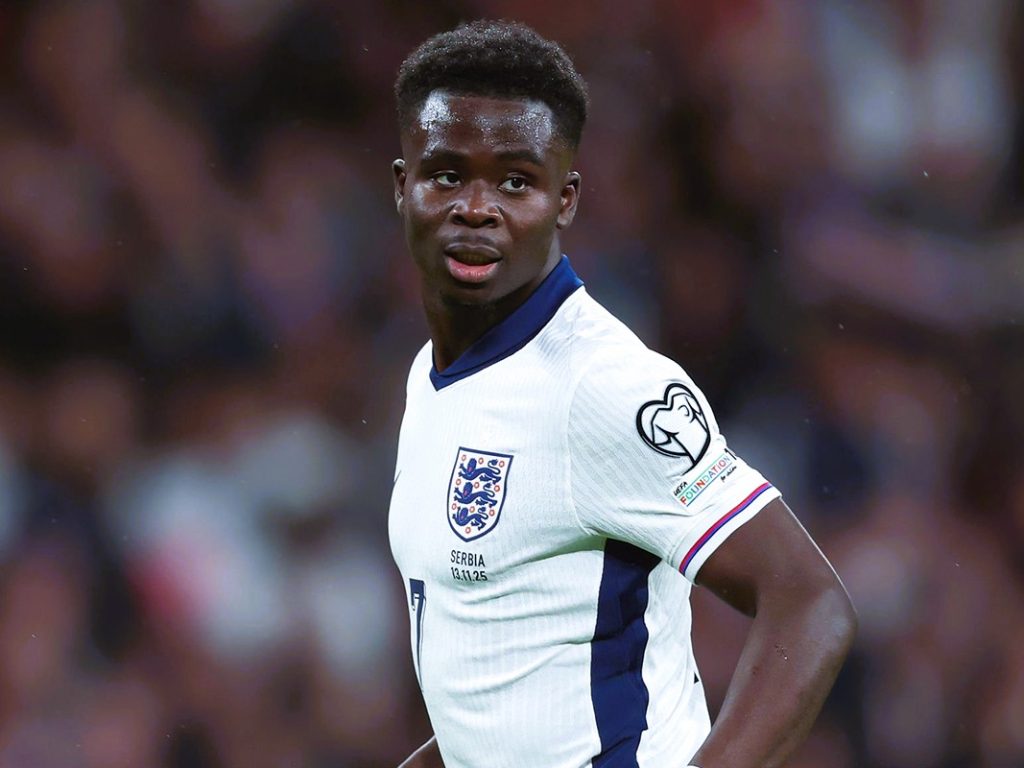
Of all the names on this list, Bukayo Saka may be the one with the most exciting future ahead of him.
The Arsenal winger arrived at Qatar 2022 as one of England’s brightest talents and delivered on every expectation, scoring three World Cup goals in a campaign that included spectacular strikes against Senegal and Iran.
Saka will be only 24 years old at the 2026 World Cup — in the prime of a wide forward’s most productive years — and has already demonstrated the composure, technique, and big-game temperament to succeed on the tournament’s grandest stage.
He is one of the most electrifying attackers in world football, a player whose directness, creativity, and eye for goal give England a dimension that their most successful tournament sides have always possessed.
If Saka adds to his three goals in 2026, he will begin making a serious claim on England’s all-time World Cup scoring charts. He is, quite possibly, the future of this list.
8. Roger Hunt — The Forgotten 1966 Hero
History has been perhaps unkind to Roger Hunt, whose three goals at the 1966 World Cup helped England lift the Jules Rimet Trophy.
The Liverpool striker was an integral part of Alf Ramsey’s World Cup-winning squad, combining effectively with Hurst and providing some of the goalscoring threat that Geoff Hurst’s hat-trick occasionally overshadows in the collective memory.
Hunt was an intelligent, industrious forward whose tireless work rate and reliable finishing made him one of the best strikers in English football during the mid-1960s.
His contribution to England’s greatest football moment should not be minimised simply because another teammate wrote the most dramatic chapter of that final.
9. David Platt — Italia 90 Specialist
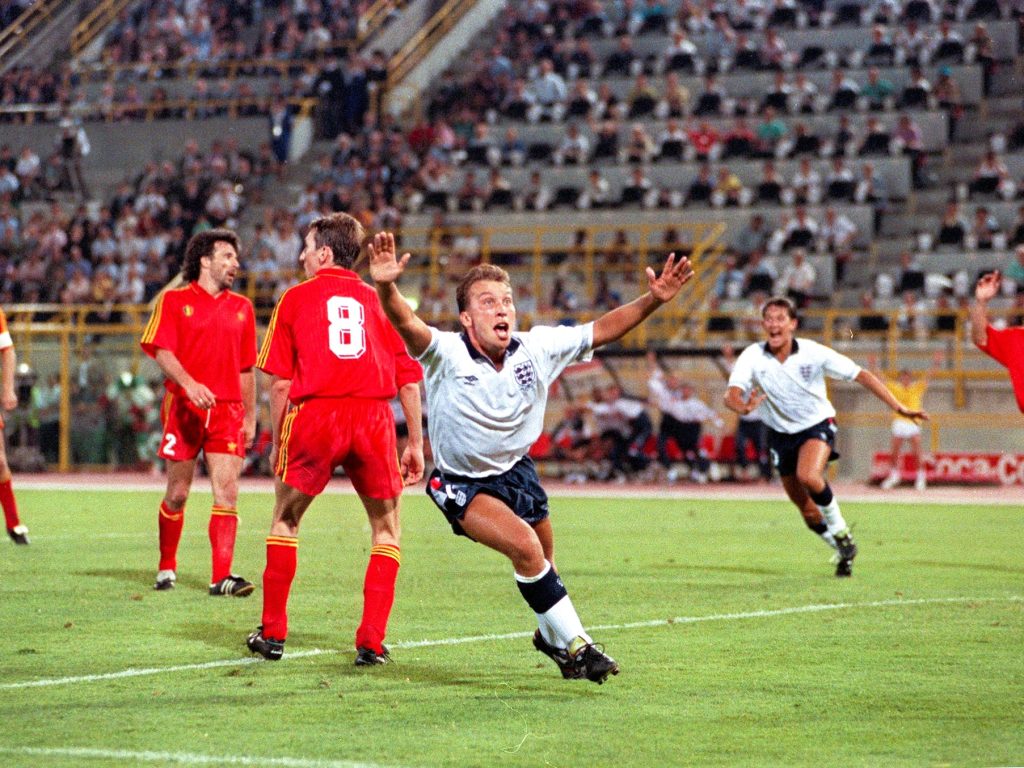
David Platt became a national hero during the extraordinary drama of Italia 90, and his contribution of three World Cup goals across two tournaments (1990 and 1994) underlines what a remarkably effective international goal scorer he was during his peak years.
His most iconic moment came in the last sixteen of the 1990 tournament against Belgium, when a perfectly timed volley from a Gascoigne free-kick in the final moments of extra time sent England into the quarterfinals and became one of the most celebrated goals in Three Lions history.
Platt had the gift of arriving at exactly the right moment — and the composure to finish when the stakes could not have been higher.
10. Marcus Rashford — Big Tournament Contributor
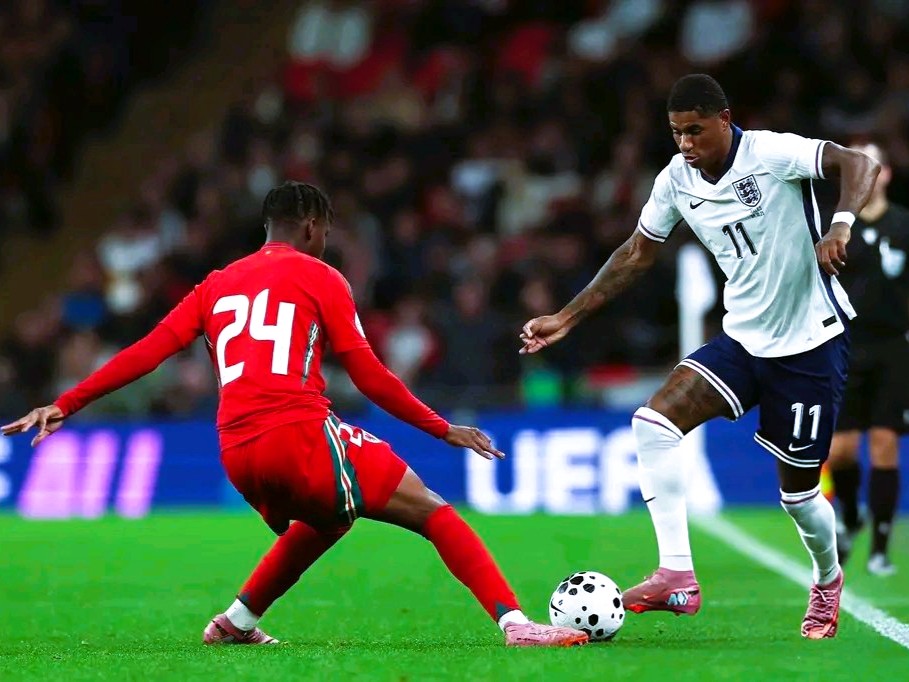
Marcus Rashford enters the 2026 World Cup with three World Cup goals spread across his appearances for England at the 2018 and 2022 tournaments.
The Manchester United forward has consistently demonstrated the pace, directness, and ability to deliver in the biggest moments of international football.
He scored twice in England’s impressive group stage at the 2022 Qatar tournament, including a brilliant free-kick against Wales.
With Rashford still only in his mid-twenties at the time of the 2026 tournament, there remains considerable potential for him to significantly extend his contribution to England’s FIFA World Cup scoring records.
His combination of physical attributes and technical quality makes him one of the most dangerous attackers England can deploy from any position.
11. Steven Gerrard — England’s Midfield Leader
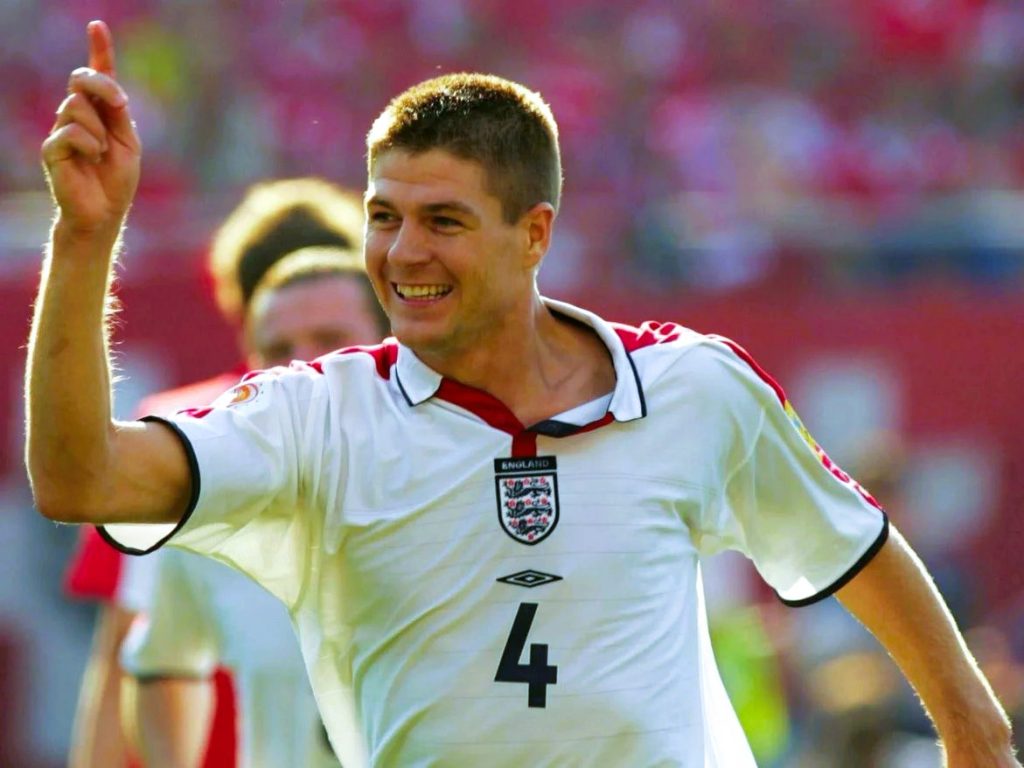
Steven Gerrard accumulated three World Cup goals across three tournaments — 2006, 2010, and 2014 — and represents one of the great might-have-been stories of England’s World Cup history.
Liverpool’s legendary captain was arguably the finest box-to-box midfielder England produced during the opening decades of the 21st century, and his World Cup goals — including a stunning long-range strike against Trinidad and Tobago in 2006 — represented a fraction of his overall contribution to the Three Lions cause.
Gerrard’s World Cup legacy is as much about leadership, drive, and competitive intensity as it is about goals.
But his place in the list of England’s top World Cup scorers acknowledges a player whose ambition for England football never dimmed, even as tournament heartbreaks accumulated.
12. David Beckham — England Captain and Icon
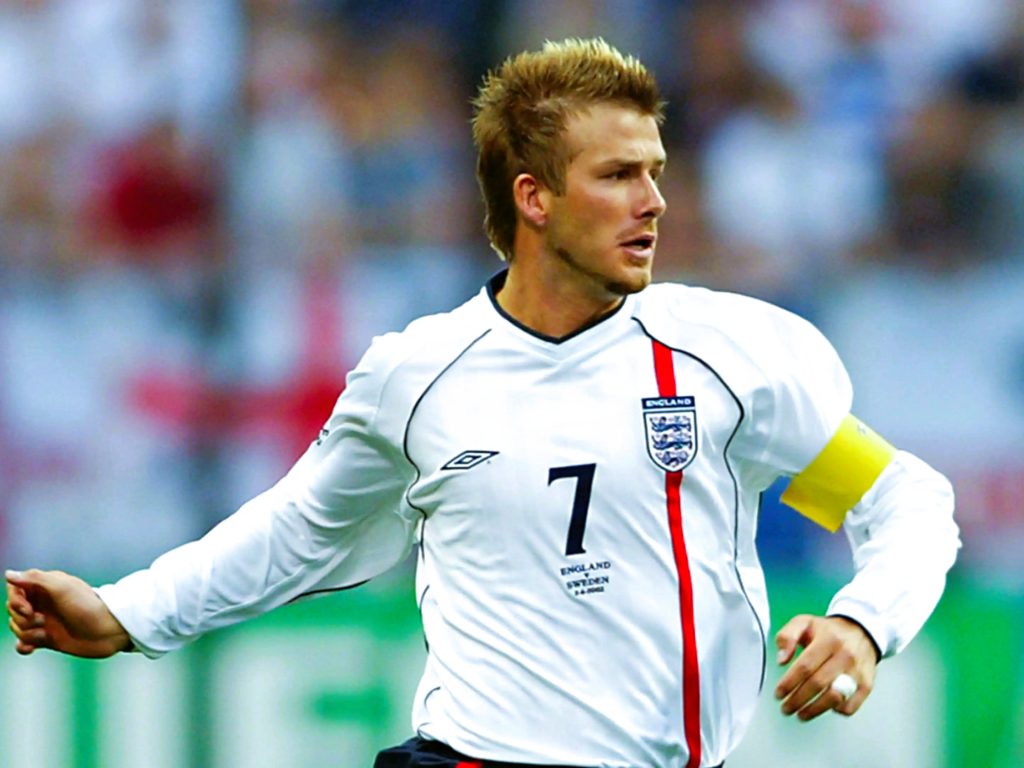
Three World Cup goals. One genuine football icon. David Beckham’s contribution to England’s FIFA World Cup history encompasses far more than goals.
His story is woven through some of the most dramatic moments in Three Lions tournament history, from the red card against Argentina in 1998 to the breathtaking free-kick that sealed England’s qualification for the 2002 World Cup.
To the penalty conversion against Argentina in Sapporo that completed one of international football’s most compelling personal redemption arcs.
Beckham’s World Cup goals spanned three tournaments (1998, 2002, 2006) and reflected his unique ability to deliver the moments that mattered: free-kicks hit with almost supernatural precision, penalties struck with the confidence of a man who had confronted his sporting demons and emerged stronger.
His three goals place him among England’s all-time FIFA World Cup scorers, though his real legacy is something that statistics can never fully capture.
England’s Greatest FIFA World Cup Moments
Football history is measured in moments — and England have produced some of the most unforgettable in the tournament’s story.
- Geoff Hurst vs West Germany, 1966 Final — The defining moment of English football. Three goals, one World Cup, a nation transformed. Nothing in England’s football history before or since has matched the sheer weight of the 1966 World Cup final victory.
- Bobby Charlton Leading England to Glory — Charlton’s two goals against Portugal in the 1966 semifinal were moments of breathtaking quality from a player operating at the very peak of his powers. His long-range shooting, his composure under pressure, and his leadership on the pitch made him the heartbeat of England’s greatest tournament campaign.
- Michael Owen vs Argentina, 1998 — A teenage boy, thirty yards from goal, the world watching. What followed was the most audacious individual World Cup goal an England player has ever scored, a moment of pure instinct and extraordinary technical execution that announced Owen to global football in the most spectacular manner possible.
- Beckham’s Penalty Redemption vs Argentina, 2002 — Four years after a red card ended his 1998 World Cup in shame, David Beckham stepped up against Argentina at the 2002 World Cup and converted a penalty in front of a watching nation. It was sport’s great redemption narrative playing out in real time — a captain lifting himself and his country through the sheer force of composed brilliance.
England FIFA World Cup Records and Statistics
England’s history at the FIFA World Cup spans nearly a century of international football, and the records accumulated over that time tell a remarkable story.
- Most World Cup goals for England — Gary Lineker (10 goals)
- Most goals in a single World Cup tournament — Gary Lineker (6 goals, Mexico 1986)
- England World Cup Golden Boot winners — Gary Lineker (1986), Harry Kane (2018)
- Only hat-trick in a World Cup final — Geoff Hurst (1966)
- England’s best World Cup finish — Winners (1966)
- Most England World Cup appearances — Bobby Charlton (4 World Cups: 1958, 1962, 1966, 1970)
- Most goals in World Cup knockout stages — Gary Lineker
- Youngest England World Cup scorer — Michael Owen (17 years, 1998)
These records represent the full scope of England’s FIFA World Cup statistics — from the postwar foundations laid by Nat Lofthouse to the modern dominance of Harry Kane. The 2026 tournament offers the opportunity to add several new entries to this list.]
England at the 2026 FIFA World Cup
The 2026 FIFA World Cup, hosted across the United States, Canada, and Mexico, represents England’s most significant opportunity to end 60 years of tournament heartbreak.
With arguably the most talented and balanced squad in a generation, the Three Lions enter the tournament as genuine contenders to go all the way — and the attacking options available to the England manager represent a depth and quality rarely available to any national team.
England’s Biggest Stars Heading into 2026
Harry Kane — The captain. The record-chaser. At 32, the focal point of everything England do in attack. If England are to win this tournament, Kane will almost certainly be at the centre of it.
Jude Bellingham — Perhaps the most complete midfielder of his generation, Bellingham brings an extraordinary combination of technical brilliance, physical intensity, and maturity well beyond his years. His ability to arrive late in the box and score crucial goals makes him one of the most dangerous players in the world tournament context.
Bukayo Saka — Three World Cup goals already and arguably improving season by season at Arsenal. Saka’s directness, creativity, and ability to perform on the biggest occasions make him one of England’s most reliable attacking weapons.
Phil Foden — Arguably the most technically gifted English footballer of his generation, Foden’s ability to unlock defences in tight spaces and deliver the decisive pass or finish in crucial moments makes him a genuine match-winner at tournament level.
Cole Palmer — The Chelsea forward’s emergence as one of the Premier League’s most dangerous attacking players has given England an additional dimension of quality and unpredictability that could prove vital in a tournament where opponents will have extensively prepared for Kane and Bellingham.
Declan Rice — The Arsenal midfielder provides the defensive solidity and forward thrust that allows England’s more attacking players to express themselves freely. His ability to control the tempo of matches is an underrated but essential component of England’s tactical identity.
England’s Chances of Winning the World Cup
No England team since 1966 has won the FIFA World Cup, but the 2026 squad carries genuine reason for optimism.
The attacking depth, individual quality in key positions, and growing tournament experience of key players like Kane, Bellingham, and Saka suggest this is a team that could genuinely compete with the very best.
If England can maintain defensive solidity and convert their attacking quality into goals consistently across a seven-game tournament, a first World Cup since 1966 is not a fantasy — it is a realistic ambition.
England’s Attack and Tactical Evolution
England’s evolving tactical approach — moving away from the rigid 4-2-3-1 of earlier eras toward a more fluid, pressing-based system that can accommodate multiple attacking threats simultaneously — has been one of the most encouraging developments in Three Lions football.
The ability to deploy Kane as the focal point while Bellingham, Saka, Foden, and Palmer interchange freely behind him creates tactical problems for any defensive structure in the world.
Can Kane Break Lineker’s Record in 2026?
The arithmetic is simple and compelling. Harry Kane needs two World Cup goals in 2026 to draw level with Gary Lineker’s 10-goal England record.
Three goals would give England a new all-time leading FIFA World Cup scorer.
Given that England are among the strongest teams in the 2026 tournament and Kane’s continued excellence at club level — his goal-scoring exploits at Bayern Munich have been nothing short of extraordinary — the likelihood of him breaking the record must be considered very high.
Kane will be 32 during the 2026 World Cup, an age at which leading European strikers continue to perform at elite levels.
He is in the best scoring form of his career at club level. He carries the experience of two World Cup campaigns. And he carries the motivation of a player who knows exactly what history awaits him.
Frequently Asked Questions
Who scored the most World Cup goals for England?
Gary Lineker holds the record with 10 goals, scored across the 1986 and 1990 FIFA World Cups. His six goals at Mexico 1986 remain the most by an England player in a single tournament.
How many World Cup goals does Harry Kane have?
Harry Kane has scored 8 World Cup goals — six at the 2018 FIFA World Cup in Russia (where he won the Golden Boot) and two at the 2022 FIFA World Cup in Qatar. He enters the 2026 FIFA World Cup just two goals behind Lineker’s all-time England record.
Who scored a hat-trick in a World Cup final for England?
Geoff Hurst is the only player in the history of the FIFA World Cup to have scored a hat-trick in the final. He achieved this in England’s 4-2 victory over West Germany on 30 July 1966 at Wembley Stadium.
Which England player won the World Cup Golden Boot?
Two England players have won the FIFA World Cup Golden Boot: Gary Lineker (1986, with six goals in Mexico) and Harry Kane (2018, with six goals in Russia).
Could Harry Kane break England’s World Cup goals record?
Yes. Kane needs just two more goals at the 2026 FIFA World Cup to equal Gary Lineker’s all-time England record of 10. Three goals would give him the outright record. Given his continued excellence at the highest club level, his 2026 appearance is expected, and England’s likelihood of progressing deep into the tournament is considerable.
Who is England’s greatest World Cup player ever?
This is one of football’s most enjoyable debates, and there is no definitive answer. Geoff Hurst remains unique for his hat-trick in the 1966 final. Gary Lineker is the all-time leading scorer. Harry Kane is poised to rewrite the record books. Each represents a different definition of World Cup greatness, and the question of which matters most — historical significance, goals scored, or tournament-wide impact — is ultimately a matter of perspective.
Conclusion
England’s FIFA World Cup history is a story of extraordinary individuals who rose to the occasion when their country and their generation needed them most.
From Geoff Hurst’s immortal hat-trick in the summer of 1966, through Gary Lineker’s Golden Boot brilliance in Mexico and Italy, to Michael Owen’s breathtaking teenage genius and Harry Kane’s modern goalscoring mastery, the Three Lions’ World Cup attacking legends form a lineage that speaks to everything that is great about English football.
Kane’s pursuit of Lineker’s record in 2026 is one of the great sporting narratives heading into the tournament — a chance for England’s captain to etch his name into football history in the most conclusive fashion possible.
Two goals away from equality, three from outright immortality, Kane arrives in the United States, Canada, and Mexico not merely as England’s leader but as a man on a personal quest that could redefine how this country remembers the greatest players to have worn its shirt.
Around Kane, the next generation is ready. Bukayo Saka carries the torch of England’s tradition of world-class wide forwards. Jude Bellingham embodies a new model of complete midfield excellence.
Phil Foden, Cole Palmer, and Marcus Rashford provide the depth and unpredictability that great tournament sides always require.
England’s enduring dream of another World Cup title has never felt more grounded in genuine possibility.
The 1966 heroes are immortalised forever; the 2026 generation has the talent, the experience, and the hunger to create a new chapter worthy of comparison.
The Three Lions’ greatest World Cup scoring story may not yet have been written. Harry Kane has a pen in hand, and the world is watching.