







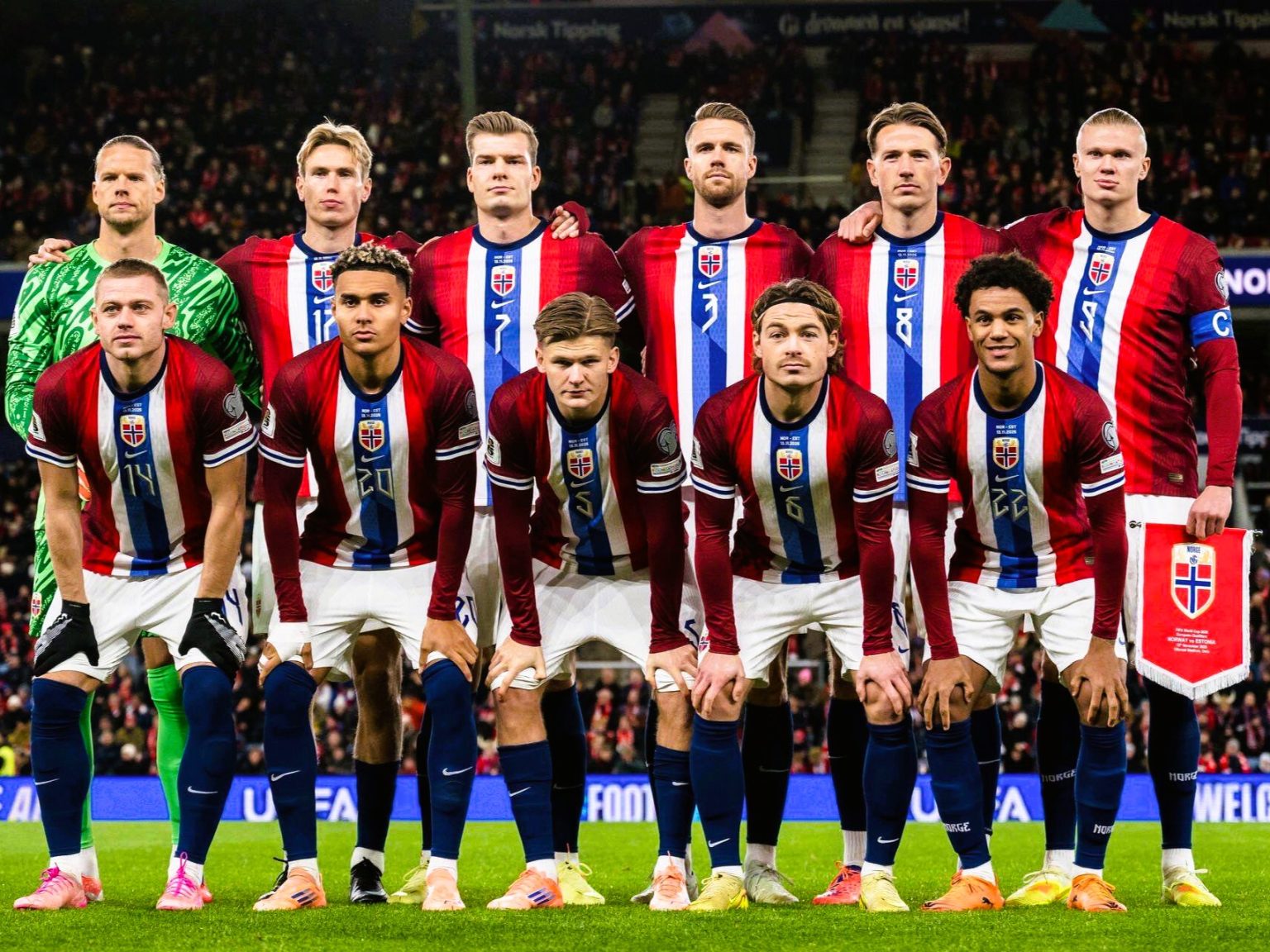

Norway, who return to the 2026 FIFA World Cup after a 28-year absence, will be one of the tournament’s most intriguing “dark horses.”
With rising expectations as one of Europe’s most exciting emerging teams, the Norway national football team — led by world-class talents such as Erling Haaland and Martin Ødegaard — will aim to make a long-awaited impact on football’s biggest stage and challenge some of the competition’s strongest nations.
With the tournament expanding to 48 teams, Norway’s potential path to the final includes several possible scenarios depending on their group-stage finish.
Below is a full breakdown of Norway’s World Cup journey, including their group opponents, match schedule, qualification routes, and possible knockout-stage matchups as they pursue a historic run in North America.
When Does Norway’s 2026 FIFA World Cup Journey Begin?
Norway’s 2026 FIFA World Cup campaign will begin on Tuesday, June 16, 2026, at Gillette Stadium in Boston, in Foxborough, Massachusetts.
After their opening match in Boston, Norway will travel to New York, New Jersey on June 22. Their group stage campaign concludes on June 26, when they return to Boston.
Norway’s Group Opponents
Norway have been drawn in Group I for the 2026 FIFA World Cup. The “Vikings” will face France, Senegal and the winner of the Inter-Confederation Playoffs Route 2.
As the 2018 champions and 2022 runners-up, France are in this group as one of the tournament’s favourites. This is the final of a high-profile European clash and will feature a marquee head-to-head between Erling Haaland and Kylian Mbappe.



One of Africa’s top-ranked teams, Senegal brings a squad packed with top talent from European leagues. Norway and Senegal have only met once before, a friendly in 2006 that the West African team won 2-1.
Norway’s inaugural opponents will be the winner of the Inter-Confederation Playoffs involving Iraq, Bolivia and Suriname. The playoff will be finalised at the end of March 2026.
Norway Group Stage Schedule
Norway’s 2026 FIFA World Cup group stage journey begins on Tuesday, June 16, 2026, against a yet-to-be-determined playoff winner in Boston.
| Date (2026) | Opponent | Venue | Time (ET) |
|---|---|---|---|
| June 16 | Playoff Winner (BOL/SUR/IRQ) | Gillette Stadium | 6:00 PM |
| June 22 | Senegal | MetLife Stadium | 8:00 PM |
| June 26 | France | Gillette Stadium | 3:00 PM |
Norway Group Standings
The table below reflects the group standings before kickoff and will be updated after each matchday.
| Pos | Team | MP | W | D | L | GD | Pts |
|---|---|---|---|---|---|---|---|
| 1 | France | 0 | 0 | 0 | 0 | 0 | 0 |
| 2 | Norway | 0 | 0 | 0 | 0 | 0 | 0 |
| 3 | Senegal | 0 | 0 | 0 | 0 | 0 | 0 |
| 4 | Playoff Winner* | 0 | 0 | 0 | 0 | 0 | 0 |
You may also like:
- Brazil’s Road to the 2026 World Cup Final
- USA’s Road to the 2026 World Cup Final
- Morocco’s Road to the 2026 FIFA World Cup Final
How Norway Qualifies for the Knockout Stage
Norway must navigate the tournament’s expanded 48-team format to reach the knockout stages of the 2026 FIFA World Cup.
The most direct route for the “Vikings” is to finish as one of the top two teams in Group I.
By finishing first or second after matches against France, Senegal and the play-off winner (Bolivia, Suriname, or Iraq), they earn an automatic spot in the newly established Round of 32, which serves as the first hurdle in the knockout stages.
If Norway finishes third in Group I, they still have a viable path to progress.
Under the current rules, the eight best third-placed teams from 12 groups advance to the Round of 32. This ranking is determined primarily by total points, then goal difference, goals scored, and finally disciplinary (fair play) points.
With 32 of the 48 participating nations advancing, it is imperative for Norway to avoid being among the bottom 16 teams of the tournament to keep their journey alive.
Norway Potential Knockout Stage Path
Norway’s possible path to the knockout stages of the 2026 FIFA World Cup depends on their final ranking in Group I. With the competition expanding to 48 teams, the “Vikings” could advance to the newly established Round of 32 through three primary scenarios.
As Group I winners: Norway will stay on the East Coast for the 77th match in New York, New Jersey on June 30, 2026. This path is strategically ideal as it bypasses the other group winners in the first knockout round and rewards them with a match in the stadium that will eventually host the World Cup final.
As Group I runners-up: The team will travel south to Dallas on June 30, 2026. Their opponent will be the Group E runners-up.
As best third-place finisher: If Norway is selected as one of the eight best third-place finishers, they could face the Group A winner for the 79th match in Mexico City on June 30. Other possible opponents for the third-place finisher in Group I include the winners of Groups B, D, G, K, or L.
Norway as Group Winner
If Norway finishes as the winner of Group I, they will be on the East Coast for their first knockout match in the Round of 32. The match, designated as Match 77, is scheduled for Tuesday, June 30, 2026, at MetLife Stadium in New York, New Jersey.
As the group winner, the “Vikings” will face the third-place team from Groups C, D, F, G, or H, which would theoretically provide a more manageable path to the Round of 16 by bypassing the other group winners.
Winning the group would be strategically important, as it would place Norway in the same spot where the World Cup finals will eventually be held, allowing Erling Haaland and company to gain early familiarity with the tournament’s most important pitch.
If they make it past the Round of 32, their journey will likely be to the Round of 16 in Philadelphia on July 4, 2026, followed by a potential quarterfinal in Boston on July 9. This route is arguably the most efficient, as it keeps the teams concentrated within the northeastern corridor of the United States.
After the quarterfinals, the group winners advance to the semifinals in Dallas on July 14, with the ultimate goal of returning to New Jersey for the World Cup finals on July 19, 2026. Under this 48-team format, the group winner must win five consecutive knockout matches to secure the trophy.
| Round | Date (2026) | Potential Opponent | Venue |
|---|---|---|---|
| Round of 32 | June 30 | 3rd place (Group C/D/F/G/H) | MetLife Stadium |
| Round of 16 | July 4 | Winner of Group E winners v Group A/B/C/D/F third place | Lincoln Financial Field |
| Quarter-final | July 9 | Winner of Match 90 | Gillette Stadium |
| Semi-final | July 14 | Winner of Match 98 | AT&T Stadium |
| Final | July 14 | TBD | MetLife Stadium |
Norway as Group Runner-Up
If Norway finishes as the runner-up in Group I, they will advance to the Round of 32 to face the runner-up in Group E. This high-stakes knockout match, designated as Match 78, is scheduled for Tuesday, June 30, 2026, at AT&T Stadium in Dallas, Arlington, Texas.
Potential opponents in Group E include a formidable lineup from Germany, Ivory Coast, or Ecuador.
If the “Vikings” win in Dallas, their journey will continue until the Round of 16 on Sunday, July 5, 2026. This match (Match 91) will take them back to MetLife Stadium in New York, New Jersey.
As the runner-up ahead of the Round of 16, Norway will advance to the Quarterfinals on July 11, 2026 at Hard Rock Stadium in Miami.
From there, the potential route leads to the semifinals in Atlanta on July 15, culminating in the World Cup final in New Jersey on July 19, 2026. The route is geographically difficult, requiring the team to travel from the Northeast to the South and back to the East Coast over a two-week period.
| Round | Date (2026) | Potential Opponent | Venue |
|---|---|---|---|
| Round of 32 | June 30 | Runner-up Group E | AT&T Stadium |
| Round of 16 | July 5 | Winner of Group C winners vs. Group F runners-up | MetLife Stadium |
| Quarter-final | July 11 | Winner Match 92 | Hard Rock Stadium |
| Semi-final | July 15 | Winner Match 100 | Mercedes-Benz Stadium |
| Final | July 19 | TBD | MetLife Stadium |
Norway as Best Third-Placed Team
If Norway finishes as one of the eight best third-place teams, their path to the Round of 32 is highly variable.
Under the 48-team format, the third-place finisher from Group I is typically slotted to face the winner of Group A, Group B, Group D, Group G, Group K, or Group L.
The specific location and date for this match depends on a complex lookup table for which other groups also produced third-place teams.
Since the final determination will not be made until all group stage matches are completed on June 27, 2026, this route provides the least amount of travel predictability and recovery time for the team.
Historically, qualifying as the best third-place team has required a strong goal difference and a disciplined fair-play record.
If Norway take this route, they will likely enter the knockout stages as underdogs, but with Erling Haaland leading the line, they have become the “bracket buster” that any group winner would want to avoid.
| Match | Date (2026) | Potential Opponent | Venue |
|---|---|---|---|
| Match 79 | June 30 | Winner Group A | Estadio Azteca |
| Match 80 | July 1 | Winner Group L | Mercedes-Benz Stadium |
| Match 81 | July 1 | Winner Group D | Levi’s Stadium |
| Match 82 | July 1 | Winner Group G | Lumen Field |
| Match 85 | July 2 | Winner Group B | BC Place Vancouver |
| Match 87 | July 3 | Winner Group K | GEHA Field at Arrowhead |
Norway’s Best Route to the 2026 FIFA World Cup Final
Norway’s best path to the 2026 FIFA World Cup final begins with a Group I win, which gives them a more favorable knockout bracket and avoids early clashes with other top-seeded group winners.
The logistical advantages of winning the group are crucial to maintaining the physical peak of stars like Erling Haaland and Martin Odegaard.
Finishing in first place allows Norway to remain in the northeastern corridor for the early knockout stages.
This reduces cross-continental travel fatigue, keeping the team fresh as they aim to navigate an expanded 48-team bracket that now requires five consecutive knockout wins to reach the final.
In contrast, being selected as the runner-up or best third-place team presents immediate high-risk scenarios and more difficult journeys.
For the Norwegian team, returning to the world stage after 28 years, securing top spot in Group I would be the most effective way to manage both the quality of the opposition and the physical demands of the competition.