
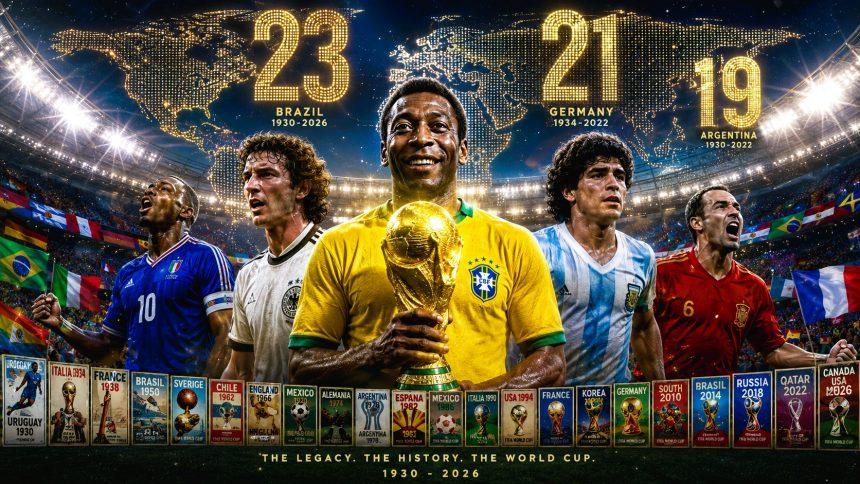
Since Uruguay hosted the inaugural tournament in 1930, the FIFA World Cup has grown from a 13-team experiment into the most-watched sporting event on the planet.
Every four years, the world holds its breath as national football teams — some storied, some fresh-faced — battle for the right to call themselves world champions.
But beyond the trophies and the tears, there is another story worth telling: the story of consistency. Of nations that have shown up, decade after decade, refusing to let the world’s stage pass them by.
World Cup qualification records reveal which national teams have built football cultures strong enough to compete at the highest level across generations.
More Read

The 2026 FIFA World Cup — the 23rd edition — is historic in its own right, the first to feature 48 nations across three host countries: the United States, Canada, and Mexico.
As the tournament expands to produce 104 matches and up to eight games per team, the all-time World Cup appearances ranking is being rewritten before our eyes.
This article ranks the nations with the most FIFA World Cup appearances in history, traces their journeys from 1930 through 2026, and examines what consistent qualification really means in the global game.
Which National Team Has the Most FIFA World Cup Appearances?
Brazil. No other answer is possible.
More Read

The Seleção are not only the most successful nation in World Cup history — they are the only national team to have played in every single edition of the tournament.
From Uruguay 1930 to the expanded USA/Canada/Mexico 2026 edition, Brazil has qualified for all 23 FIFA World Cups.
That is a record of participation that no other football nation on earth can claim.
Germany follows with 21 appearances, a remarkable figure made even more impressive given West Germany’s forced absence from the 1950 tournament.
Argentina comes next with 19 appearances, a number that has risen sharply in recent decades thanks to sustained excellence under Lionel Messi.
Italy, despite the humiliation of failing to qualify for the recent 2018, 2022, and 2026 editions, still sits fourth with 18 appearances.
Mexico, the most represented CONCACAF nation, matches Italy on 17 appearances — the most of any team yet to win the title.
National Teams With the Most FIFA World Cup Appearances (1930–2026)
| Team | Appearances | Debut | Most Recent Qualification | Best Result |
| Brazil | 23 | 1930 | 2026 | Champions (1958, 1962, 1970, 1994, 2002) |
| Germany | 21 | 1934 | 2026 | Champions (1954, 1974, 1990, 2014) |
| Argentina | 19 | 1930 | 2026 | Champions (1978, 1986, 2022) |
| Italy | 18 | 1934 | 2014 | Champions (1934, 1938, 1982, 2006) |
| Mexico | 18 | 1930 | 2026 | Quarter-finals (1970, 1986) |
| Spain | 17 | 1934 | 2026 | Champions (2010) |
| England | 17 | 1950 | 2026 | Champions (1966) |
| France | 17 | 1930 | 2026 | Champions (1998, 2018) |
| Belgium | 15 | 1930 | 2026 | Third place (2018) |
| Uruguay | 15 | 1930 | 2026 | Champions (1930, 1950) |
| Switzerland | 13 | 1934 | 2026 | Quarter-finals |
| Sweden | 13 | 1934 | 2026 | Runners-up (1958) |
| Serbia | 13 | 1930 | 2022 | Fourth place (1930, 1962) |
| South Korea | 12 | 1954 | 2026 | Fourth place (2002) |
| United States | 12 | 1930 | 2026 | Third place (1930) |
| Netherlands | 12 | 1934 | 2026 | Runners-up (1974, 1978, 2010) |
| Russia | 11 | 1958 | 2018 | Fourth place (1966) |
| Czech Republic | 10 | 1934 | 2026 | Runners-up (1934, 1962) |
| Portugal | 9 | 1966 | 2026 | Third place (1966) |
| Scotland | 9 | 1954 | 2026 | Group stage |
| Paraguay | 9 | 1930 | 2026 | Quarter-finals (2010) |
| Hungary | 9 | 1934 | 1986 | Runners-up (1938, 1954) |
| Poland | 9 | 1938 | 2022 | Third place (1974, 1982) |
| Slovakia | 9 | 1934 | 2010 | Runners-up (1934, 1962) |
| Chile | 9 | 1930 | 2014 | Third place (1962) |
| Japan | 8 | 1998 | 2026 | Round of 16 (2002, 2010, 2018, 2022) |
| Cameroon | 8 | 1982 | 2022 | Quarter-finals (1990) |
| Austria | 8 | 1934 | 2026 | Third place (1954) |
| Croatia | 7 | 1998 | 2026 | Runners-up (2018) |
| Morocco | 7 | 1970 | 2026 | Fourth place (2022) |
| Australia | 7 | 1974 | 2026 | Round of 16 |
| Colombia | 7 | 1962 | 2026 | Quarter-finals (2014) |
| Iran | 7 | 1978 | 2026 | Group stage |
| Saudi Arabia | 7 | 1994 | 2026 | Round of 16 (1994) |
| Bulgaria | 7 | 1962 | 1998 | Fourth place (1994) |
| Tunisia | 7 | 1978 | 2026 | Group stage |
| Romania | 7 | 1930 | 1998 | Quarter-finals (1994) |
| Costa Rica | 6 | 1990 | 2022 | Quarter-finals (2014) |
| Denmark | 6 | 1986 | 2022 | Quarter-finals (1998) |
| Nigeria | 6 | 1994 | 2018 | Round of 16 (1994, 1998, 2014) |
| Ghana | 5 | 2006 | 2026 | Quarter-finals (2010) |
| Ecuador | 5 | 2002 | 2026 | Round of 16 (2006) |
| Algeria | 5 | 1982 | 2026 | Round of 16 (2014) |
| Peru | 5 | 1930 | 2018 | Quarter-finals (1970, 1978) |
Five Nation With the Most FIFA World Cup Appearances
Brazil — 23 World Cup Appearances
- South America: CONMEBOL
- First appearance: 1930
- Titles: 5
- Finals: 7
- Missed editions: 0
- Latest: 2026 Group C
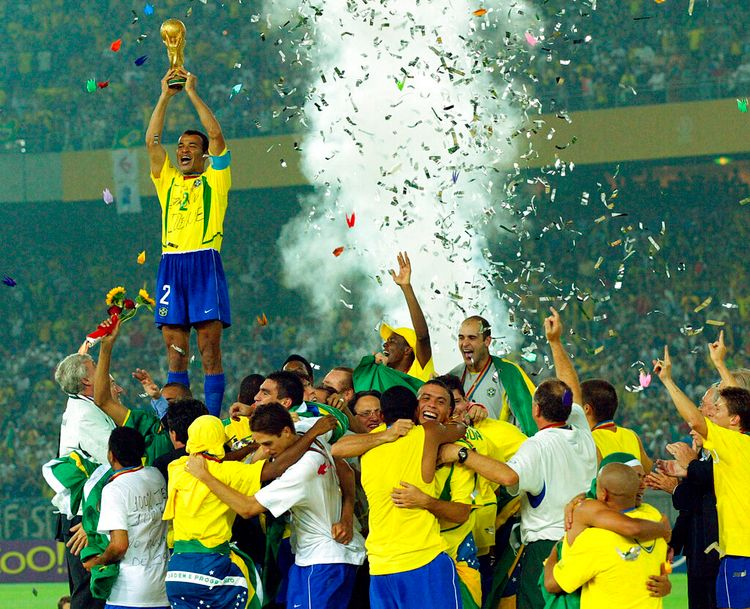
Brazil are the undisputed king of World Cup participation — the only national team in the history of football to have qualified for and competed in every single edition of the tournament, from the inaugural 1930 competition in Uruguay through to the expanded 2026 edition hosted across the United States, Canada, and Mexico.
All 23 World Cups. Not one missed. That record of perfect attendance across 96 years of football history is, by any measure, the greatest feat of sustained national team excellence the sport has ever produced.
Their consistency is rooted in a footballing culture unlike any other on earth. In Brazil, football is not merely a sport — it is the national language, spoken in favelas and academies and packed stadiums with equal fluency.
The country has produced an unbroken line of world-class players across every generation: Pelé in the 1950s and 60s, Zico and Falcão in the 80s, Romário and Bebeto in the 90s, Ronaldo and Ronaldinho in the 2000s, and now Vinicius Jr. and Rodrygo carrying the yellow shirt into 2026.
That generational pipeline is why Brazil have never been absent — because the talent never runs dry.
Five World Cup titles — won in 1958, 1962, 1970, 1994, and 2002 — give them more championships than any other nation.
The 1970 team, featuring Pelé, Jairzinho, Tostão, and Rivelino, is widely regarded as the finest footballing side ever assembled, winning every single game and scoring 19 goals in six matches.
Their 2002 victory in Japan and South Korea, led by the fully fit and unstoppable Ronaldo, was a different but equally dominant triumph.
In 2026, now managed by Carlo Ancelotti, Brazil arrive in Group C hungry to end a title drought stretching back 24 years.
Germany — 21 World Cup Appearances
- Europe: UEFA
- First appearance: 1934
- Titles: 4
- Finals: 8
- Missed editions: 1 (1950)
- Latest: 2026 Group E
If Brazil represent footballing joy, Germany represent footballing will.
No nation has contested more World Cup finals — eight in total, a record that may never be matched — and their 21 tournament appearances reflect a football culture built on organisation, resilience, and the extraordinary ability to regenerate.
Where other nations rise and fall with golden generations, Germany simply keeps producing new ones, adapting their style decade by decade while the results remain relentlessly consistent.
Germany’s World Cup lineage runs through the DFB — the Deutscher Fußball-Bund — which FIFA recognises as a continuous institution from 1904, encompassing the West Germany era (1954–1990) and unified Germany thereafter.
They were excluded from the 1950 tournament as a post-war measure, meaning their only absence since the competition began in earnest is that single edition.
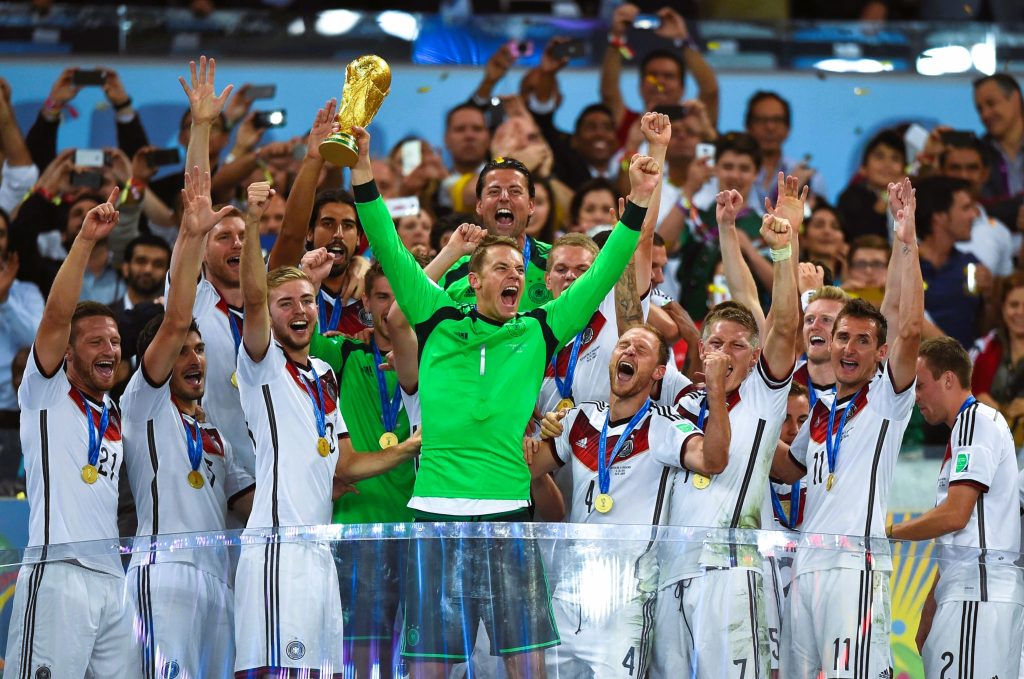
From Fritz Walter lifting the trophy in Bern in 1954, through Franz Beckenbauer’s imperial 1974 team, to Lothar Matthäus marshalling the 1990 champions, to the breathtaking 2014 generation who dismantled Brazil 7–1 in Belo Horizonte before claiming the title in Rio, each era has produced a Germany team that belonged on the very biggest stage.
Miroslav Klose, with 16 World Cup goals, remains the tournament’s all-time top scorer — a record that embodies German efficiency: consistent, powerful, almost mechanical in its accumulation.
In 2026, under Julian Nagelsmann, Germany arrive in Group E as one of Europe’s genuine favourites.
A nation that has never gone more than two consecutive tournaments without reaching a final has every intention of extending that record.
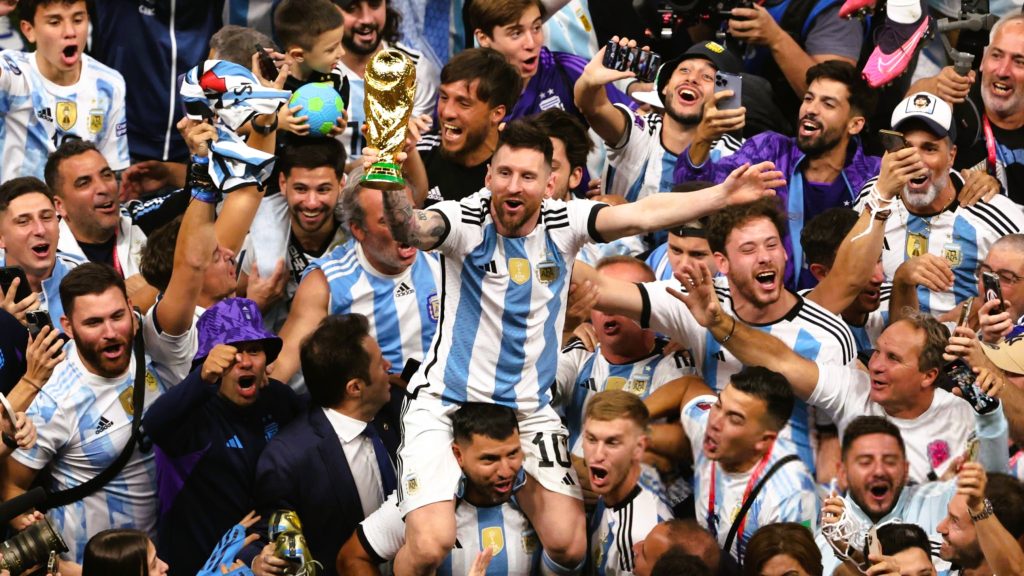
Argentina — 19 World Cup Appearances
- South America: CONMEBOL
- First appearance: 1930
- Titles: 3, Defending champions
- Finals: 5
- Missed editions: 1 (1970)
- Latest: 2026 group J
Argentina’s relationship with the FIFA World Cup is the most passionate, painful, and ultimately redemptive love story in football.
They were there at the very beginning — reaching the final of the 1930 inaugural tournament before losing 4–2 to hosts Uruguay — and they arrive at 2026 as defending champions, bookending nearly a century of World Cup history with two defining final appearances.
In between lies every human emotion the sport can generate: heartbreak, genius, controversy, triumph, and above all an intensity of national feeling that makes Argentine football unlike anything else in the world.
Two figures tower over Argentina’s World Cup story more than any others.
Diego Maradona’s 1986 campaign in Mexico remains the greatest individual performance in the tournament’s history: six games, five goals, five assists, and two of the most discussed moments in sporting history — the “Hand of God” goal and the “Goal of the Century” against England in the quarter-final — all on his way to lifting the trophy.
Three and a half decades later, Lionel Messi completed his own redemption arc in Qatar 2022, leading Argentina past France in one of the most extraordinary finals ever played, winning 4–2 on penalties after a breathless 3–3 draw, and finally claiming the one trophy that had eluded him through four previous tournaments.
Argentina have missed only one World Cup since their first appearance — the 1970 edition — and their modern run of 12 consecutive qualifications since 1974 reflects an infrastructure of football excellence that runs deep through their clubs, academies, and culture.
In 2026, drawn into Group J alongside Algeria, Austria, and Jordan, they arrive in North America as the tournament’s second-ranked team, with Messi expected to play what will almost certainly be his farewell World Cup at age 38.
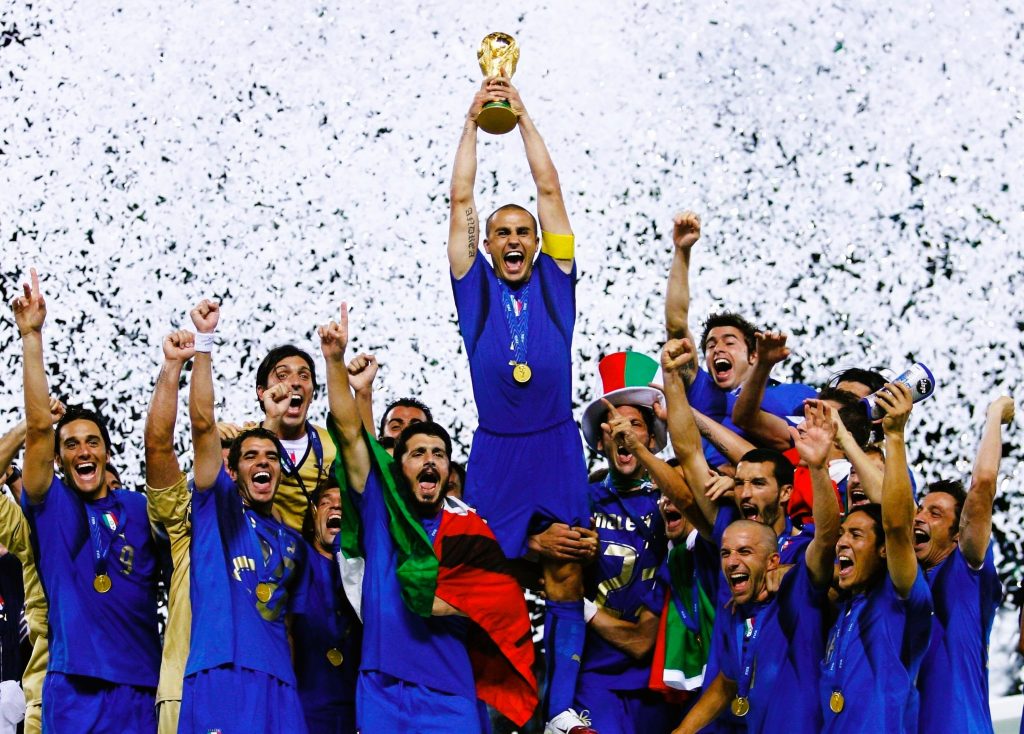
Italy — 18 World Cup Appearances
- Europe: UEFA
- First appearance: 1934
- Titles: 4
- Finals: 6
- Last appearance: 2014
- Consecutive absences: 3
Italy’s place in World Cup history is both magnificent and, in recent years, profoundly tragic.
Four world titles, six final appearances, and a football culture that gave the world catenaccio, the libero, and some of the most tactically sophisticated football ever played — the Azzurri are, by any historical measure, one of the greatest World Cup nations in the sport’s history.
They were the first team ever to defend the title, winning back-to-back tournaments in 1934 and 1938.
Their 1982 victory in Spain, led by Paolo Rossi’s six goals, and their 2006 triumph in Germany under Marcello Lippi, are both regarded as masterclasses in tournament football.
And yet since 2006, Italy have not won a single knockout match at a World Cup — because they have not played in one.
Their failure to qualify for 2018, when they lost a playoff to Sweden, was shocking.
Their 2022 absence, eliminated by North Macedonia in a playoff semi-final, was almost inconceivable.
But 2026 delivered the most painful blow of all: despite the expanded 48-team field making qualification easier than ever, Italy lost their UEFA playoff final to Bosnia and Herzegovina on penalties — 4–1 in the shootout after a 1–1 draw — becoming the first former World Cup winner in history to miss three consecutive tournaments.
Coach Gennaro Gattuso resigned days later. The Italian football federation called it a crisis requiring fundamental reconstruction.
Italy’s total of 17 World Cup appearances still places them among the all-time elite, and their footballing heritage — from the dynasty clubs of Serie A to the academies that produced Buffon, Pirlo, Del Piero, and Totti — guarantees they will return.
But for a third consecutive summer, the Azzurri will watch the world’s greatest tournament from home, a humiliation without precedent for a nation of their stature.
Mexico — 18 World Cup Appearances
- North/Central America · CONCACAF
- First appearance: 1930
- Titles: 0
- Best finish: Quarter-finals
- Missed editions: 3
- Latest: 2026 Group A (co-hosts)
Mexico’s 18 World Cup appearances make them the most successful CONCACAF nation in the tournament’s history, and the country with the most appearances among nations that have never lifted the trophy.
El Tri first appeared in 1930 and have missed only a handful of editions since — most notably the infamous 1990 suspension, when they were banned for fielding over-age players in a youth competition.
Their consistency in reaching the round of 16 — earning the Mexican fans’ self-deprecating nickname “Quinto partido” (the fifth game they never seem to reach) — is a source of both pride and frustration.
In 2026, as co-hosts alongside the United States and Canada, Mexico will play their first group game in their own country: a massive occasion that the football-mad nation will embrace with characteristic passion.
France, England and Spain’s Modern Era Growth
France, England, and Spain each count 16 World Cup appearances, but their paths to that figure could not be more different.
France were a middling presence in World Cup football for much of the 20th century before exploding into relevance in 1998, hosting and winning the tournament with a team featuring Zinedine Zidane, Thierry Henry, and Didier Deschamps.
A second title followed in Russia 2018, cementing France as a modern World Cup dynasty. In 2026 — Deschamps’ final tournament as manager — Les Bleus arrive with Kylian Mbappé, arguably the world’s best player, as their centrepiece.
England, whose World Cup history began in 1950 (they had declined to participate in earlier editions), won their only title on home soil in 1966.
The decades since have delivered more anguish than triumph, but Gareth Southgate’s teams reached semi-finals in 2018 and the final in the 2020 European Championship, while the 2026 edition — with a new manager at the helm — brings fresh optimism.
Spain, meanwhile, went from perennial underachievers to world champions in the space of a decade.
Their 2010 victory in South Africa — playing the famous tiki-taka possession style — was followed by European Championship success in 2012.
By 2026, Spain will return as the world’s top-ranked team and genuine favourites, anchored by a midfield generation widely regarded as the best in the sport.
Countries With the Most Consecutive FIFA World Cup Appearances
Consecutive qualification is the true test of a national team’s depth and footballing infrastructure. It requires not just quality in one generation, but the ability to regenerate — to replace retired legends with new ones before the standard drops.
| Nation | Consecutive Appearances | Years |
| Brazil | 23 | 1930–2026 |
| Germany | 17 | 1954–2026 |
| Argentina | 13 | 1974–2026 |
| Mexico | 10 | 1986–2026 |
| South Korea | 11 | 1986–2026 |
| Spain | 12 | 1978–2026 |
*Germany’s unbroken run through 2022 stands at 17 consecutive appearances. Their 2026 qualification continues an essentially unbroken record since 1954.
Brazil’s run of 23 consecutive appearances will almost certainly never be equalled. Germany’s 17-edition unbroken streak from 1954 to 2022 is the longest by any European nation.
Argentina’s modern run, covering 13 consecutive tournaments since 1974, speaks to the depth of South American football’s most passionate rivalry. South Korea, consistent qualifiers since 1986, have cemented Asia’s place at the top table.
Most Successful National Teams in FIFA World Cup History
World Cup appearances tell one story. Titles, finals, and semi-finals tell another — the story of which nations have not merely shown up, but left their mark.
| Nation | Appearances | Titles | Finals Reached | Semi-finals |
| Brazil | 23 | 5 | 7 | 11 |
| Germany | 21 | 4 | 8 | 13 |
| Italy | 18 | 4 | 6 | 8 |
| Argentina | 19 | 3 | 5 | 6 |
| France | 16 | 2 | 3 | 6 |
| Uruguay | 14 | 2 | 3 | 5 |
| England | 16 | 1 | 2 | 3 |
| Spain | 16 | 1 | 1 | 3 |
| Netherlands | 11 | 0 | 3 | 5 |
| Mexico | 17 | 0 | 0 | 0 |
The contrast between appearances and trophies is most stark when you look at the Netherlands and Mexico.
The Dutch — three-time finalists — have the most World Cup finals appearances of any nation without a title.
Mexico, with more tournaments played than England or the Netherlands, have never advanced past the quarter-final stage. High participation does not guarantee high achievement; it simply provides the opportunity.
Germany’s record of eight finals appearances — meaning they have contested the final in more than a third of all tournaments they have entered — is the most remarkable single statistic in World Cup team history.
National Teams With the Most FIFA World Cup Matches Played
While World Cup appearances measure how often a nation qualifies for the tournament, total matches played reveals which teams consistently advance deep into the competition.
Nations that regularly reach the quarter-finals, semi-finals, and finals naturally accumulate far more matches than teams eliminated in the group stage.
Brazil and Germany dominate this category thanks to decades of sustained success, while Argentina’s recent runs under Lionel Messi have pushed them rapidly up the all-time rankings.
| Rank | Nation | World Cup Matches Played | Appearances | Best Finish |
| 1 | Brazil | 114 | 23 | 5× Champions |
| 2 | Germany | 112 | 21 | 4× Champions |
| 3 | Italy | 83 | 18 | 4× Champions |
| 4 | Argentina | 86 | 19 | 3× Champions |
| 5 | France | 66 | 16 | 2× Champions |
| 6 | England | 69 | 16 | 1× Champions |
| 7 | Spain | 63 | 16 | 1× Champions |
| 8 | Mexico | 57 | 17 | Quarter-finals |
| 9 | Netherlands | 55 | 11 | Runners-up |
| 10 | Uruguay | 56 | 14 | 2× Champions |
Why Brazil and Germany Dominate the Match Rankings
The reason Brazil and Germany sit so far ahead in total matches played comes down to a simple formula: they qualify for everything, and when they get there, they rarely go home early.
Both nations are serial semi-finalists and finalists. Germany’s eight finals alone account for at least 16 additional matches compared to a team that never reached a final.
Brazil’s eleven semi-final appearances mean a consistent run of six or seven games per tournament rather than the three a group-stage exit delivers.
Add to this the depth of their squads — capable of rotating without losing quality — and a winning mentality that generations of coaching have built into their national identity, and the mathematics of match accumulation become inevitable.
Argentina’s Rapid Rise in Total Matches Played
Argentina’s 2014, 2018, and 2022 campaigns under managers Alejandro Sabella, Jorge Sampaoli, and Lionel Scaloni respectively have dramatically increased their all-time match total.
The 2014 run to the final alone added seven games. The 2022 triumph in Qatar added seven more, including one of the longest and most dramatic finals in World Cup history.
If Argentina advance deep into the 2026 bracket, they could close the gap on Italy in total matches played within a single tournament.
The Impact of the 48-Team 2026 World Cup Format
The expanded 48-team format fundamentally changes the economics of World Cup match accumulation.
Teams can now play up to eight matches in a single tournament — one more than the previous maximum of seven.
For a nation like Brazil or Germany, which expects to reach at least the semi-finals, this means eight matches per edition becomes the baseline expectation.
Records that have stood for decades could be broken within a single summer.
For Argentina, fresh off a 2022 title, the prospect of eight more games in North America in 2026 is both a challenge and an opportunity to further cement their place in the all-time match-play rankings.
FIFA World Cup Appearance Records and Interesting Facts
Some of the most compelling stories in World Cup history are found in the records rather than the results:
- Brazil is the only national team to have competed in every FIFA World Cup, from 1930 to 2026 — 23 editions without a single absence.
- Germany has appeared in more World Cup finals (8) than any other nation, reaching the final in over a third of all tournaments they have entered.
- Mexico’s “Quinto Partido” curse — the country has reached the round of 16 in seven consecutive tournaments (1986–2018) without once advancing to the quarter-finals.
- Argentina failed to qualify for the 1970 World Cup, the last time they missed a tournament before building their remarkable modern streak.
- Uruguay — two-time world champions and co-founders of the World Cup — were the first nation to win the tournament (1930) and remain one of the most punching-above-their-weight nations relative to population size.
- The Netherlands hold the record for most World Cup finals (3) without winning the title — losing in 1974, 1978, and 2010.
- Italy are the only nation to have successfully defended the World Cup title, winning consecutive tournaments in 1934 and 1938.
- Miroslav Klose of Germany remains the World Cup’s all-time top scorer with 16 goals, a record likely to stand for years to come.
- Eight players — including Lionel Messi, Cristiano Ronaldo, Guillermo Ochoa, and Rafael Marquez — have each appeared in five separate World Cup tournaments, the record for individual appearances as of 2022.
- The 2026 World Cup is the first to feature 48 teams, effectively giving smaller footballing nations twice as many opportunities to qualify as the previous 32-team format.
FIFA World Cup 2026 and the Expansion Era
How the 48-Team Format Changes Qualification Records
The 2026 World Cup is not simply a larger tournament — it is a structural reset for global football.
The expansion from 32 to 48 teams means that every confederation receives significantly more qualifying places.
UEFA’s allocation rises from 13 to 16. CONMEBOL goes from 4.5 to 6.5. CAF, the African confederation, more than doubles its allocation.
For World Cup qualification records, this means the arithmetic of consistency is changing.
Nations that previously occupied the “nearly there” position in their respective continental qualifications — finishing fifth in CONMEBOL, for example — now have a genuine route to the tournament.
The barrier to entry has been lowered; the question is whether the competition itself will feel the difference.
For established heavyweights, the expanded format brings more games and more opportunities to extend their all-time appearance and match-play records at an accelerated pace.
Nations Making Historic Returns
The 2026 tournament has already delivered some notable stories of return. Italy, absent from the previous two World Cups, return through the UEFA playoffs.
Scotland — last present at a World Cup in 1998 — are back after a 28-year absence, drawn into Group C alongside Brazil, Morocco, and Haiti.
Several African nations appear at their first World Cup or return after long absences, reflecting the CAF expansion: South Africa, Congo DR, Iraq, and Cape Verde all feature in a 48-team field that is the most geographically and culturally diverse in the tournament’s history.
FAQs
Which country has the most FIFA World Cup appearances?
Yes. Brazil are the only national team in history to have qualified for and played in every single FIFA World Cup, from the inaugural 1930 tournament in Uruguay through to the expanded 2026 edition in North America.
Has Brazil played in every World Cup?
Yes. Brazil are the only national team in history to have qualified for and played in every single FIFA World Cup, from the inaugural 1930 tournament in Uruguay through to the expanded 2026 edition in North America.
Which European team has the most World Cup appearances?
Germany leads European nations with 21 World Cup appearances, having competed in every tournament since 1954 (they were excluded from 1950) under the unified DFB banner, including the West Germany era from 1954 to 1990.
Which country has the most consecutive World Cup appearances?
Brazil leads with 23 consecutive appearances from 1930 to 2026 — an unbroken record that spans the entirety of the World Cup’s history. Among European nations, Germany’s unbroken run from 1954 to 2022 (17 consecutive tournaments) is the longest.
Which nation has the most World Cup matches played?
Brazil lead the all-time ranking in total World Cup matches played, with approximately 114 games across their 23 tournaments. Germany follow closely on 112 matches, driven by their extraordinary run of eight finals and numerous deep tournament runs.
What is the most successful national team in FIFA World Cup history?
By the broadest measure — combining appearances, titles, finals, and semi-finals — Brazil stand as the most successful nation in World Cup history. They have played in more tournaments, won more titles (5), and consistently advanced deeper into the knockout rounds than any other national team. Germany’s case is strong in terms of finals reached (8), but Brazil’s perfect qualification record across 23 editions is unmatched.
The Greatest World Cup Nations of All Time
The greatest national teams in FIFA World Cup history are not simply defined by the trophies they have won.
They are defined by their legacy — by the memories they have created, the players they have produced, and the consistency with which they have shown up on the world’s biggest stage, year after year, decade after decade.
Brazil stand alone. Twenty-three consecutive tournaments. Five world titles. Pelé and Ronaldo and Ronaldinho and now Vinicius Jr.
A golden thread of footballing genius running from 1930 to 2026. No nation has given more to the World Cup, and none has taken more from it in return.
Germany’s record is perhaps the more admirable from a purely athletic standpoint — consistent, relentless, adaptable.
Eight finals, four titles, across six decades of reinvention. West Germany in 1954. The great Beckenbauer teams of the 1970s.
The Klose-Lahm-Özil generation of 2014. Germany have never asked the world to sympathise; they have simply kept arriving.
Argentina have the most passionate relationship with the tournament — a nation whose football identity is inseparable from Diego Maradona’s 1986 masterclass, Batistuta’s firepower, and Messi’s redemptive 2022 triumph. Three titles and a hunger that feels permanently unsatisfied.
Italy, France, Uruguay, England, Spain — all have written chapters of World Cup history that will be read for generations. Together, these nations have shaped the tournament from its first match in Montevideo in 1930 to the expanded spectacular coming to North America in 2026.
World Cup appearances matter because they are the measure of a football nation’s commitment to the game’s highest stage.
They represent youth academies, coaching structures, qualifying campaigns, and the cumulative passion of millions of fans.
To have appeared in the World Cup 15, 18, or 23 times is not an accident — it is a statement of who you are in the global game.