







Germany’s place in FIFA World Cup history is etched in gold — four world titles, eight final appearances, and a seemingly endless production line of elite goalscorers.
From the post-war miracle of 1954 to the clinical demolition of Brazil in 2014, Germany World Cup scorers have consistently defined what attacking excellence looks like on the biggest stage in football.
This article ranks and profiles the greatest Germany World Cup top scorers of all time, examines the records they set, the moments they created, and looks ahead to the rising stars who could add their names to this legendary list at the Germany 2026 World Cup.
Whether you are searching for the most German FIFA World Cup goals by a single player, a complete breakdown of German World Cup statistics, or an appreciation of German football legends, this is the definitive guide.
Who Has Scored the Most Goals for Germany at the FIFA World Cup?
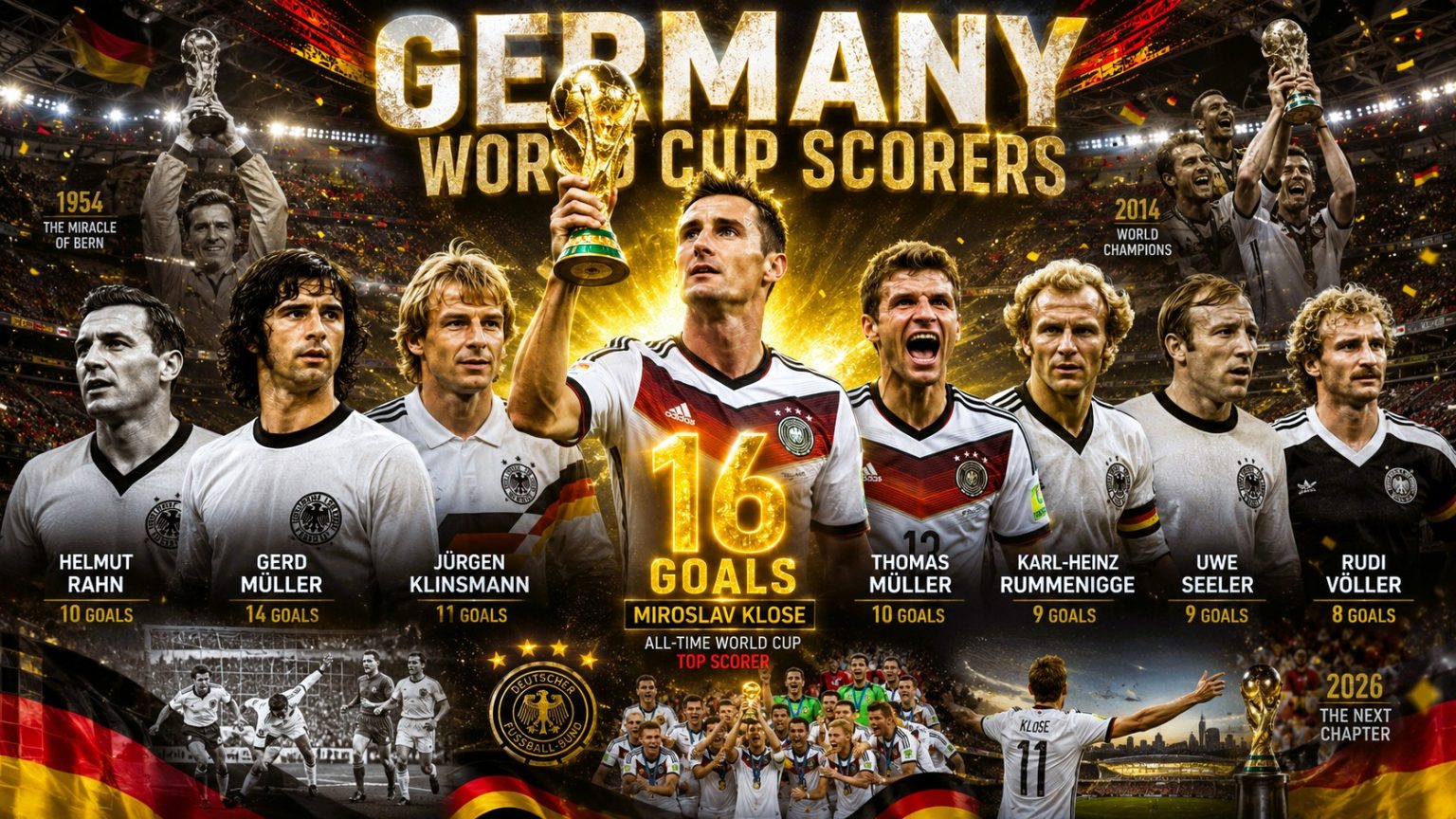
Miroslav Klose is Germany’s all-time top scorer at the FIFA World Cup with 16 goals across four tournaments from 2002 to 2014.
He also holds the all-time FIFA World Cup scoring record, surpassing Brazil legend Ronaldo Nazário during the 2014 semifinal against Brazil.
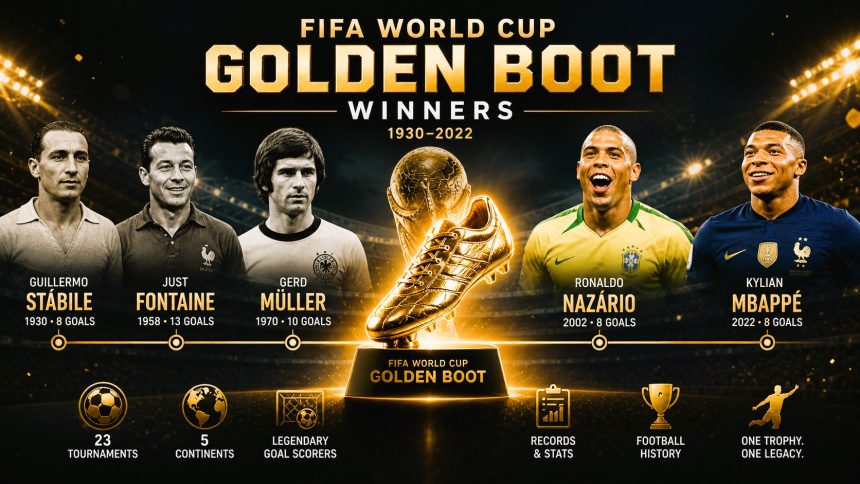
Klose’s achievement surpassed the legendary Gerd Müller, who scored 14 goals in just 13 matches across two tournaments.
While Müller’s goals-per-game ratio of 1.08 remains arguably more devastating, Klose’s longevity, consistency across four editions, and his record-breaking 16th goal against Brazil in the 2014 semifinal cement his status as the greatest Germany all-time World Cup scorer.

No other player in Germany World Cup history comes close to these two giants. Jürgen Klinsmann is third with 11 goals, a full five behind Klose’s record.
Germany Players with the Most FIFA World Cup Goals
Below is the complete ranking of the Germany World Cup top goal scorers in FIFA World Cup history, incorporating every player who has scored for Germany (including West Germany) at the tournament.
Germany World Cup Top Scorers
| Rank | Player | Goals | Matches | Goals Per Match | World Cups | Years |
| 1 | Miroslav Klose | 16 | 24 | 0.67 | 4 | 2002–2014 |
| 2 | Gerd Müller | 14 | 13 | 1.08 | 2 | 1970–1974 |
| 3 | Jürgen Klinsmann | 11 | 17 | 0.65 | 3 | 1990–1998 |
| 4 | Helmut Rahn | 10 | 10 | 1.00 | 2 | 1954–1958 |
| 5 | Thomas Müller | 10 | 16 | 0.63 | 3 | 2010–2018 |
| 6 | Karl-Heinz Rummenigge | 9 | 19 | 0.47 | 3 | 1978–1986 |
| 7 | Uwe Seeler | 9 | 21 | 0.43 | 4 | 1958–1970 |
| 8 | Rudi Völler | 8 | 15 | 0.53 | 3 | 1986–1994 |
| 9 | Hans Schäfer | 7 | 10 | 0.70 | 2 | 1954–1958 |
| 10 | Max Morlock | 6 | 9 | 0.67 | 2 | 1954–1958 |
Statistics include West Germany and are based on official FIFA World Cup data through the 2022 tournament. 2026 figures will be updated following the North America World Cup.
Top 10 Germany World Cup Scorers
1. Miroslav Klose — 16 Goals

When historians debate the Germany FIFA World Cup goals record, every conversation begins and ends with Miroslav Klose.
Born in Poland and raised in Germany, Klose became not only the Germany all-time World Cup scorer but the holder of the all-time FIFA World Cup scoring record — a mark that may stand for generations.
Klose announced himself to the world at Korea/Japan 2002, scoring five goals with a series of trademark acrobatic headers that announced a new era in German attacking football.
He added another five at Germany 2006, playing in front of a home crowd that roared his name. At South Africa 2010, despite an ageing squad, Klose delivered four more goals. And then came Brazil.
At the 2014 FIFA World Cup, Klose wrote history in the most dramatic fashion possible.
In the semifinal against Brazil, he came off the bench and scored his 16th World Cup goal, surpassing Ronaldo Nazário’s long-standing record of 15.
The stadium fell silent; Klose, characteristically humble, celebrated with quiet dignity.
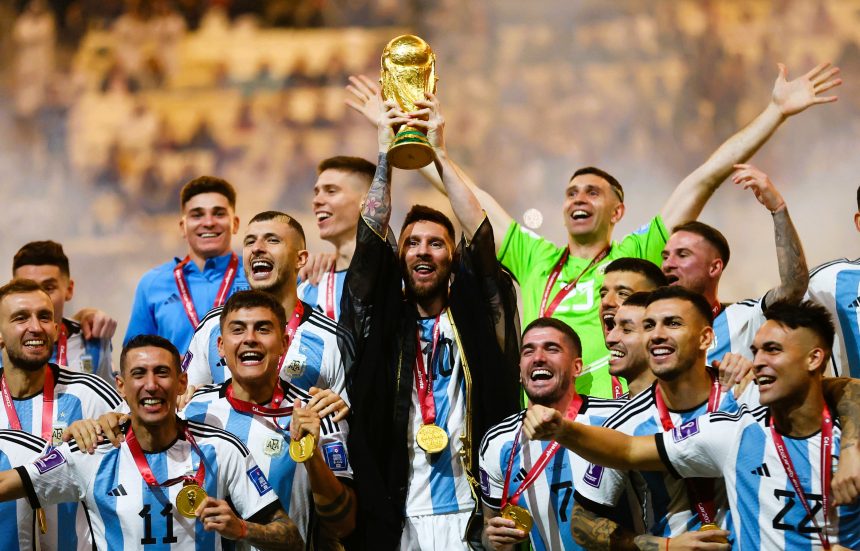
Germany went on to win the match 7–1 — the most devastating result in World Cup semifinal history — and claimed the trophy against Argentina in the final.
Klose’s Klose World Cup scoring record remains the gold standard for Germany FIFA World Cup goals.
His consistency across four consecutive tournaments — scoring in every one, delivering in knockout stages, and finishing as a world champion — defines what Germany World Cup scorers aspire to be.
2. Gerd Müller — 14 Goals
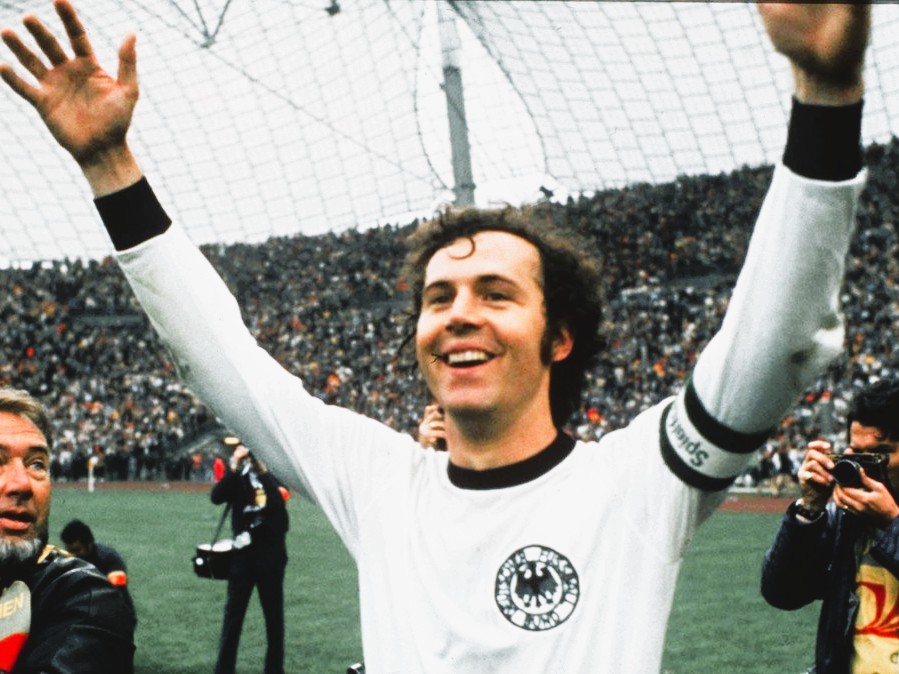
If Klose’s achievement is defined by longevity, Gerd Müller’s is defined by sheer, terrifying efficiency.
Nicknamed Der Bomber der Nation, Müller scored 14 World Cup goals in only 13 matches — a goals-per-game ratio of 1.08 that no player in World Cup history has come close to matching across a comparable number of games.
At the 1970 FIFA World Cup in Mexico, Müller was simply unstoppable. He scored 10 goals in six matches, winning the World Cup Golden Boot and tearing apart every defence he faced.
His performances in that tournament — including hat-tricks and crucial knockout-stage goals — remain among the greatest individual World Cup scoring runs in the sport’s history.
Despite Germany losing a breathtaking semifinal to Italy 4–3 (a match still called Il Partita del Secolo, the Game of the Century), Müller’s brilliance was undeniable.
Four years later, on home soil at the 1974 World Cup in West Germany, Müller delivered when it mattered most.
In the final against the Netherlands — a Dutch side containing Johan Cruyff and widely regarded as the best team in the world — Müller turned in a cramped penalty area and fired a low shot past Jan Jongbloed to make it 2–1.
Germany never looked back. That Gerd Müller World Cup-winning goal secured the nation’s second world title and confirmed Müller as the deadliest Germany World Cup scorer of his generation.
Müller passed away in August 2021, but his legacy endures as one of the greatest forwards in the history of the game and in German football history.
3. Jürgen Klinsmann — 11 Goals
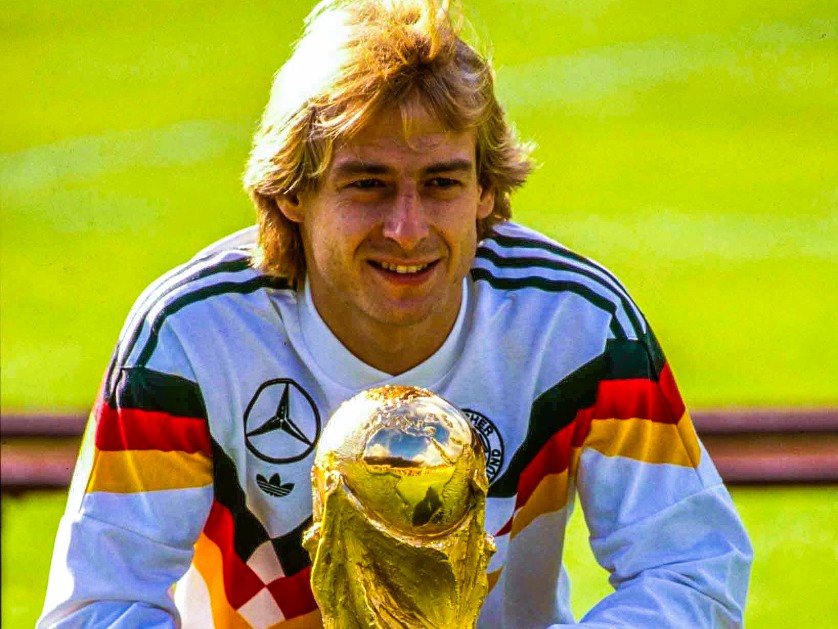
Jürgen Klinsmann stands as one of the most complete forwards in Germany football legends history — a player of intelligence, athleticism, and clinical finishing who contributed 11 goals across three FIFA World Cup tournaments.
Klinsmann first appeared on the world stage at Italia 1990, a tournament that ended in glory as West Germany defeated Argentina 1–0 in the final.
His performances throughout the tournament — combining goals with pressing, leadership, and movement off the ball — earned him recognition as one of Europe’s elite strikers.
At USA 1994, playing in sweltering summer heat, he continued to deliver, and he bowed out of the World Cup at France 1998 still among the most dangerous attackers in the competition.
What separated Klinsmann from his peers was his ability to perform across different styles of German football, adapting to different systems while consistently finding the net at the highest level.
His total of 11 Jurgen Klinsmann World Cup goals places him firmly in the upper tier of all-time Germany all-time football scorers World Cup rankings.
He would later return to German football as the national team manager, leading Germany to a famous third-place finish at the 2006 World Cup on home soil — helping launch a new golden generation.
4. Helmut Rahn — 10 Goals
The name Helmut Rahn is inseparable from one of football’s greatest upsets and one of Germany’s greatest World Cup goals.
At the 1954 FIFA World Cup in Switzerland, West Germany — a nation still rebuilding from the devastation of World War II — produced what became known as the Miracle of Bern, defeating the mighty Hungarian side, considered by many the greatest team ever assembled, in the final.
Rahn was the hero. His 84th-minute equaliser and then his 87th-minute winner — a fierce left-footed strike past goalkeeper Gyula Grosics — delivered one of the most extraordinary upsets in football history.
Hungary had beaten Germany 8–3 in the group stage. It made no difference. Rahn, a powerful winger from Essen with a ferocious shot, had written history.
His 10 Helmut Rahn World Cup goals across two tournaments (1954 and 1958) place him among the finest Germany World Cup attacking legends the sport has ever seen.
More than his statistics, Rahn’s goals in 1954 represented the symbolic rebirth of German football and of Germany itself on the world stage.
5. Thomas Müller — 10 Goals
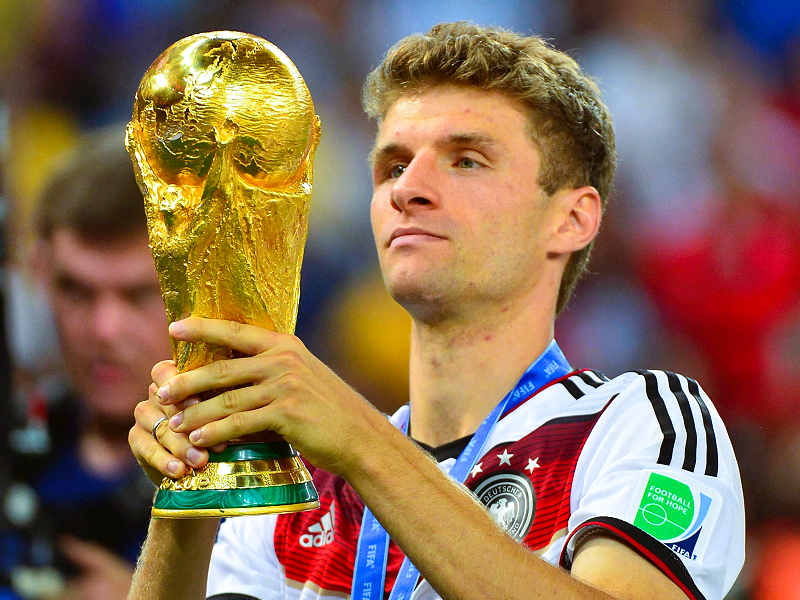
Thomas Müller is one of the most unique and beloved figures in Germany World Cup history — a player who defies conventional attacking categorisation and consistently produces when the pressure is highest.
At the 2010 FIFA World Cup in South Africa, Müller was a revelation.
Playing in just his second international tournament, the then-20-year-old Bayern Munich midfielder scored five goals and provided three assists, claiming the World Cup Golden Boot as the tournament’s top scorer and the Best Young Player award simultaneously.
His performances against England — where he scored twice in a 4–1 rout — and against Argentina became defining Thomas Müller World Cup goals moments.
Four years later at Brazil 2014, Müller added five more goals and was a key architect of Germany’s fourth world title. His hat-trick against Portugal in the group stage set the tone for a dominant German campaign.
Müller’s positional play — what he himself calls Raumdeuter (space interpreter) — gives him a unique ability to arrive in dangerous positions without traditional dribbling or pace.
With 10 Germany FIFA World Cup goals, he sits alongside Helmut Rahn in the all-time rankings, and there have been persistent discussions about a possible Thomas Müller 2026 appearance if he remains part of the national team conversation.
6. Karl-Heinz Rummenigge — 9 Goals
Karl-Heinz Rummenigge was the defining German footballer of the early 1980s — a powerful, technically gifted forward who captained West Germany to successive World Cup finals in 1982 and 1986, ultimately finishing on the losing side both times despite extraordinary individual performances.
His 9 Karl-Heinz Rummenigge World Cup goals came across three tournaments, with his finest performances arriving under enormous physical strain.
At Spain 1982, playing while carrying a muscle injury, Rummenigge came off the bench to inspire a stunning comeback against France in the semifinal before Germany eventually fell to Italy in the final.
His goals in that campaign demonstrated both his quality and his resilience.
In 1986 in Mexico, Rummenigge scored in the final against Argentina — Germany trailed 2–0 before mounting a remarkable fightback to level at 2–2, only to concede a winner to Burruchaga in the closing stages.
His contribution across multiple tournaments places him firmly among Germany World Cup legends.
7. Uwe Seeler — 9 Goals
Uwe Seeler shares the remarkable distinction with Miroslav Klose of having scored in four consecutive FIFA World Cups — a feat that speaks to extraordinary longevity, durability, and class at the international level.
Seeler represented West Germany from 1958 through 1970, a career spanning three different footballing generations.
A compact, powerful centre-forward renowned for his heading ability and never-say-die spirit, Seeler was adored in Hamburg and across West Germany as the people’s footballer — humble, hardworking, and consistently brilliant on the biggest stage.
His 9 Uwe Seeler World Cup goals may not carry the same statistical weight as Klose’s 16, but the consistency across four tournaments — and his role in shaping Germany football history across a transformative era — makes him one of the true Germany World Cup legends.
8. Rudi Völler — 8 Goals
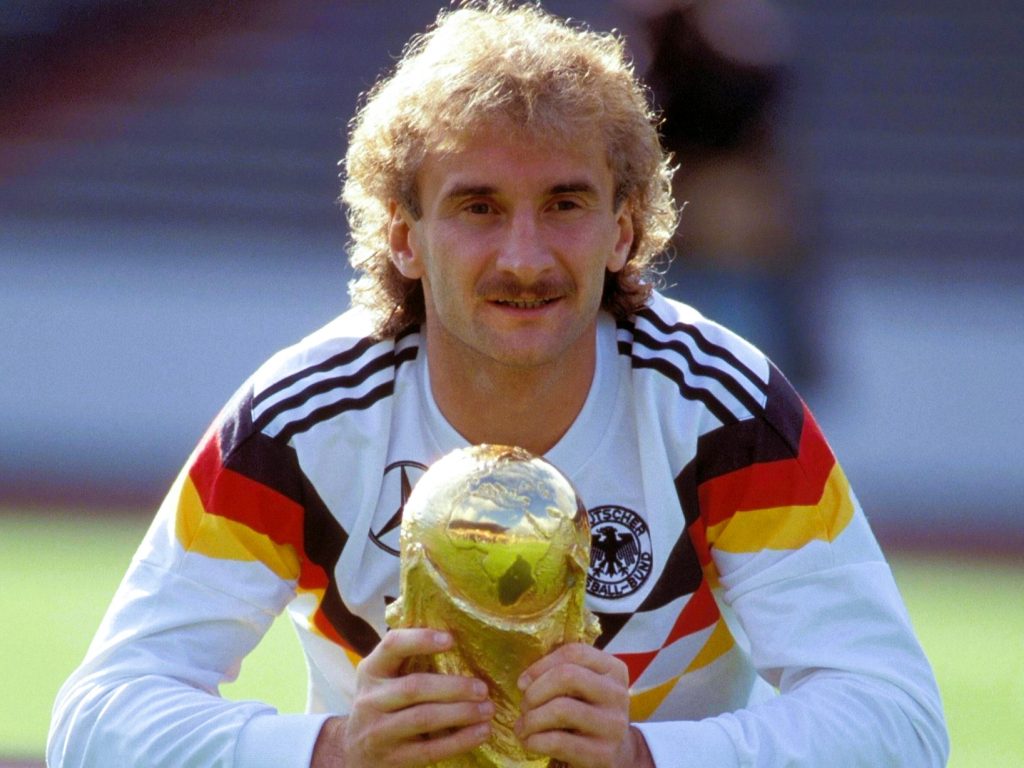
Rudi Völler was one of the most effective strikers of the late 1980s and early 1990s, forming a devastating partnership with Jürgen Klinsmann that powered West Germany to the 1990 World Cup title in Italy.
His 8 Rudi Völler World Cup goals came across three tournaments, with his most important contributions arriving at Italia 1990 — where he was part of arguably the most organised and tactically disciplined German squad ever assembled under manager Franz Beckenbauer.
Völler’s ability to hold up play, combine with teammates, and score crucial goals made him the ideal attacking partner.
He also appeared in multiple Germany World Cup finals — as a player in 1986 and 1990, experiencing both defeat and triumph.
His World Cup legacy is inseparable from the great German sides of that era, and he later served as Germany’s national team manager, leading the side to the 2002 World Cup final.
9. Hans Schäfer — 7 Goals
Hans Schäfer was one of the attacking architects of West Germany’s 1954 World Cup triumph, contributing 7 goals across his World Cup career and playing a crucial role in the matches that built toward the Miracle of Bern.
A versatile forward capable of playing across the attacking line, Schäfer embodied the spirit of that 1954 squad — technical, courageous, and driven by a collective purpose greater than individual glory.
His performances at the 1954 FIFA World Cup helped establish the foundation of post-war German football history and remain an important chapter in the all-time Germany World Cup scorers record books.
10. Max Morlock — 6 Goals
Max Morlock occupies a special place in the hearts of German football supporters — a player who scored one of the most consequential goals in the country’s footballing history.
In the 1954 World Cup Final against Hungary, with Germany trailing 2–0 after just eight minutes, Morlock reduced the deficit with a composed finish — the first of Germany’s three goals in a stunning comeback.
That goal lit the fuse on one of sport’s greatest upsets. Morlock’s 6 Max Morlock World Cup goals across his career place him 10th in all-time Germany World Cup goal rankings, but his role in 1954’s historic triumph will never be forgotten in German football history.
Miroslav Klose’s FIFA World Cup Goal Record
No examination of Germany FIFA World Cup records is complete without a dedicated appreciation of what Miroslav Klose achieved across 12 years at the tournament.
The numbers:
- 16 goals across four tournaments
- 24 matches played — more than any other player in German World Cup history
- Goals in the group stage, round of 16, quarterfinals, semifinals, and the final
- Knockout-stage goals that eliminated opposition and defined campaigns
Klose’s landmark moment came on 8 July 2014 in Belo Horizonte. Germany faced Brazil in the World Cup semifinal.
With the score at 1–0 and Brazil reeling, Klose latched onto a rebound in the 23rd minute and side-footed the ball into the net.
It was his 16th World Cup goal — one more than Ronaldo Nazário’s 15, which had stood as the all-time record since 2002. Klose turned to the crowd, raised two fingers, and smiled. The record was his.
Germany went on to win 7–1 — still the most stunning scoreline in World Cup semifinal history — and then defeated Argentina 1–0 in extra time to claim their fourth world title.
Klose finished his World Cup career as a champion and a record-holder. No German and no player in FIFA World Cup all-time scorers history has ever scored more.
Germany’s Greatest FIFA World Cup Goals
Götze vs Argentina — 2014 Final (Extra Time)
Mario Götze’s winning goal in the 2014 World Cup Final in Rio de Janeiro may be the most celebrated moment in modern German football history.
With the score locked at 0–0 after 90 minutes, Götze — who had come on as a substitute — controlled André Schürrle’s cross on his chest and volleyed left-footed into the bottom corner in the 113th minute.
Germany’s fourth world title. The image of Joachim Löw embracing the bench, and of Götze sliding on his knees across the Maracanã turf, will endure forever.
Gerd Müller vs Netherlands — 1974 Final
Described above in Müller’s profile, his instinctive turn-and-finish in the 43rd minute at the Olympiastadion in Munich gave West Germany the lead they would never relinquish.
It was the Gerd Müller World Cup-winning goal that ended Dutch dreams and delivered Germany’s second world title against the greatest team of the era.
Klose vs Brazil — 2014 Semifinal
The record-breaking 16th goal. The quiet celebration. The 7–1 scoreline. This was history in real time — not just Germany World Cup records being shattered, but the entire sport’s understanding of what was possible in a World Cup semifinal being rewritten.
Thomas Müller vs England — 2010 Round of 16
Müller’s brace in a 4–1 demolition of England — coming after Frank Lampard’s ghost goal that should have made it 2–2 was disallowed — announced Germany’s 2010 generation to the world.
His energy, movement, and composure made him impossible to handle, and the Thomas Müller World Cup goals in that match set the tone for a tournament-defining run.
Helmut Rahn vs Hungary — 1954 Final
The original German World Cup miracle. Rahn’s 87th-minute winner against the Mighty Magyars remains one of the most dramatic goals in the history of the sport.
The radio commentary — “Rahn müsste schießen… Rahn schießt… Tooooor!” — still raises the hairs on the necks of German football supporters decades later.
Germany FIFA World Cup Records and Statistics
Most Goals in a Single World Cup for Germany
Gerd Müller’s 10 goals at the 1970 FIFA World Cup in Mexico remains the single-tournament record for a German player.
No other Germany player has scored more than five in a single tournament.
Klose and Klinsmann each reached five in 2002 and 2006 respectively, but Müller’s mark stands unchallenged as the most dominant single-tournament Germany World Cup statistics achievement.
Most Knockout Stage Goals
Miroslav Klose excelled in the knockout rounds — where it matters most. Of his 16 World Cup goals, a significant portion came in the round of 16, quarterfinals, semifinals, and final.
This ability to deliver in high-pressure elimination matches defines his legacy as more than just a group-stage accumulator.
Youngest Germany World Cup Scorer
Germany has a history of young attackers breaking through at World Cups — Thomas Müller (20 in 2010) is among the youngest to make an immediate impact, though historical research into the 1934 and 1938 editions may yield earlier records in the more distant Germany World Cup history.
Oldest Germany World Cup Scorer
Miroslav Klose scored at the 2014 World Cup at the age of 36 years and 21 days, making him one of the oldest Germans to score at the tournament.
His final World Cup goal — the record-breaking 16th — came in the twilight of his career and represents one of sport’s most enduring examples of longevity at the highest level.
Most World Cup Matches for Germany
Lothar Matthäus holds the record for most World Cup match appearances by a German player, with 25 games played across five tournaments (1982–1998).
While not primarily a scorer, Matthäus remains the embodiment of Germany World Cup appearances longevity and leadership.
Germany at the 2026 FIFA World Cup
The Germany 2026 World Cup campaign represents one of the most eagerly anticipated chapters in German football history.
After a disappointing group-stage exit at Russia 2018 and an early quarterfinal defeat at Qatar 2022, Germany is rebuilding under manager Julian Nagelsmann with a squad that blends experience with exceptional young talent.
The Germany 2026 World Cup squad is expected to feature two of the most exciting young players in European football:
Jamal Musiala — the Bayern Munich midfielder, born in Stuttgart and raised partly in England, has already established himself as one of the world’s most gifted technical players.
His close control, dribbling ability, and football intelligence in tight spaces make him capable of unlocking any defence.
At 22 by the time the 2026 tournament begins, the Jamal Musiala World Cup campaign could be the one that defines a generation.
Florian Wirtz — the Bayer Leverkusen playmaker has emerged as arguably the most creative player in the Bundesliga.
His vision, passing range, and ability to deliver in crucial moments give Germany a player capable of winning matches on his own.
A Florian Wirtz Germany World Cup campaign at full fitness would represent one of the most exciting individual storylines at the tournament.
Germany future football stars also include Leroy Sané, Kai Havertz (should he find World Cup form), and a new generation of full-backs and central midfielders emerging through the Bundesliga.
As for Thomas Müller, questions about his Thomas Müller 2026 inclusion remain. At 36 by the tournament, his return to the squad remains possible but uncertain — though few would rule out one final chapter for the country’s most naturally gifted footballing intelligence.
Germany’s pursuit of a fifth World Cup title — which would take them level with Brazil — remains the driving ambition.
After a period of transition, 2026 could be the moment when the next generation of German World Cup players announces itself to the world.
Germany’s Greatest World Cup Attacking Legends
Any comprehensive review of German football legends World Cup history must celebrate the players who defined not just Germany’s record books but the history of the tournament itself.
These are the figures who made Germany synonymous with clinical, efficient, and devastating attacking football:
Miroslav Klose — The record holder. Sixteen goals across four tournaments. A champion. A gentleman. The greatest Germany World Cup scorer of all time.
Gerd Müller — The most efficient striker in World Cup history. Fourteen goals at more than one per game. Two world titles. Der Bomber. One of the greatest forwards the sport has ever seen.
Jürgen Klinsmann — Three tournaments, 11 goals, one world title. A complete modern forward whose intelligence and athleticism defined an era.
Thomas Müller — Two Golden Boots, 10 goals, one world title. The Raumdeuter who redefined what a World Cup attacking midfielder could be.
Karl-Heinz Rummenigge — Three finals, nine goals, and the defining German captain of the 1980s. His performances while injured at Spain 1982 remain among the most courageous in the tournament’s history.
Rudi Völler — Eight goals, one world title, two finals. The ideal partner striker who embodied German collective football at its finest.
Helmut Rahn — The Miracle of Bern’s hero. Ten goals. The man who gave Germany its football identity.
Uwe Seeler — Four World Cups, nine goals, and a career that spanned an era of transformation in the German game.
Together, these Germany World Cup attacking legends have contributed over 90 goals to the Germany World Cup scoring rankings and have shaped a tournament legacy unlike that of any other nation except Brazil.
Frequently Asked Questions
Who scored the most World Cup goals for Germany?
Miroslav Klose, with 16 goals across four tournaments (2002, 2006, 2010, 2014). He also holds the all-time FIFA World Cup record.
How many World Cup goals does Klose have?
16 — the all-time record for any player in FIFA World Cup history.
Did Gerd Müller score more than Thomas Müller?
Yes. Gerd Müller scored 14 World Cup goals; Thomas Müller has scored 10.
Who is Germany’s top World Cup scorer?
Miroslav Klose, with 16 goals.
Which German player scored in a World Cup final?
Several, including Gerd Müller (1974), Karl-Heinz Rummenigge (1986), Rudi Völler (1986), and Mario Götze (2014, the winner).
Who scored the most goals in one World Cup for Germany?
Gerd Müller, with 10 goals at the 1970 FIFA World Cup in Mexico — also the Golden Boot that year.
Who is Germany’s youngest World Cup scorer?
Historical records vary, but Thomas Müller at 20 years old in 2010 is among the most prominent modern examples.
Could Jamal Musiala become Germany’s next great World Cup scorer?
His talent certainly puts him in that conversation. If Germany progresses deep into the 2026 tournament, Musiala has the quality to establish himself among the Germany World Cup scoring rankings all-time list.
Conclusion
Germany’s story at the FIFA World Cup is one of the most extraordinary in the history of sport. Four titles. Eight finals. Scores of legendary players. And a Germany World Cup scorers list that reads like a who’s who of the greatest forwards the game has ever produced.
At the top of that list stands Miroslav Klose — 16 goals, four tournaments, one world title, and the all-time record that may outlast every other mark in the game.
Below him, Gerd Müller’s 14 goals at over a goal per game make a legitimate case for the greater pure scoring achievement.
And around them, Klinsmann, Rahn, Thomas Müller, Rummenigge, Seeler, Völler, and the heroes of 1954 form a tapestry of German football history unlike anything the sport has seen from a single nation outside Brazil.
Now, as Germany looks toward the Germany 2026 World Cup with Musiala, Wirtz, and the next generation of Germany future football stars, the tradition continues.
The records may stand — Klose’s 16 goals may never be beaten — but the pursuit of adding to Germany all-time football scorers World Cup history will drive every player who pulls on that white shirt in North America in the summer of 2026.
The Germany World Cup legends of tomorrow are just beginning to write their stories. And if history is any guide, they will be extraordinary ones.