








Germany’s story at the FIFA World Cup is unlike any other in the history of football.
From the Black Forest to the beaches of Brazil, from the glaciers of Switzerland in 1954 to the sun-drenched stadiums of Qatar in 2022, Die Mannschaft have been a permanent, dominant, and defining presence at the sport’s greatest tournament.
No nation has appeared in more World Cup finals — eight in total. Only Brazil, with five titles, has lifted the trophy more often. And in terms of sheer consistency across generations, Germany stands alone.
That consistency is not accidental. It is built on a culture of physical intensity, tactical discipline, and above all, the kind of longevity that produces players who show up not once or twice on the biggest stage, but four or five times.
The players who have accumulated the most World Cup appearances for Germany are not merely talented footballers — they are serial competitors, leaders, and winners who made the World Cup their arena across decades.
In this article, we rank the Germany players with the most FIFA World Cup appearances from 1930 to 2026, profile each legend, examine Germany’s all-time records, and look ahead to the 2026 edition — hosted across the United States, Canada, and Mexico — where a new generation of Germans will add their chapters to one of sport’s most extraordinary histories.
Germany have played in 20 of the 22 World Cup tournaments held to date (they did not participate in 1930 and were banned in 1950).
They have reached the final eight times, won four titles (1954, 1974, 1990, 2014), and produced some of the most iconic players and moments the tournament has ever seen.


Their record of consistency is matched by the quality of those who have carried the shirt — and nowhere is that quality better measured than in World Cup appearance counts.
Which Germany Player Has the Most FIFA World Cup Appearances?
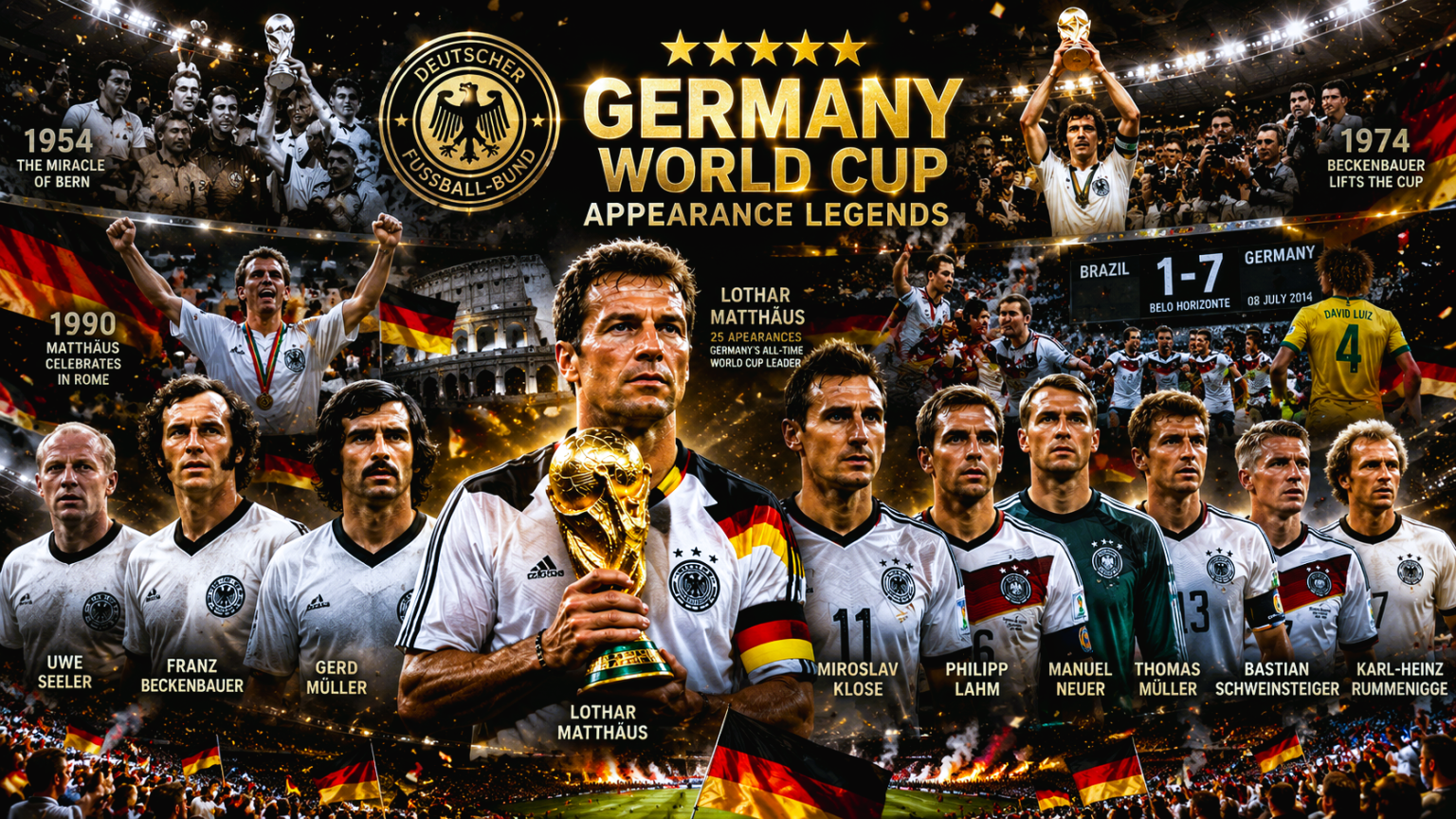
The outright record holder among Germany players is Lothar Matthäus, with 25 World Cup appearances across five tournaments spanning 1982 to 1998.
For many years, Matthäus also held the all-time record across all nations — a distinction he kept until Argentina’s Lionel Messi surpassed him in the 2022 final in Qatar, reaching 26.
Close behind Matthäus is Miroslav Klose with 24 appearances across four tournaments, making him the second-most experienced German in World Cup history.
Uwe Seeler sits third with 21 appearances — a figure that, when he retired in 1970, made him the first player in history to reach 20 World Cup matches.
Then come Philipp Lahm and Bastian Schweinsteiger joint fourth on 20 apiece, with a six-way tie at 19 that includes Thomas Müller, Manuel Neuer, Per Mertesacker, Wolfgang Overath, Karl-Heinz Rummenigge, and Berti Vogts.
The sheer depth of that list — spanning 1958 through to 2018, covering defenders, midfielders, goalkeepers, and forwards — tells you everything about Germany’s culture of World Cup excellence.
Germany Players with the Most FIFA World Cup Appearances
Germany World Cup appearance leaders
| Rank | Player | Position | World Cup Tournaments | Appearances | WC Goals |
| 1 | Lothar Matthäus | Midfielder | 5 (1982–1998) | 25 | 6 |
| 2 | Miroslav Klose | Forward | 4 (2002–2014) | 24 | 16 |
| 3 | Uwe Seeler | Forward | 4 (1958–1970) | 21 | 9 |
| 4 | Philipp Lahm | Defender | 3 (2006–2014) | 20 | 1 |
| 4 | Bastian Schweinsteiger | Midfielder | 3 (2006–2014) | 20 | 5 |
| 6 | Per Mertesacker | Defender | 3 (2006–2014) | 19 | 1 |
| 6 | Thomas Müller | Forward | 3 (2010–2018) | 19 | 10 |
| 6 | Manuel Neuer | Goalkeeper | 3 (2010–2018) | 19 | 0 |
| 6 | Wolfgang Overath | Midfielder | 3 (1966–1974) | 19 | 3 |
| 6 | Karl-Heinz Rummenigge | Forward | 3 (1978–1986) | 19 | 9 |
| 6 | Berti Vogts | Defender | 3 (1970–1978) | 19 | 0 |
Note: Franz Beckenbauer (18), Sepp Maier (18), and Toni Kroos (17) also rank among Germany’s all-time World Cup appearance leaders just outside the top 11.
All statistics based on official FIFA World Cup data through the 2022 tournament. 2026 figures will be updated following the North America World Cup.
Top 10 Germany Players with Most World Cup Appearances
1. Lothar Matthäus – 25 Appearances
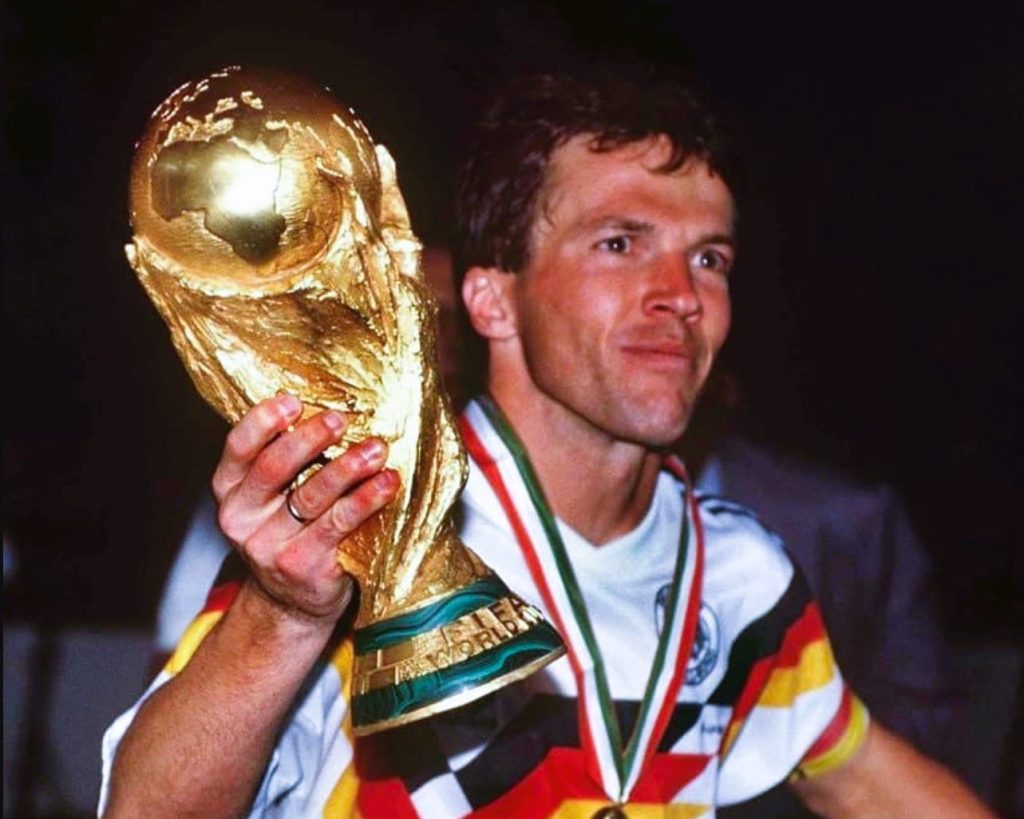
Tournaments: 1982, 1986, 1990, 1994, 1998 | Goals: 6
There is only one place to begin, and his name is Lothar Matthäus.
The greatest appearance-maker in German World Cup history — and for decades the greatest in the history of the tournament itself — Matthäus is a titan whose record reflects not just talent, but an almost superhuman competitive drive that refused to age.
Born in Erlangen, Bavaria, in 1961, Matthäus made his World Cup debut in Spain in 1982 as a 21-year-old midfielder bursting with pace and aggression.
West Germany reached the final that year, losing to Italy. He was back in 1986 in Mexico, where West Germany again reached the showpiece — this time falling to Argentina and Diego Maradona.
Then came 1990, and Italy, and the moment Matthäus would define himself for all time.
As captain of West Germany, Matthäus led his country to the World Cup title, winning 1–0 against Argentina in Rome with a performance of total mastery.
That year, he was named the inaugural FIFA World Player of the Year — and the Ballon d’Or. He was at the absolute peak of his powers, the best footballer on the planet.
But what separates Matthäus from merely great players is what came next.
He returned to the World Cup in 1994 in the United States at age 33, and again in France in 1998 at 37 — a feat no German outfield player had ever achieved.
He was transitioning from midfielder to sweeper by then, but he was still competing at the highest level, still Germany’s most important player, still a force on the World Cup stage.
His 25 appearances is a record that stood as the all-time men’s mark until Messi overtook it in 2022.
Matthäus is also Germany’s most-capped international of all time, with 150 appearances spanning two decades.
His World Cup record is the ultimate expression of what longevity and greatness look like in German football.
2. Miroslav Klose – 24 Appearances

Tournaments: 2002, 2006, 2010, 2014 | Goals: 16
If Matthäus holds the appearances record, Miroslav Klose holds the one that may never be broken at all: 16 World Cup goals across 24 matches in four tournaments — the highest total in the history of the men’s FIFA World Cup.
Klose was born in Opole, Poland, and grew up in Germany, representing the national team from 2001 onwards.
His story is one of the great World Cup careers — not because he was the most technically gifted player of his generation, but because he was utterly, devastatingly perfect for the biggest stage.
His movement in the box, his anticipation, his ability to be in exactly the right place at the right time: these were the qualities that made him a World Cup phenomenon even when his club performances were, by the highest standards, merely very good.
He announced himself at his first World Cup in Japan and South Korea in 2002 with five goals, including a hat-trick against Saudi Arabia.
He scored five more in Germany in 2006. Four more in South Africa in 2010. And in Brazil in 2014 — his fourth and final tournament at age 36 — he scored the goal that made history.
His strike against the hosts in the semi-final took his tally to 15 and broke Ronaldo Nazário’s all-time record. He lifted the trophy days later when Germany beat Argentina 1–0 in extra time.
Klose’s 24 appearances span 12 years and four entirely different German teams, yet he remained a consistent presence and contributor throughout.
He scored at least once at every World Cup he attended — one of only a handful of players in history to achieve that across four tournaments.
His combination of appearances and goals makes him arguably the greatest World Cup player Germany has ever produced.
3. Uwe Seeler – 21 Appearances
Tournaments: 1958, 1962, 1966, 1970 | Goals: 9
Long before Klose, Matthäus, or any of the modern generation, there was Uwe Seeler — Hamburg’s beloved son and one of the pioneers of World Cup longevity.
When Seeler retired from international football in 1970, he had played 21 World Cup matches, becoming the first player in the history of the tournament to reach 20 appearances. That milestone alone tells you the scale of his achievement.
Seeler was a centre-forward of the old school — robust, physically powerful, brilliant in the air, and utterly relentless.
He spent his entire club career at Hamburger SV, turning down lucrative offers from Inter Milan and others out of loyalty to his hometown club.
He scored 43 goals in 72 appearances for West Germany, and at the World Cup he was his country’s talisman through four consecutive tournaments.
At his first World Cup in Sweden in 1958, West Germany reached the semi-finals. In 1962 in Chile, they exited in the quarter-finals.
In 1966, in England — captaining his country — Seeler led West Germany all the way to the final at Wembley, where they lost 4–2 to the hosts after extra time.
And in Mexico in 1970, at 34 years old, he helped West Germany finish third in a tournament that produced some of the most spectacular football ever played at a World Cup, including the famous “Game of the Century” semi-final against Italy.
Seeler also became the first player to score in four different World Cup tournaments — a feat that has since been matched only by Pelé, Klose, and Cristiano Ronaldo.
Nicknamed Uns Uwe (Our Uwe) by the people of Hamburg, he was one of FIFA’s 125 greatest living players as named by Pelé in 2004. He passed away in July 2022 at the age of 85, beloved to the last.
4. Philipp Lahm – 20 Appearances
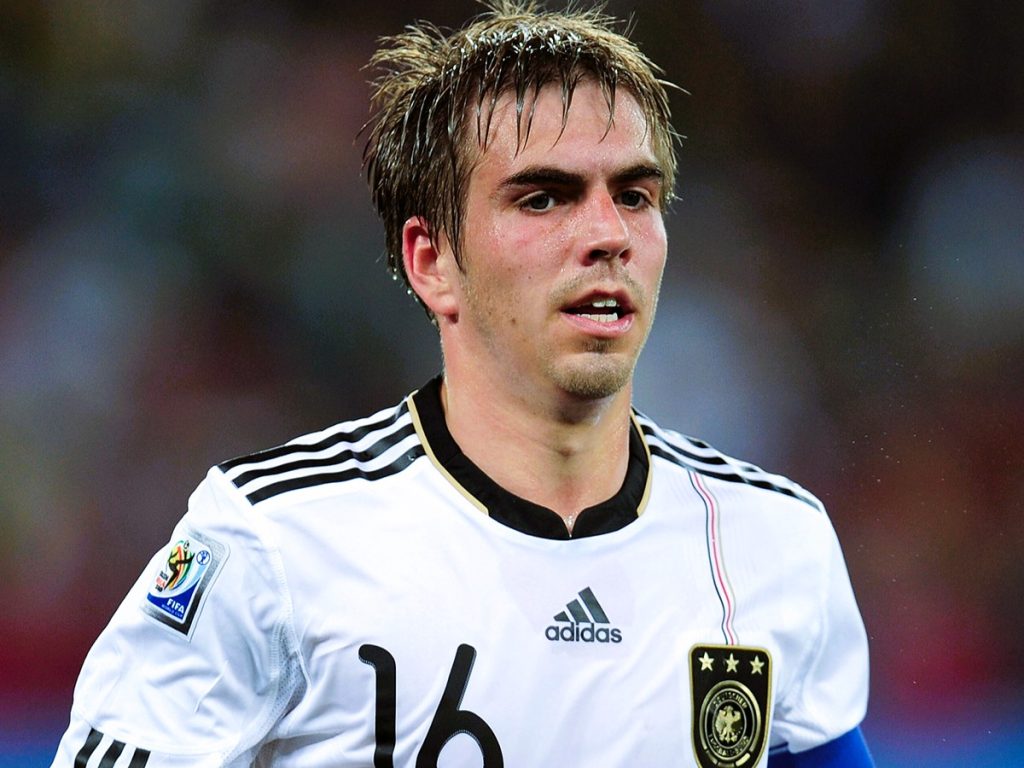
Tournaments: 2006, 2010, 2014 | Goals: 1
Philipp Lahm belongs to a very small group of footballers who can be described without exaggeration as the finest player of his generation in his position.
The Bayern Munich full-back — equally comfortable on the right or left flank, and capable of operating as a central midfielder when required — was the embodiment of German tactical intelligence and precision across three World Cup campaigns.
His debut tournament came on home soil in 2006, when Germany reached the semi-finals and Lahm scored the tournament’s opening goal — a thunderbolt against Costa Rica that set the tone for a summer of football that captivated the host nation.
He was back in South Africa in 2010, where Germany reached the semi-finals once more, playing some of the most exhilarating football of any team in the tournament, including a stunning 4–1 demolition of England and a 4–0 destruction of Argentina.
Then came 2014 in Brazil. As Germany’s captain, Lahm led one of the most cohesive and tactically sophisticated teams in modern World Cup history through seven matches, culminating in a 1–0 extra-time victory over Argentina in the Maracanã.
When Mario Götze’s chip hit the net in the 113th minute, it was Lahm who lifted the trophy — completing one of the great careers in German football.
He retired from international football immediately after that final, leaving at the very summit.
His 20 World Cup appearances across three tournaments, spanning from a 22-year-old debutant to a 30-year-old champion captain, represent the full arc of an extraordinary career.
5. Bastian Schweinsteiger – 20 Appearances

Tournaments: 2006, 2010, 2014 | Goals: 5
Bastian Schweinsteiger’s World Cup career is the story of a player who grew from a flashy, attacking wide midfielder into one of the great central midfielders of his generation — a transformation that played out across three tournaments and reached its emotional peak in Rio de Janeiro in 2014.
He arrived at his first World Cup in Germany in 2006 as a 21-year-old with flair and energy to burn, scoring twice in the third-place playoff against Portugal.
By 2010 in South Africa, he had become a more complete player, one of the orchestrators of Germany’s high-tempo, pressing style that swept past Argentina and Australia before losing to Spain in the semi-final.
And in 2014, Schweinsteiger gave perhaps the most famous individual performance in a World Cup final by any German player not named Matthäus.
Playing through heavy challenges, absorbing punishment, and bleeding from a facial cut in extra time, he ran himself into the ground for 120 minutes against Argentina.
When Götze scored the winner, the image of Schweinsteiger — exhausted, bloodied, and tearful with joy — became one of the defining photographs of that World Cup.
His 20 appearances across three tournaments place him joint fourth all-time for Germany, and his quality, longevity, and warrior mentality make him one of the most beloved German players of the modern era.
6. Per Mertesacker – 19 Appearances
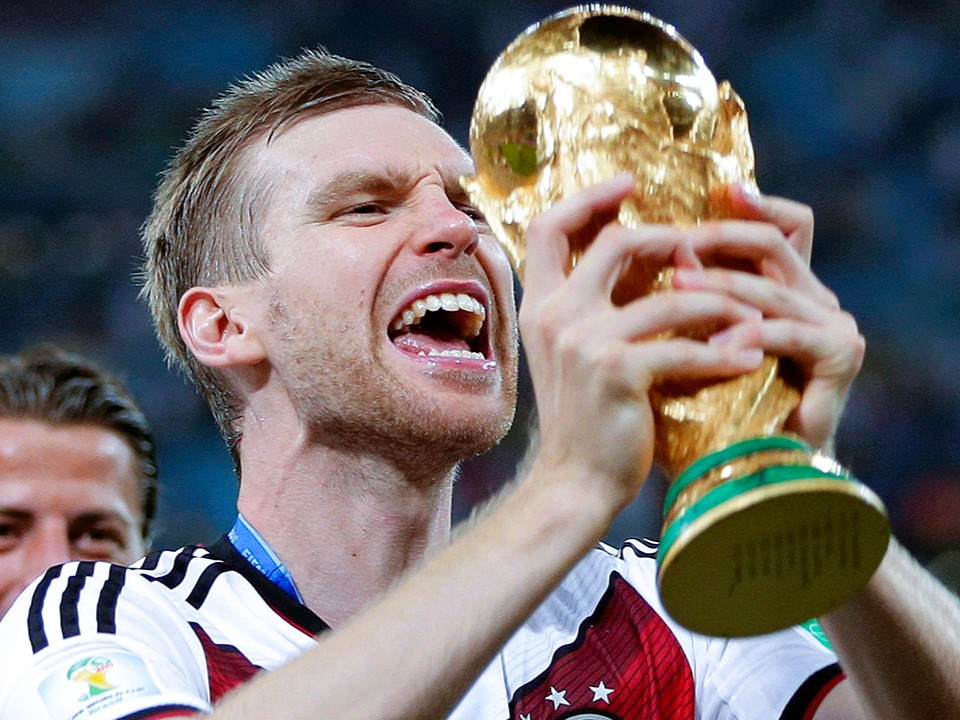
Tournaments: 2006, 2010, 2014 | Goals: 1
Per Mertesacker may not have been the most naturally athletic defender Germany has ever produced — he was famously slow in a straight line — but what he lacked in pace he more than compensated for with aerial dominance, positional intelligence, and an unshakeable composure that made him one of the most reliable central defenders of his generation.
Mertesacker was a cornerstone of Germany’s defence through three consecutive World Cups, forming partnerships first with Christoph Metzelder, then with Arne Friedrich, and finally with Mats Hummels in Brazil in 2014.
That final tournament brought him the winner’s medal his career deserved. His towering presence at set pieces — both defensively and offensively — was an asset that every Germany coach valued, and his 104 international caps reflect just how consistently he delivered.
At club level, Mertesacker’s career reached its peak at Arsenal, where he was a fan favourite and eventually club captain.
He has since become the head of Arsenal’s academy, shaping the next generation. His 19 World Cup appearances, built quietly across three campaigns, cement his place among Germany’s greatest tournament players.
7. Thomas Müller – 19 Appearances
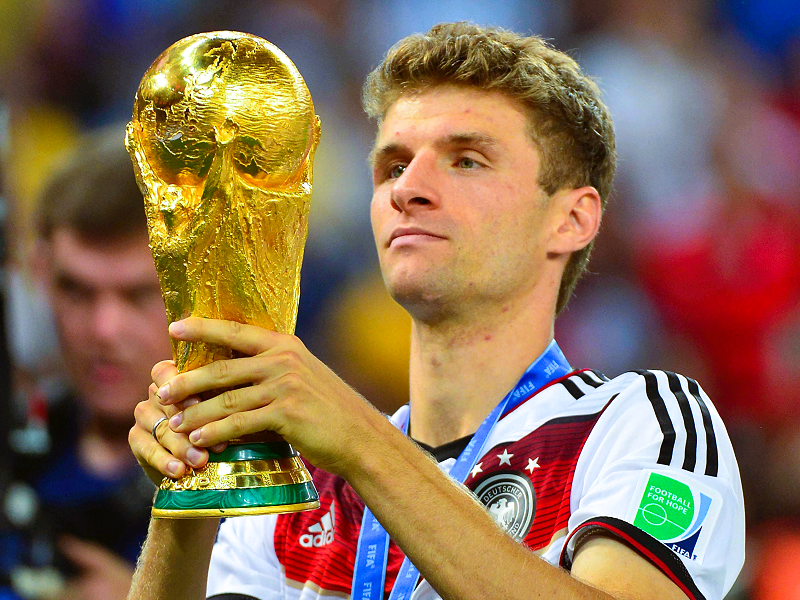
Tournaments: 2010, 2014, 2018 | Goals: 10
Thomas Müller is perhaps the most unique footballer Germany has produced in the modern era. His role — the Raumdeuter, or “space interpreter” — was one he essentially invented for himself: a forward who drifts into gaps before they appear, who anticipates moves before they begin, and who scores and creates at a rate that defies his apparent stylistic limitations.
His World Cup debut at South Africa 2010 was an explosion. Five goals and three assists earned him the Golden Boot as the tournament’s top scorer, at the age of just 20.
He also won the Best Young Player award. Germany went out in the semi-finals to Spain, but Müller’s brilliance had announced a generational talent.
Four years later in Brazil, he was even better. Five more goals, including a hat-trick in the opening match against Portugal, and another in the historic 7–1 semi-final demolition of the host nation.
Germany won the title, and Müller had scored 10 World Cup goals in two tournaments — a pace of scoring that rivals any player in the history of the competition.
His third tournament in Russia in 2018 was a disaster for Germany — the defending champions crashed out at the group stage — but it did not diminish Müller’s standing.
His 19 appearances and 10 goals place him among the elite of German World Cup history, and at 35, he was still playing professional football into 2026, leaving a tantalising open door for a potential fourth tournament.
8. Manuel Neuer – 19 Appearances

Tournaments: 2010, 2014, 2018 | Goals: 0
Manuel Neuer did not merely redefine the role of goalkeeper at the World Cup — he redefined it for the entire sport.
His concept of the sweeper-keeper, playing as an outfield player with ball-playing ability and spatial awareness far beyond any previous goalkeeper, changed the way the position is coached and evaluated across the world.
His World Cup career began in 2010 in South Africa, where Germany reached the semi-finals and Neuer was magnificent throughout, particularly in a round-of-16 victory over England where his saves and command of his area were decisive.
In 2014 in Brazil, he was simply the best goalkeeper in the world, conceding just four goals in seven matches and playing a crucial role in Germany’s title triumph.
His performance in the quarter-final against France — dominating the box, sweeping up through balls, starting attacks — was a masterclass in modern goalkeeping.
He captained Germany at the 2018 World Cup, where the team’s group-stage exit was a humiliation that still stings, but which reflected squad and tactical deficiencies rather than any failure from Neuer himself.
His 19 appearances across three tournaments make him the most experienced German goalkeeper in World Cup history, and one of the greatest shot-stoppers — and most influential players in any position — the tournament has ever seen.
9. Wolfgang Overath – 19 Appearances
Tournaments: 1966, 1970, 1974 | Goals: 3
Wolfgang Overath is one of the great midfielders of European football’s golden era, and his World Cup record — 19 appearances across three tournaments — reflects the remarkable consistency of West Germany’s squads throughout the late 1960s and early 1970s.
An elegant left-footed player of exceptional vision and technique, Overath was the creative engine of West Germany’s midfield through three consecutive World Cups.
He played in the 1966 final loss to England at Wembley, the magnificent 1970 semi-final loss to Italy in Mexico (the 4–3 “Game of the Century”), and the 1974 final victory over the Netherlands on home soil — winning the trophy he deserved on his third attempt.
Overath retired from international football immediately after the 1974 triumph, having given everything he had across twelve years of service to the national team.
He was one of the first great German playmakers of the modern era, and his 19 World Cup appearances across three finals tournaments speak to a decade of excellence at the very highest level.
10. Karl-Heinz Rummenigge – 19 Appearances
Tournaments: 1978, 1982, 1986 | Goals: 9
Karl-Heinz Rummenigge — known simply as Kalle — was one of the most dangerous forwards in the world during the late 1970s and early 1980s, a two-time Ballon d’Or winner whose electric pace, movement, and finishing made him Germany’s most feared attacker across three World Cups.
He burst onto the World Cup scene as a 23-year-old in Argentina in 1978, scoring four goals in a difficult tournament for West Germany.
By 1982 in Spain, he was the best forward in the world, leading Germany to the final where they lost to Italy — despite Rummenigge scoring a famous comeback goal as a substitute in the semi-final against France, one of the most dramatic matches in World Cup history.
The 1986 World Cup in Mexico was Rummenigge’s last — hampered by injury throughout, he still showed flashes of brilliance, including another comeback goal in a pulsating final against Argentina that West Germany ultimately lost to a late Burruchaga winner.
His nine World Cup goals across 19 appearances, despite playing significant portions of two tournaments while not fully fit, underline just how clinical a finisher he was.
11. Berti Vogts – 19 Appearances
Tournaments: 1970, 1974, 1978 | Goals: 0
Berti Vogts — nicknamed “The Terrier” — was among the most tenacious and effective man-marking defenders in the history of German football.
His 19 World Cup appearances across three tournaments mark him as one of the most experienced defenders Germany has ever fielded at the World Cup, and his contribution to the 1974 title-winning team was decisive.
Vogts was the player tasked with marking Johan Cruyff — arguably the greatest player on the planet — in the 1974 final.
Cruyff had won the first penalty of the match in the opening two minutes, and the Netherlands led before Germany had touched the ball.
But Vogts, initially given instructions he disagreed with, eventually took it upon himself to tighten his grip on Cruyff — and as the match wore on, the Dutch genius grew increasingly frustrated and ineffective.
West Germany won 2–1 to claim the World Cup on home soil, and Vogts’s defensive discipline was central to that triumph.
He also captained Germany at the 1978 World Cup in Argentina, featuring in 85 percent of Germany’s international fixtures across his career.
After retirement, he went on to manage Germany to the 1996 European Championship title — becoming one of only a handful of men to win major international tournaments as both player and manager.
Germany’s Greatest FIFA World Cup Legends
Beyond the appearance leaders, the full sweep of Germany’s World Cup history is populated by figures whose legacy extends far beyond statistics.
Franz Beckenbauer
Der Kaiser played 18 World Cup matches across three tournaments (1966, 1970, 1974) and stands as the most influential German player the tournament has ever seen.
He won the World Cup as captain in 1974 and then, incredibly, managed West Germany to the title again in 1990 — making him one of only three men in history to win the World Cup as both player and manager.
His invention of the attacking libero role changed football forever, and his performance in the 1970 semi-final — playing through a dislocated shoulder with his arm strapped to his side — remains one of the great acts of courage in World Cup history.
Gerd Müller
Der Bomber scored 14 World Cup goals in just 13 appearances — a goals-per-game ratio that remains staggering to this day.
He scored the winning goal in the 1974 final against the Netherlands and was the tournament’s top scorer at the 1970 World Cup, notching 10 goals including the winner against England in the quarter-finals.
His record of 14 goals stood as the all-time mark until Ronaldo Nazário overtook it in 2006, and then Klose broke it in 2014.
Miroslav Klose
Already covered in depth above, but worth emphasising in this context: Klose’s 16 World Cup goals across 24 appearances represent a combination of longevity and efficiency that no other player in history has matched.
He is Germany’s greatest World Cup scorer and the greatest World Cup scorer of any nation.
Lothar Matthäus
Germany’s most-capped international, five-tournament survivor, and the man who defined competitive longevity at the World Cup.
His 1990 campaign in Italy remains one of the finest individual performances in the history of the tournament.
Thomas Müller
The Raumdeuter redefined what a modern attacking player can be at a World Cup, scoring 10 goals across just two effective tournaments (2010 and 2014) while also creating chances at a rate that no statistics fully capture.
Germany FIFA World Cup Records and Statistics
Most World Cup Matches by a Germany Player
Lothar Matthäus — 25 appearances (1982–1998)
Most World Cup Goals for Germany
Miroslav Klose — 16 goals (2002–2014), also the all-time men’s World Cup record
Most World Cup Tournaments Played
Lothar Matthäus — five tournaments (1982, 1986, 1990, 1994, 1998)
Germany’s Best World Cup Finish
Winners — 1954, 1974, 1990, 2014 (four titles)
Germany’s Biggest World Cup Win
8–0 vs Saudi Arabia (2002, Group Stage)
Germany’s Most Iconic Result
7–1 vs Brazil (2014, Semi-final) — the most decisive semi-final result in World Cup history
Germany’s World Cup Finals Record
Eight finals appearances: 1954 (W), 1966 (L), 1974 (W), 1982 (L), 1986 (L), 1990 (W), 2002 (L), 2014 (W)
Germany in FIFA World Cup History
Total FIFA World Cup Appearances
Germany have participated in 20 of 22 World Cups (absent in 1930 and banned in 1950). They have played more World Cup matches than any European nation and their overall record — wins, final appearances, and tournament consistency — is surpassed only by Brazil.
FIFA World Cup Titles Won
Germany have won the World Cup four times:
- 1954 — The “Miracle of Bern.” West Germany 3–2 Hungary. Fritz Walter led a team widely expected to lose and produced one of the greatest upsets in the tournament’s history.
- 1974 — Home soil glory. Beckenbauer’s West Germany beat the Netherlands 2–1 in a final that featured one of the great World Cup teams ever assembled.
- 1990 — Matthäus’s masterpiece. West Germany 1–0 Argentina. Brehme’s penalty sealed a title that was built on defensive organisation and the genius of Matthäus.
- 2014 — Götze’s moment. Germany 1–0 Argentina (AET). Mario Götze’s 113th-minute volley completed a 12-year rebuilding project and delivered Germany’s first World Cup title as a unified nation.
Germany’s World Cup Final Appearances
No nation has appeared in more World Cup finals than Germany’s eight. Their record of four wins and four losses in finals represents the most high-stakes consistency in football history.
Germany’s Greatest World Cup Moments
The Miracle of Bern (1954): West Germany’s 3–2 defeat of the formidable Hungarian team — the so-called Golden Team, who had been unbeaten for four years — remains the most unexpected World Cup triumph of the twentieth century.
It was the moment Germany returned to the international stage after the Second World War and gave a nation fractured by defeat something to celebrate.
Beckenbauer’s Arm (1970): In the semi-final against Italy in Mexico — the 4–3 “Game of the Century” — Franz Beckenbauer played for long stretches with a dislocated shoulder, his arm strapped to his side, rather than leave the field.
West Germany lost 4–3 in extra time, but Beckenbauer’s courage became a symbol of everything German football stood for.
The 1990 Title: After losing finals in both 1982 and 1986, Matthäus’s West Germany finally delivered. Andreas Brehme’s penalty in the 85th minute of the final against Argentina gave West Germany their third title.
It was the last World Cup for a divided Germany — within months, reunification would transform the nation.
7–1 vs Brazil (2014): Perhaps the most extraordinary single result in World Cup history. Brazil, the hosts and five-time champions, were dismantled in a semi-final that ended with Germany scoring five goals in an 18-minute spell in the first half.
Thomas Müller scored a hat-trick. Klose broke the all-time scoring record. Brazil were humiliated on home soil. Germany won 7–1.
Götze’s Winner (2014): Mario Götze, having been told by coach Joachim Löw to “show the world you are better than Messi,” entered as a substitute in the final and scored with a sublime chest-and-volley in the 113th minute to beat Argentina. It was the defining moment of modern German football.
Germany Players with 4 or More FIFA World Cups
Only two Germany players have appeared at four or more FIFA World Cups:
Lothar Matthäus (five World Cups): 1982, 1986, 1990, 1994, 1998. The only German ever to appear at five different tournaments, and the second player in history to do so, after Mexico’s Antonio Carbajal.
His five-tournament span of 16 years is an achievement that may never be matched by a German player.
Miroslav Klose (four World Cups): 2002, 2006, 2010, 2014. Klose’s four tournaments produced 16 goals — the most in World Cup history.
His 24 appearances across those four editions make him Germany’s second-most experienced World Cup player of all time.
Uwe Seeler (four World Cups): 1958, 1962, 1966, 1970. The pioneering four-tournament veteran who became the first player in history to reach 20 World Cup appearances and the first to score in four different tournaments.
Players who attended three consecutive World Cups — including Lahm, Schweinsteiger, Neuer, Müller, Mertesacker, Rummenigge, Overath, Vogts, Beckenbauer, and Maier — form the backbone of Germany’s all-time appearance list and represent the continuity of excellence that has defined the national team across every era.
Germany’s Best World Cup Generation
Germany have produced multiple outstanding World Cup squads, each defining their era.
The 1974 side is widely considered one of the greatest teams in World Cup history.
Built around Beckenbauer, Sepp Maier, Paul Breitner, and Gerd Müller, they won on home soil with a style of football that blended tactical sophistication with individual brilliance.
Had they faced any other national team in the final, they would be remembered as unchallenged champions. That they beat the magnificent Dutch team of Cruyff, Neeskens, and Rep makes the achievement even more remarkable.
The 1990 side lacked the creativity of the ’74 team but had steel, organisation, and Matthäus at his absolute peak.
They conceded only five goals in seven matches, and their discipline under pressure — typified by penalty shootout victories and a defence that gave opponents almost nothing — was a masterclass in tournament football.
The 2014 side was the end product of a decade-long overhaul of German football that began after the humiliation of Euro 2000.
Technically gifted, pressing hard, interchangeable across positions, and featuring world-class talents at every line — Neuer, Boateng, Hummels, Lahm, Khedira, Kroos, Müller, Klose, Özil — they played the most complete football of any German team since 1974.
The 7–1 against Brazil remains the peak expression of what they were capable of.
FAQs
Who has the most World Cup appearances for Germany?
Lothar Matthäus holds the record with 25 appearances across five tournaments from 1982 to 1998. He also held the all-time men’s World Cup appearances record until Lionel Messi surpassed him in 2022.
Who scored the most World Cup goals for Germany?
Miroslav Klose scored 16 goals across 24 appearances in four World Cups (2002, 2006, 2010, 2014). This is also the all-time men’s World Cup scoring record.
How many World Cups has Germany won?
Germany have won four FIFA World Cups: 1954, 1974, 1990, and 2014.
Which German player played in five World Cups?
Lothar Matthäus is the only German player to have appeared at five FIFA World Cups, spanning 1982, 1986, 1990, 1994, and 1998. Only a small number of players across all nations have achieved this feat.
Who captained Germany to the 2014 World Cup title?
Philipp Lahm captained Germany throughout the 2014 World Cup in Brazil, lifting the trophy after the 1–0 extra-time victory over Argentina in the Maracanã. He retired from international football immediately after.
Which Germany player has the most World Cup goals?
Miroslav Klose with 16 goals — the highest total by any player in the history of the men’s FIFA World Cup.
Who was the first Germany player to score in four different World Cups?
Uwe Seeler became the first player in history to score in four different World Cup tournaments, achieving the feat across 1958, 1962, 1966, and 1970. The record has since been matched only by Pelé, Klose, and Ronaldo.
What is Germany’s record at the FIFA World Cup?
Germany have participated in 20 World Cups, reached the final eight times, and won four titles. They are one of only two nations (along with Brazil) to have appeared in more than six finals.
Conclusion
The story of Germany at the FIFA World Cup is, ultimately, a story about consistency — the consistency to produce great players in every generation, to develop teams capable of competing at the very highest level tournament after tournament, and to cultivate a football culture in which longevity, discipline, and collective achievement are valued as highly as individual brilliance.
Lothar Matthäus embodies that story in his 25 appearances: five tournaments, sixteen years, and a refusal to ever stop competing.
Miroslav Klose embodies it in his 16 goals: four tournaments, 24 appearances, and a scoring record that may stand for the rest of the century.
Uwe Seeler embodies it in his 21 matches across four World Cups during an era when simply reaching the tournament required a kind of footballing greatness that today’s expanded format makes easier to achieve.
And behind those three giants stand eight more players tied at 19 or 20 appearances — Lahm, Schweinsteiger, Müller, Neuer, Mertesacker, Overath, Rummenigge, and Vogts — each representing a different era, a different position, and a different expression of what it means to be a German player at the World Cup.
As the 2026 FIFA World Cup approaches — hosted by the United States, Canada, and Mexico — Germany’s current generation will have the chance to add their names to this extraordinary list.
A new squad is taking shape under head coach Julian Nagelsmann, with players like Jamal Musiala, Florian Wirtz, and Joshua Kimmich already accumulating World Cup experience. Whether any of them will ultimately challenge the records of Matthäus or Klose remains to be seen.
What is certain is this: Germany will be there, competing hard, organised, and dangerous as ever. They always are.
That, more than any individual record, is the true measure of their World Cup greatness — the consistency of a nation that has never stopped believing the World Cup is theirs to win.