
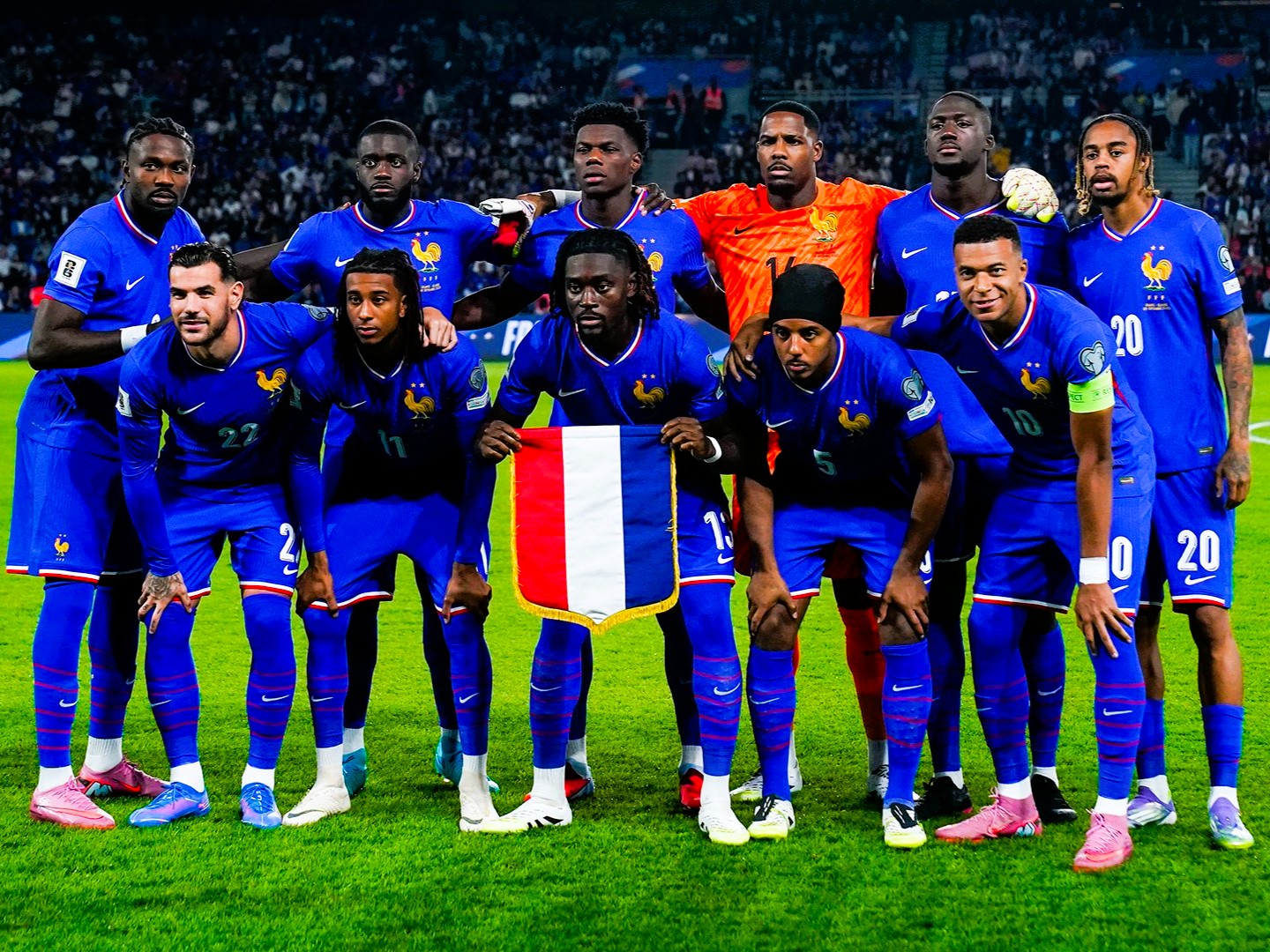

After lifting the trophy in 2018 and suffering a dramatic penalty shootout defeat in the all-time classic final of 2022, France return to the global stage seeking another World Cup crown.
As one of Europe’s dominant footballing powers and a consistent tournament contender, France enter the 2026 FIFA World Cup with expectations firmly set on another deep run.
Led by talisman Kylian Mbappé and head coach Didier Deschamps, Les Bleus combine elite tournament experience with a new generation of world-class talent.
The expanded 48-team tournament, co-hosted by the United States, Canada, and Mexico, introduces a redesigned group stage and an additional knockout round—reshaping the path to football’s ultimate prize.
In this article, we break down France’s road to the 2026 FIFA World Cup Final, analysing group-stage challenges, potential knockout opponents, bracket dynamics, and every realistic route standing between Les Bleus and football immortality.
When Does France’s 2026 FIFA World Cup Journey Begin?
France’s 2026 FIFA World Cup journey begins on Tuesday, June 16, 2026, with a highly anticipated opening group stage match against Senegal.
France’s Group I Opponents
This group is often described as competitive or a potential “Group of Death” due to the mix of a top favorite (France), a solid African side (Senegal), and two dangerous underdogs (Norway’s attacking quality and Iraq’s resilience).
Senegal boasts a seasoned squad with recent knockout-stage experience from the 2022 World Cup.
Backed by an imposing defense anchored by Kalidou Koulibaly, they use intense midfield pressing to create transitional chaos for their opponents.
Norway cruised through European qualifying with an explosive offense.
The creative mastermind, Martin Ødegaard feeds surgical vertical passes to Erling Haaland, presenting a massive tactical headache for anyone trying to defend against them.
Making their first appearance since Mexico 1986, Iraq is riding an emotional wave of national pride.
Managed by Graham Arnold, they are expected to play highly disciplined, deep-defending football while leaning on midfielder Zidane Iqbal for creative counter-attacks.
France is heavily favored to top the group, but Senegal and Norway could challenge for second place, while Iraq aims for surprise results. All group matches occur between June 16–26, 2026.
France Group Stage Schedule
| Date | Opponent | Venue | Time (ET) |
| June 16, 2026 | France vs. Senegal | MetLife Stadium | 3:00 PM |
| June 22, 2026 | France vs. Iraq | Lincoln Financial | 5:00 PM |
| June 26, 2026 | Norway vs. France | Gillette Stadium | 3:00 PM |
France Group Standings
| Team | P | W | D | L | GF | GA | GD | Pts |
|---|---|---|---|---|---|---|---|---|
| France | 0 | 0 | 0 | 0 | 0 | 0 | 0 | 0 |
| Senegal | 0 | 0 | 0 | 0 | 0 | 0 | 0 | 0 |
| Norway | 0 | 0 | 0 | 0 | 0 | 0 | 0 | 0 |
| Iraq | 0 | 0 | 0 | 0 | 0 | 0 | 0 | 0 |
How France Qualifies for the Knockout Stage
The 2026 World Cup will feature a 48-team format with 12 groups of four teams.
The top two teams from each group will automatically advance to the round of 32, along with the eight best third-placed teams from all groups.
This means that 32 teams will now advance to the expanded first knockout stage.
For France, qualification is almost certain given their talent pool. As group winners, they will receive nine points from three wins; two wins and a draw (seven points) should also be enough for at least second place.
In the worst case scenario, finishing third with four to six points could still qualify them as one of the best thirds, especially if goal difference is favourable.
However, aiming lower than first would risk a tough knockout draw.
France Potential Knockout Stage Path
The expansion to 48 teams has forced FIFA to create a unique bracket structure.
A “tennis-style” seeding system has been implemented to ensure the top four nations (Spain, Argentina, France, and England) cannot meet until the semi-finals if they win their groups.
Depending on where France finishes, their path will look drastically different. Groups cross over in predefined ways: Group I winners feed into one side, potentially avoiding powerhouses until later rounds.
France as Group Winner
If France wins Group I, they are placed in the “top half” of the bracket’s quadrant reserved for them.
According to the bracket logic, the Group I winner will face a third-place team from Groups C, D, F, G, or H in the Round of 32. This is the “easier” on-paper route designed to protect the top seeds.
| Round | Potential Opponent | Match Date (2026) | Venue |
|---|---|---|---|
| Round of 32 | 3rd place (Group C/D/F/G/H) | June 30 | MetLife Stadium |
| Round of 16 | Winner of Match 74 | July 4 | Lincoln Financial Field |
| Quarter-final | Winner of Match 90 | July 9 | Gillette Stadium |
| Semi-final | Winner of Match 98 | July 14 | AT&T Stadium |
| Final | TBD | July 19 | MetLife Stadium |
France as Group Runner-Up
If France finishes as Group I runners-up at the 2026 FIFA World Cup, their path to the knockout stages could become much more challenging.
Unlike the group winner’s route, this route would force them to face another group runner-up immediately and risk facing top-tier nations in advance.
| Round | Potential Opponent | Match Date (2026) | Venue |
|---|---|---|---|
| Round of 32 | Runner-up Group E | June 30 | AT&T Stadium |
| Round of 16 | Winner Match 76 | July 5 | MetLife Stadium |
| Quarter-final | Winner Match 92 | July 11 | Hard Rock Stadium |
| Semi-final | Winner Match 100 | July 15 | Mercedes-Benz Stadium |
| Final | TBD | July 19 | MetLife Stadium |
France as Best Third-Placed Team
For France, finishing third in Group I would be a significant underperformance but not necessarily the end of their tournament.
The third-placed team from Group I could be placed in a bracket against the winner of Group A, B, D, G, K, or L.
This could mean a round of 32 matchup against the host nation or a resurgent giant, with no rhythm or geographical logic to the preparations.
If France are selected as the best third-placed team, they would be placed in a bracket to face the group winner.
This could result in an early Round of 32 meeting with a Pot 1 giant such as Germany or Belgium, increasing volatility and upset risk.
| Match | Potential Opponent | Date (2026) | Venue |
|---|---|---|---|
| Match 79 | Winner Group A | June 30 | Estadio Azteca |
| Match 80 | Winner Group L | July 1 | Mercedes-Benz Stadium |
| Match 81 | Winner Group D | July 1 | Levi’s Stadium |
| Match 82 | Winner Group G | July 1 | Lumen Field |
| Match 85 | Winner Group B | July 2 | BC Place Vancouver |
| Match 87 | Winner Group K | July 3 | GEHA Field at Arrowhead |
France’s Best Route to the 2026 FIFA World Cup Final
France’s best route to the 2026 FIFA World Cup Final on July 19, 2026 is to finish top of Group I.
Under the expanded 48-team format, winning the group allows France to avoid other top-seeded contenders such as Spain, Argentina, and England until at least the semi-final stage, preserving a more controlled progression through the knockout rounds.
This route also provides a logistical advantage, with early knockout fixtures expected to take place primarily along the northeastern United States corridor, helping to limit travel demands and recovery strain as the tournament intensifies.
Alternative qualification paths—either as a group runner-up or best third-placed team—significantly increase volatility.
Those scenarios could expose France to early heavyweight encounters against sides such as the Netherlands or Brazil, a risk that has proven costly in previous World Cup campaigns.
As defending finalists with unmatched tournament experience, France are well equipped for another deep run.
However, only by winning Group I can they fully control their knockout destiny and position themselves on the most balanced path back to football’s biggest stage.