







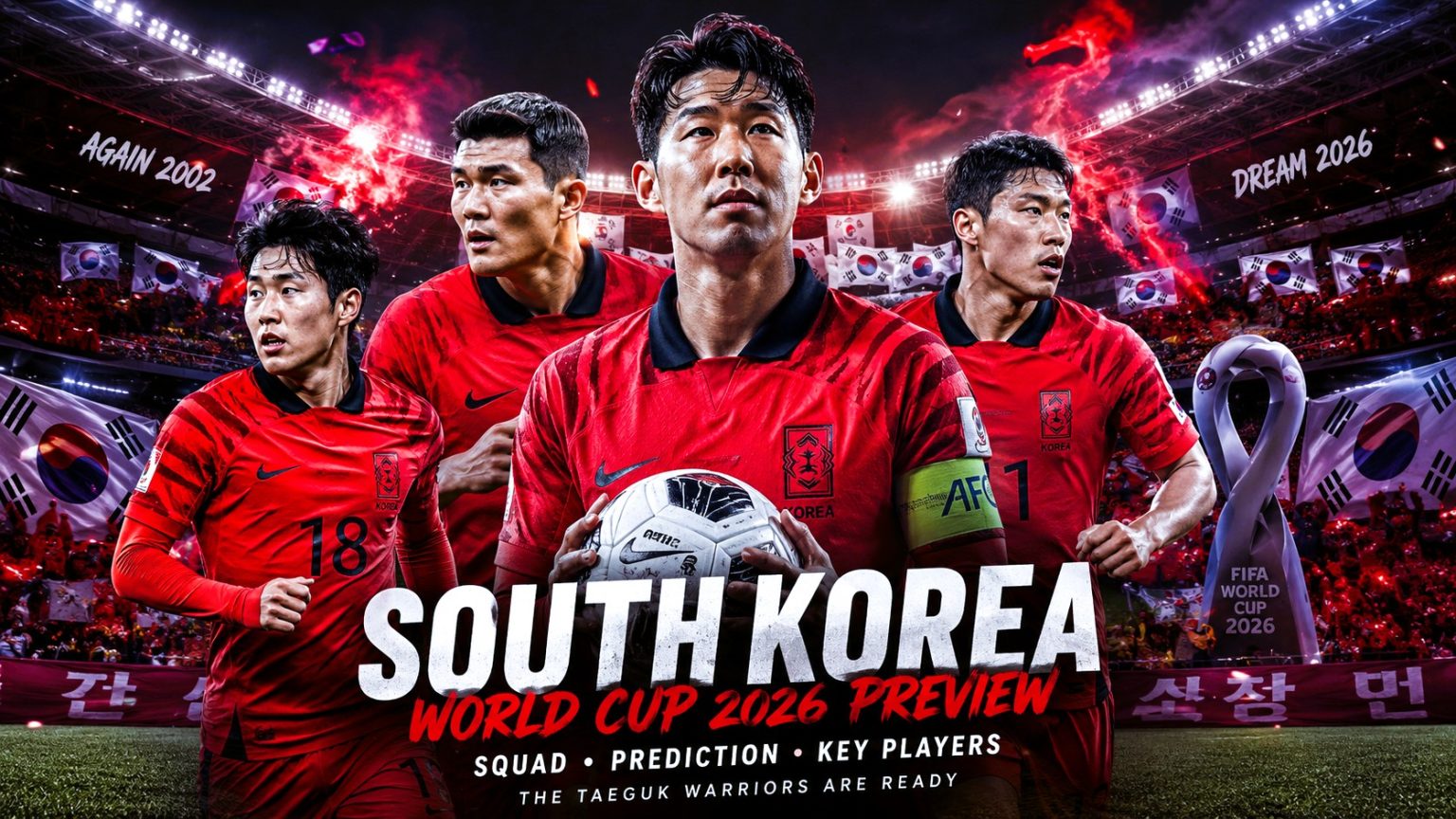

The Taeguk Warriors are ready. As one of Asia’s most enduring football powerhouses, the Korea Republic arrives at the 2026 FIFA World Cup carrying both the weight of legacy and the electricity of a genuinely talented generation.
With captain Son Heung-min leading a squad packed with European-based talent, coach Hong Myung-bo’s side enters the expanded 48-team tournament as one of the most intriguing AFC contenders — and a legitimate dark horse with real knockout stage aspirations.
South Korea’s Road to World Cup 2026
South Korea’s qualification campaign for FIFA World Cup 2026 was a statement of intent rather than a struggle for survival.
The Korea Republic — one of Asian football’s true giants — extended their extraordinary qualifying streak, booking their 11th successive World Cup appearance, a run that stretches back to 1986 and is the envy of every other AFC nation.
That consistency alone sets South Korea apart. No other Asian team has maintained such a relentless presence on the global stage, and each cycle the squad arrives not just to participate, but to compete.
In 2022 in Qatar, they demonstrated exactly what that means — beating Portugal in the group stage before pushing Brazil hard in the Round of 16. In 2018 in Russia, they stunned defending champions Germany.
And in 2002, co-hosting alongside Japan, they achieved the impossible: a run to the semi-finals, still the greatest result in Asian World Cup history.
The Korea Republic road to FIFA World Cup 2026 was anchored by the collective quality of a squad that has continued to mature.



Hong Myung-bo, a legendary former defender and now the national team coach, guided his side through the AFC qualification rounds with a clear tactical identity — disciplined defensively, dangerous on the transition, and capable of producing moments of genuine brilliance.
South Korea Squad for FIFA World Cup 2026
Coach Hong Myung-bo named his official 26-man roster on May 16, 2026, with the selection leaning heavily on proven internationals rather than experimentation.
The squad represents the full spectrum of South Korean football — from Bundesliga elite to domestic K-League stalwarts — and is widely regarded as one of the most balanced Korea Republic squads in recent memory.
Goalkeepers
- Jo Hyeon-woo (Ulsan HD)
- Kim Seung-gyu (FC Tokyo)
- Song Bum-keun (Jeonbuk Hyundai Motors)
Jo Hyeon-woo is the expected first-choice keeper, a reliable and experienced presence who has long been one of the most trusted shot-stoppers in the K-League.
Defenders
- Kim Min-jae (Bayern Munich)
- Cho Yu-min (Sharjah)
- Lee Han-beom (FC Midtjylland)
- Kim Tae-hyeon (Kashima Antlers)
- Park Jin-seob (Zhejiang FC)
- Lee Gi-hyuk (Gangwon FC)
- Lee Tae-seok (Austria Vienna)
- Seol Young-woo (Red Star Belgrade)
- Jens Castrop (Borussia Mönchengladbach)
- Kim Moon-hwan (Daejeon Hana Citizen)
The most notable addition in defence is Jens Castrop of Borussia Mönchengladbach — the first player with dual heritage (German father, Korean mother) to make a South Korea World Cup squad.
Castrop played age-group football for Germany before switching allegiance last year and has since earned five senior caps, giving Hong Myung-bo a versatile, European-pedigreed option in midfield and defence.
Midfielders
- Yang Hyun-jun (Celtic)
- Paik Seung-ho (Birmingham City)
- Hwang In-beom (Feyenoord)
- Kim Jin-gyu (Jeonbuk Hyundai)
- Bae Jun-ho (Stoke City)
- Eom Ji-sung (Swansea City)
- Hwang Hee-chan (Wolverhampton Wanderers)
- Lee Dong-gyeong (Ulsan HD)
- Lee Jae-sung (Mainz)
- Lee Kang-in (Paris Saint-Germain)
Forwards
- Oh Hyeon-gyu (Beşiktaş)
- Son Heung-min (LAFC) — Captain
- Cho Gue-sung (FC Midtjylland)
A notable inclusion in midfield is Hwang In-beom of Feyenoord, despite the influential midfielder battling an ankle injury.
His selection underlines just how important Hong considers him to South Korea’s tactical structure.
Best Starting XI and Predicted Formation
Hong Myung-bo is expected to line up in a 4-3-3 or 4-2-3-1 system, depending on the opponent.
Based on current form, fitness and squad depth, the strongest starting XI for South Korea at the 2026 World Cup looks like this:
| GK: Jo Hyeon-woo | ||
| RB: Kim Moon-hwan | CB: Kim Min-jae | CB/LB: Cho Yu-min |
| CB: Lee Han-beom | ||
| CM: Hwang In-beom | CM: Kim Jin-gyu | AM: Lee Kang-in |
| LW: Hwang Hee-chan | CF: Son Heung-min | RW: Yang Hyun-jun |
This South Korea expected formation maximises width, allows Lee Kang-in to operate as the creative fulcrum behind Son, and places Kim Min-jae as the defensive anchor at the heart of the back line.
Key Players to Watch
Son Heung-min — Captain, LAFC

If there is one name that defines this South Korea World Cup 2026 campaign, it is Son Heung-min.
The 33-year-old captain is appearing at his fourth World Cup, and for many — including Son himself — it may well be his last. After a decade at Tottenham Hotspur, Son joined LAFC in MLS last summer and has carried his elite form with him.
The numbers are staggering: 140 international caps, 54 international goals, and a joint national record for World Cup goals (three).
He needs just one more to set a new record outright — and to equal the all-time Asian record for World Cup goals.
His two-footed finishing, elite transition speed, and ability to perform in the highest-pressure moments make him South Korea’s most decisive weapon.
The Son Heung-min final World Cup appearance narrative adds emotional weight to what is already a compelling story.
Lee Kang-in — Creative Engine, PSG

The 23-year-old Paris Saint-Germain midfielder is the breakout tournament candidate South Korea fans are most excited about.
Lee Kang-in produced a superb club season, registering four goals and five assists in 38 appearances for PSG.
His vision, dribbling ability, and technical quality set him apart as the creative heartbeat of this side.
At 2026, Lee Kang-in has every reason to announce himself on the world stage as one of the finest midfielders of his generation.
Kim Min-jae — Defensive Masterclass, Bayern Munich
At 29 years old, Kim Min-jae enters this tournament at the absolute peak of his powers.
The Bayern Munich centre-back has secured consecutive Bundesliga titles (2024-25 and 2025-26), following his history-making Serie A triumph with Napoli.
With 77 international caps and an elite statistical profile — exceptional interception rates, aerial dominance, progressive passing from deep — Kim is the foundational metric of everything South Korea does defensively.
His Kim Min-jae defensive masterclass will be central to how far this team can go.
Hwang Hee-chan — Dynamic Forward, Wolverhampton Wanderers
The Wolves forward gives South Korea a relentless, high-energy option on the left flank.
Hwang Hee-chan’s direct running, pressing intensity, and goal threat from wide areas make him one of the most dynamic attackers in the AFC contingent at this tournament.
He is the engine that gives Son Heung-min the freedom to be decisive.
Jens Castrop — Rising Star, Borussia Mönchengladbach
The dual-heritage midfielder represents something new for Korean football.
Castrop’s inclusion signals a broadening of the talent pool and offers Hong Myung-bo tactical flexibility — a technically gifted, Bundesliga-developed player who can operate across multiple midfield roles.
As one of South Korea’s rising stars at 2026, he is a major subplot of this campaign.
South Korea Strengths and Weaknesses
Strengths
Elite Individual Quality at the Top. Son, Kim Min-jae, and Lee Kang-in are not just good for Asia — they are world-class footballers by any standard.
Son won the Premier League Golden Boot. Kim Min-jae has dominated in Serie A and the Bundesliga. Lee Kang-in is a Champions League footballer.
This is the South Korea golden generation in name and fact.
Attacking Football Style. Hong Myung-bo has built a system that rewards quick vertical play and direct runs in behind.
South Korea’s attacking football style — pressing high, transitioning fast, and exploiting width — is a genuine threat to any opponent in the tournament.
Depth in Midfield. The midfield options available to Hong are arguably the deepest in AFC World Cup history for Korea.
Hwang In-beom, Lee Kang-in, Lee Jae-sung, Bae Jun-ho, and Paik Seung-ho provide variety in profile, pace, and function.
Experience in Big Moments. This squad has beaten Germany, beaten Portugal, and reached the last 16 at back-to-back tournaments. They do not wilt under pressure.
Expanded Format Advantage. With the 2026 World Cup expanded to 48 teams, the top two in each group advance to the knockout phase — and the top eight third-place finishers also progress to the Round of 32. South Korea’s group stage chances have never been better.
Weaknesses
Goalscoring Depth Beyond Son. South Korea’s forward options beyond Son Heung-min remain a question.
Oh Hyeon-gyu at Beşiktaş and Cho Gue-sung at Midtjylland are solid but not prolific at the highest level. If Son is unavailable or shackled, goals could become harder to find.
Hwang In-beom’s Fitness. The Feyenoord midfielder was selected despite an ankle injury. His availability and sharpness will be critical to South Korea’s midfield balance.
Defensive Cover Beyond Kim Min-jae. While Kim Min-jae is elite, the depth behind him is less convincing at the highest level. Partners and cover at centre-back will be tested.
The Age Factor. With several key players in their late twenties and early thirties, and Son at 33, the squad must manage energy and recovery carefully across the group stage.
Tactical Analysis and Playing Style
Under Hong Myung-bo, South Korea’s tactical analysis reveals a team built on defensive organization and attacking transition.
The Taeguk Warriors are not a possession-heavy side in the modern European sense; they are a team that defends with structure, presses intelligently, and strikes with speed.
Kim Min-jae anchors a back four that is compact and physically dominant. In front of him, Hwang In-beom operates as a ball-winning screen, winning second balls and recycling possession.
Lee Kang-in, floating between the lines, is the key connective tissue — turning defensive recovery into offensive opportunity.
Wide players — Hwang Hee-chan on the left, Yang Hyun-jun or others on the right — stretch opposition back lines and create the channels Son Heung-min exploits with devastating runs.
Son’s movement between the lines is what makes South Korea’s attack so difficult to defend against: he can finish from distance, run in behind, or drop short and link play.
Defensively, the system presses high when the trigger arises and drops into a mid-block when out of possession, relying on Kim Min-jae’s reading of the game to mop up any damage.
It is a system that has beaten world-class opposition before — and at 2026, it is well-suited to a group stage against Mexico, Czechia, and South Africa.
Group A Analysis: South Korea’s Path Through the Group Stage
South Korea’s possible opponents at the 2026 World Cup begin with a Group A that is loaded with narrative, tactical contrast, and genuine jeopardy.
Understanding each opponent is critical to assessing South Korea’s FIFA World Cup chances — and whether the Taeguk Warriors can set up a deep knockout run.
Mexico

Mexico are the heavyweights of Group A, and they arrive carrying enormous home pressure.
Under coach Javier Aguirre — now in his third stint with the national team — El Tri have back-to-back CONCACAF titles, winning both the Nations League in March 2025 and the Gold Cup in July, giving the squad a belief and identity that had been missing for several years.
Mexico’s campaign will revolve around experienced figures like Raúl Jiménez, Hirving Lozano, and Edson Álvarez.
The key question is not whether they qualify — but how far they can go. Historically, Mexico have struggled to break past the Round of 16. Playing at home, expectations are significantly higher this time.
The concern for El Tri is cohesion. The primary worry heading into the summer is that the squad was missing twelve regulars for both March friendlies, and the full-strength lineup has had very limited minutes together in competitive situations.
For South Korea, this creates an opportunity: press Mexico early, disrupt their rhythm before it forms, and exploit any defensive uncertainty at the back.
After quarter-final finishes at the home editions in 1970 and 1986, Mexico arrive at this year’s tournament hoping to replicate the success of their 2025 CONCACAF Gold Cup campaign.
The home crowd will roar. South Korea must be tactically disciplined and emotionally unshakeable.
South Korea vs. Mexico Verdict: Mexico are favourites, but South Korea have beaten bigger teams in bigger moments. A draw would be a fine result; a win is not impossible.
Czechia

Do not underestimate Czechia. They return to the World Cup for the first time since 2006, having gotten there through two penalty shootouts in five days under a 74-year-old coach who took the job days before the playoffs began.
That mental resilience tells you something about the team’s character.
Czechia thrives through set pieces, physicality, and their size. Veterans like Tomáš Souček and Patrik Schick bring Champions League and Premier League experience to a squad that is difficult to break down and capable of punishing a lapse in concentration from any dead-ball situation.
For South Korea — a team built on pace and fluid movement — Czechia’s organized structure and aerial presence pose specific problems.
South Korea and Czechia appear evenly matched on paper, each bringing contrasting strengths. South Korea rely on pace and transitions, while Czechia’s structure and physicality make them a difficult opponent.
This is the game that will likely define South Korea’s group stage fate. A win here almost certainly secures progression. A loss makes the arithmetic uncomfortable.
South Korea vs. Czechia Verdict: South Korea are narrow favourites based on individual quality, but Czechia will make them earn every point. Expect a tight, tense match decided by a moment of class — Son Heung-min or Lee Kang-in providing it for Korea.
South Africa

Every group has one team that refuses to follow the script. In Group A, that team is Bafana Bafana.
South Africa are the tournament’s opening game opponents for Mexico — a rematch of the 2010 World Cup’s famous curtain-raiser — and they carry with them the unpredictability that makes African football so compelling at major tournaments.
The collective defensive discipline manager Hugo Broos has built over five years has generally been solid.
Their counter-attacking speed and defensive organisation make them capable of disrupting the group’s established order. South Africa will look to absorb, frustrate, and hit on the break — a style that can bamboozle teams who expect an easy night.
The question of finding a reliable finisher alongside their main forward threat remains an area coach Broos needs to address before the tournament starts.
If their attack fires, South Africa are genuinely dangerous.
If it misfires, the defensive discipline alone may not be enough to steal the points needed.
For South Korea, the South Africa fixture — their final group game — could be a dead rubber or a must-win decider depending on earlier results. Either way, the Taeguk Warriors must take it seriously.
South Korea vs. South Africa Verdict: South Korea win, but Bafana Bafana will make it uncomfortable. A 2-0 or 2-1 is the most likely scenario.
Predicted Group A Standings
| Pos | Team | W | D | L | GF | GA | GD | Pts |
| 1st | 🇲🇽 Mexico | 2 | 1 | 0 | 5 | 2 | +3 | 7 |
| 2nd | 🇰🇷 South Korea | 2 | 0 | 1 | 4 | 3 | +1 | 6 |
| 3rd | 🇨🇿 Czechia | 1 | 0 | 2 | 3 | 5 | -2 | 3 |
| 4th | 🇿🇦 South Africa | 0 | 1 | 2 | 2 | 4 | -2 | 1 |
South Korea advance in second place — with real momentum heading into the knockout rounds.
Can South Korea Reach the Knockout Stage?
The honest answer? Yes — and they should. South Korea’s World Cup group stage chances are genuinely strong in 2026.
Their Group A draw — against co-hosts Mexico, Czechia, and South Africa — is demanding but navigable.
South Korea have never feared big occasions. They shocked Germany in 2018. They pushed Portugal over the line in 2022.
Mexico are dangerous as co-hosts but have perennial knockout-stage struggles of their own. Czechia are a technically organised but limited side. South Africa are a significant wildcard.
In a 48-team tournament where the third-place route to the Round of 32 exists, South Korea only need to replicate their minimum — not their maximum. A passage to the knockout rounds is a realistic base expectation.
The more exciting question is whether this squad can go further. The South Korea World Cup dark horse tag is not media hype — it is statistical reality.
Their squad quality, tournament experience, and tactical solidity make them capable of beating any team on their day. A quarter-final appearance is not fanciful.
Final Prediction for South Korea at World Cup 2026
- Group Stage: South Korea advance — second in Group A, behind Mexico.
- Round of 32: South Korea progress against a mid-tier European or CONMEBOL side.
- Round of 16: This is where the Taeguk Warriors’ journey likely reaches its pivotal moment — a potential clash with one of the tournament’s elite sides. A repeat of 2002’s spirit, or an exit at a familiar hurdle.
Prediction: Round of 16, with a genuine chance of a quarter-final if the draw falls kindly and Son Heung-min hits form at the decisive moment.
South Korea enters the 2026 FIFA World Cup as more than a participant. They are a team with history, with a captain writing his final chapter on the biggest stage, and with the talent to cause problems for anyone in the world. The Taeguk Warriors are coming — and the world should be watching.
South Korea’s group stage fixtures
- June 11: South Korea vs. Czechia — Estadio Guadalajara, Guadalajara, Mexico
- June 18: Mexico vs. South Korea — Estadio Guadalajara, Guadalajara, Mexico
- June 24: South Africa vs. South Korea — Mercedes-Benz Stadium, Atlanta, USA