







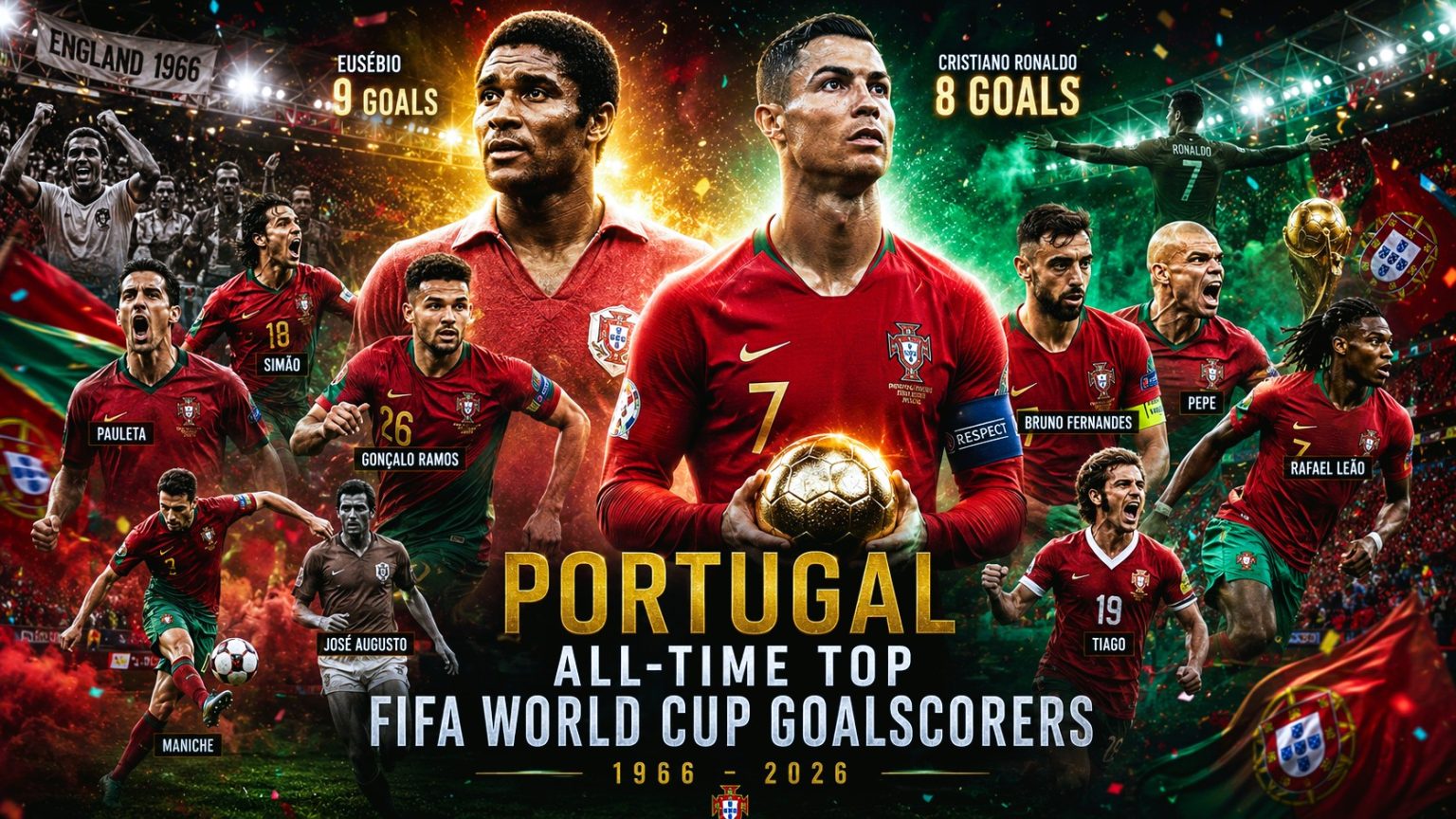

There is something almost mythological about Portugal’s relationship with the FIFA World Cup.
The Seleção das Quinas — named for the five blue shields on their crest — have given the world some of football’s most immortal moments, from Eusébio’s tears in 1966 to Cristiano Ronaldo’s audacious hat-trick against Spain in 2018, from Gonçalo Ramos’s explosive emergence in Qatar to the golden promise of a new generation readying itself for the 2026 edition on North American soil.
Portugal is not a nation that has won the World Cup. Yet in the annals of football heritage, few countries have produced goalscoring legends of such magnitude, players who transcended tournaments and became football immortals.
Eusébio and Cristiano Ronaldo — separated by six decades — both burned so brightly at the World Cup that their names are forever woven into the fabric of international football greatness.
This is the story of Portugal’s greatest World Cup goalscorers, ranked by goals, shaped by era, and bound by a single, enduring ambition: to one day lift the most coveted trophy in football.
Portugal Players with Most FIFA World Cup Goals – Full Rankings
| Rank | Player | Goals | World Cup Editions Scored In |
| 1 | Eusébio | 9 | 1966 |
| 2 | Cristiano Ronaldo | 8 | 2006, 2010, 2014, 2018, 2022 |
| 3 | Pauleta | 4 | 2002, 2006 |
| 4 | José Augusto | 3 | 1966 |
| =4 | Gonçalo Ramos | 3 | 2022 |
| =4 | José Torres | 3 | 1966 |
| 7 | Bruno Fernandes | 2 | 2022 |
| =7 | Maniche | 2 | 2006 |
| =7 | Simão | 2 | 2006, 2010 |
| =7 | Pepe | 2 | 2018, 2022 |
| =7 | Rafael Leão | 2 | 2022 |
| =7 | Tiago | 2 | 2010 |
Figures represent World Cup finals matches only, not qualifiers. The 2026 tournament is ongoing at the time of publication.
Portugal’s Greatest World Cup Goal Scorers (1966–2026)
Eusébio – 9 Goals

To understand Portugal’s World Cup DNA, you must begin where it all began: Goodison Park, Liverpool, July 1966.
Eusébio da Silva Ferreira — born in Mozambique, forged in the fires of Benfica, and elevated to football immortality at the 1966 FIFA World Cup — remains the greatest goalscorer in Portuguese World Cup history.

Nine goals in a single tournament. One edition. A record that has stood for nearly six decades and may never be broken.
The scale of what Eusébio achieved in England defies modern comprehension.
In an era without video analysis, without sports science, without the global media infrastructure that would later elevate Pelé and Franz Beckenbauer into household names worldwide, Eusébio simply destroyed defences.
He won the Eusébio Golden Boot — the tournament’s top scorer award — with a tally that remains the highest by any Portuguese player across all World Cup history.
His most iconic performance came against North Korea in the quarter-finals at Goodison Park, one of the most dramatic matches in World Cup history.
Portugal found themselves 3-0 down at half-time in a stunning first-half collapse. What followed was the Eusébio show in its purest, most devastating form.
He scored four goals — including a hat-trick in the space of 23 minutes — to drag his nation back from the edge of humiliation, ultimately winning 5-3. It remains one of the great individual comeback performances in World Cup folklore.
Portugal went on to finish third in 1966, their best-ever World Cup finish, and Eusébio’s nine goals remain the cornerstone of Portugal’s FIFA World Cup records.
Key stats:
- 9 goals in 6 matches at the 1966 World Cup
- Golden Boot winner — tournament top scorer
- Hat-trick vs North Korea in the quarter-final
- Led Portugal to a third-place finish — their best ever
- Four goals in a single match remains a Portuguese World Cup record
Cristiano Ronaldo – 8 Goals

When historians write about Cristiano Ronaldo and the FIFA World Cup, they will reach for superlatives that do not yet exist in the English language.
Eight goals across five World Cup tournaments — 2006, 2010, 2014, 2018, and 2022. No male footballer in history has ever scored in five different editions of the World Cup.
It is a record of extraordinary longevity, a testament not just to elite talent, but to an almost superhuman dedication to physical excellence.
Cristiano Ronaldo’s World Cup goals for Portugal span a 16-year arc from a fresh-faced 21-year-old in Germany to a 37-year-old statesman in Qatar.
Yet for all his record-breaking achievements, there remains a bittersweet quality to Ronaldo’s World Cup story.
He has never won it. He has never even reached the final. The tournament that has defined the careers of Messi, Zidane, Ronaldo Nazário, and Pelé has given Ronaldo goals and records, but withheld its ultimate prize.
Still, to dismiss Ronaldo’s World Cup legacy is to miss the point. His goal against Spain in 2018 — a free-kick into the top corner in the 88th minute to complete a stunning hat-trick — is one of the greatest moments ever witnessed at a World Cup.
It was peak Ronaldo: technical perfection in the highest-pressure environment football can offer. His Cristiano Ronaldo Portugal stats at World Cups show eight goals, numerous assists, and five decades of consistent excellence.
And now, at 41, the question that electrifies the Portugal World Cup 2026 conversation is simple: can Ronaldo add to his tally in North America? Can he become the first man in history to score in six World Cup tournaments? The footballer who once proclaimed himself the best in the world has never stopped believing.
Whether his body can fulfil what his mind demands is the most compelling storyline heading into 2026.
Key stats:
- 8 goals across five World Cups (2006–2022)
- First male player in history to score in five editions
- Hat-trick vs Spain in 2018 — one of the great World Cup performances
- Captain and leader for Portugal across four generations of teammates
Pauleta – 4 Goals
Pedro Miguel Carreiro Resendes, known universally as Pauleta, is perhaps the most underrated entry on this list — a striker of genuine class who never quite received the global recognition his talents deserved.
Four World Cup goals across 2002 and 2006 — a tally that places him third on Portugal’s all-time World Cup scoring list, ahead of many more celebrated names.
Pauleta was the quintessential penalty-box predator: precise, intelligent, and capable of manufacturing chances from the slimmest of margins.
As a Portugal top scorer FIFA World Cup contributor, he was the focal point of Portugal’s attack at a time when Ronaldo was still emerging.
His 2006 performances alongside a young Ronaldo and the veteran Luís Figo gave Portugal’s attack genuine depth. When he retired, Portugal lost a reliable tournament goalscorer — a void that would take years to fill.
José Augusto and José Torres – 3 Goals
History has a tendency to remember only the brightest star, and in 1966, Eusébio burned so brilliantly that his teammates have sometimes been lost in the glare.
José Augusto scored three goals in the 1966 tournament — a tally that places him joint fourth on Portugal’s all-time World Cup goalscoring list.
A gifted forward with superb technical ability, Augusto was an integral part of the 1966 side’s attacking system, creating space that Eusébio ruthlessly exploited.
José Torres, a physically imposing striker who scored three goals in the same tournament, was another key figure in Portugal’s run to third place.
His aerial ability and hold-up play were crucial to Portugal’s attacking structure.
Together, Augusto and Torres form the backbone of Portugal’s 1966 World Cup legacy alongside Eusébio — three players, nine combined goals, and a place in Portuguese football history that demands greater recognition.
Gonçalo Ramos – 3 Goals

On 6 December 2022, a 21-year-old Benfica striker strode onto the World Cup stage as a first-half substitute replacement for Cristiano Ronaldo — and proceeded to score a hat-trick against Switzerland.
It was one of the most stunning introductions to a World Cup knockout stage in the tournament’s history.
Gonçalo Ramos’s three goals in Qatar immediately elevated him from promising prospect to genuine global star.
As a Portugal World Cup top scorer in 2022 alongside Bruno Fernandes and Rafael Leão, Ramos demonstrated that the next generation of Portuguese attackers is ready for the biggest stage.
His movement, his composure, his eye for goal — all of it suggests a player who will be central to Portugal’s ambitions for years to come.
The question of whether Gonçalo Ramos will become Portugal’s next World Cup star is not really a question at all: the evidence suggests he already is. At the 2026 World Cup, aged 25, he could be at the very peak of his powers.
Bruno Fernandes – 2 Goals

Two goals at the 2022 World Cup from midfield, including a penalty against Uruguay in the group stage that sparked one of the tournament’s great controversies (a header from Ronaldo that never actually connected). Bruno Fernandes’s World Cup stats reflect a player who delivers on the biggest occasions.
His creative engine, his set-piece expertise, and his leadership qualities have made him one of Portugal’s most important players heading into 2026.
As a secondary playmaker who can chip in with crucial goals, Fernandes bridges the gap between Portugal’s legendary generation and the new wave of talent emerging around him.
Pepe – 2 Goals

Pepe — the granite-tough central defender who has spent his career putting the fear of God into opposing strikers — has somehow managed to score twice at World Cups, in 2018 and 2022.
His goal against Switzerland in Qatar, at the age of 39, made him the oldest scorer in World Cup history at that time.
It was a moment that perfectly encapsulated everything Pepe represents: defiance, physicality, and an absolutely unyielding will to compete regardless of the odds.
As a Portugal national team records holder, his entry on this list is one of the most unexpected — and most celebrated.
Rafael Leão – 2 Goals

Two goals at the 2022 World Cup, delivered with the casual elegance of a player who makes the impossible look routine.
Rafael Leão is, quite simply, one of the most exciting attacking players in world football — and at 25, the 2026 World Cup represents his moment to announce himself on the grandest stage of all.
His pace, his left foot, his ability to ghost past defenders in the tightest of spaces — these are qualities that have made him an AC Milan icon and a Portugal talisman.
As one of the Portugal young stars 2026 most likely to shape the tournament, Leão’s World Cup trajectory is one of football’s most compelling storylines. If 2022 was his introduction, 2026 could be his masterclass.
Portugal’s Greatest FIFA World Cup Generations
1966 – Eusébio’s Legendary Team
The class of 1966 remains Portugal’s greatest World Cup generation by raw achievement.
Third-place finish, nine goals from Eusébio alone, and a style of football that won admirers across the globe.
Manager José Augusto Pinto de Morais built a side around Eusébio’s genius without making the fatal mistake of relying on it exclusively — the supporting cast of Augusto, Torres, and Simões gave Portugal genuine attacking depth.
Had they drawn anyone other than England in the semi-finals — in England, at Wembley — Portugal might have gone all the way.
2006 – Figo and Ronaldo Reach the Semi-Finals
Forty years after Eusébio’s generation, Portugal returned to the World Cup semi-finals in Germany. Luís Figo, in the twilight of a magnificent career, provided the experience and leadership. A 21-year-old Cristiano Ronaldo provided the electricity.
The 2006 generation’s tally of goals was spread more evenly — Pauleta, Maniche, Simão, and Ronaldo all contributed — reflecting a more balanced squad than the Eusébio-centric 1966 side.
Their run to the semi-finals, eventually ended by France, remains one of Portugal’s finest World Cup campaigns and the last time Luís Figo graced a World Cup stage.
2018 – Ronaldo’s Hat-Trick vs Spain
Sochi. June 15, 2018. Perhaps the greatest single-match performance in Portuguese World Cup history since Eusébio’s Goodison masterclass.
Trailing Spain — the 2010 world champions — Cristiano Ronaldo scored three goals in a 3-3 draw that felt like both a Portugal victory and a statement of individual brilliance.
His 88th-minute free-kick, curling over the wall and into the top corner of David de Gea’s net, is among the most celebrated goals in World Cup history.
Among Portugal World Cup top moments, it stands second only to Eusébio’s comeback against North Korea.
2022 – Portugal’s Young Generation Emerges
Qatar 2022 was Portugal’s most complete World Cup performance since 2006. They scored eight goals in the group stage — the most of any team — and introduced the world to the full depth of their young talent.
Gonçalo Ramos’s hat-trick against Switzerland, Leão’s electric cameos, and the tactical sophistication of Roberto Martínez’s side all suggested Portugal were building towards something significant.
Their quarter-final defeat to Morocco — the first African nation to reach a World Cup semi-final — was a shock that still stings. But the talent that Portugal showed in Qatar has only grown since.
2026 – Portugal’s Next Golden Opportunity
Co-hosted by the United States, Canada, and Mexico, the 2026 FIFA World Cup represents Portugal’s best opportunity since 1966 to lift the trophy.
The squad Roberto Martínez is building combines proven international quality — Ronaldo, Bernardo Silva, Bruno Fernandes, Pepe — with an extraordinary crop of young talent that has the potential to define a generation.
Portugal’s road to the World Cup final 2026 runs through a continent that loves football but has never hosted a competition quite like an expanded 48-team World Cup. The group-stage format changes offer more margin for error.
Portugal’s tactical depth under Martínez has grown considerably. And the hunger — after decades of near-misses — has never been more intense.
Cristiano Ronaldo vs Eusébio – Portugal’s Greatest World Cup Goalscorer Debate
This is the debate that divides Portuguese football fans across generations. Two players. Two eras. One enduring question: who is Portugal’s greatest World Cup goalscorer?
| Category | Eusébio | Cristiano Ronaldo |
| Total Goals | 9 | 8 |
| Tournaments | 1 | 5 |
| Matches | 6 | 22 |
| Goals Per Match | 1.50 | 0.36 |
| Tournament Impact | Third place, Golden Boot | Five editions, no final |
| Knockout Goals | 6 | 4 |
| Era | 1966 | 2006–2022 |
| Legacy | Defined Portugal’s World Cup identity | Extended it across five decades |
The statistics tell a complicated story. Eusébio’s goals-per-match ratio of 1.50 is virtually unmatched in World Cup history at this level.
His nine goals in a single tournament represent an almost incomprehensible level of single-tournament dominance.
By raw output in a single edition, he is without question Portugal’s greatest World Cup goalscorer.But Ronaldo’s argument is equally compelling.
To score eight World Cup goals across five different tournaments, five different squads, five different tactical eras of football, requires a different kind of greatness — the greatness of sustained excellence across a full sporting lifetime.
His Cristiano Ronaldo World Cup goals span 16 years. That longevity is unprecedented in the history of the sport.
The honest answer is that both players are products of their era, and comparison across six decades is ultimately futile. What matters is that both carried Portugal’s World Cup ambitions on their shoulders and delivered moments that will be replayed as long as football is played.
Portugal at the 2026 FIFA World Cup – Updated Outlook
Can Cristiano Ronaldo Extend His Record?
This is the question that dominates every Portugal World Cup 2026 conversation. Can Ronaldo, at 41, not only participate in a sixth World Cup but score in it — extending his already unprecedented record to six tournaments?
The honest answer is: yes, it is possible. Ronaldo has defied every physical and biological prediction placed upon him throughout his career.
His goal record at club level since turning 37 has remained remarkably high. His fitness data, released periodically by his medical team, consistently reads like that of a man a decade younger.
Whether Roberto Martínez can integrate him tactically into a squad that has, in many respects, already evolved beyond needing him as its focal point, is the more complex question.
What is certain is that a Portugal squad heading to 2026 without Ronaldo on the roster — should he remain fit and motivated — is almost unthinkable from a sporting and cultural standpoint.
Will Gonçalo Ramos Become Portugal’s Next World Cup Star?
The short answer: he already is. His 2022 World Cup hat-trick against Switzerland announced him to the world. His development since then — both at PSG and in international football — has confirmed that Qatar was not a flash in the pan.
At 25 in 2026, Ramos will be operating in the prime window of a centre-forward’s career.
If Portugal’s tactical setup places him as the central striker — particularly in the knockout rounds — his goals-per-match ratio at international level suggests he could challenge Portugal’s all-time World Cup scoring records within a single tournament.
A realistic target of four to six goals in 2026, should Portugal progress deep into the competition, is entirely feasible.
Portugal’s Young Core for 2026
The talent pool from which Roberto Martínez can draw is arguably the deepest in Portugal’s footballing history. The Portugal young stars 2026 most likely to define the tournament include:
Rafael Leão — The AC Milan forward is at his peak. Two goals in 2022 were merely a preview of what a full tournament under his control could produce. His pace, vision, and left-footed precision make him a nightmare for any defence in the world.
João Neves — The Benfica (now PSG) midfielder represents the next generation of Portugal’s midfield quality. Cultured, intelligent, and technically superb, Neves brings a passing range and defensive intelligence that gives Portugal balance between creativity and solidity.
Vitinha — Another midfield gem from the PSG production line, Vitinha’s ability to control tempo and break lines is central to how Martínez wants Portugal to play. His influence grows with every major tournament.
Gonçalo Inácio — The Sporting CP centre-back is one of Europe’s most composed defensive talents. At 25 in 2026, he will be at the peak of his defensive development, and his ability to carry the ball out from the back gives Portugal a distinctive building-from-the-back option.
António Silva — Arguably the most impressive defensive talent Portugal has produced in a generation. His debut at the 2022 World Cup as a teenager — playing with the composure of a 10-year veteran — left observers genuinely awestruck. By 2026, he will be a genuine leader of Portugal’s defensive line.
Portugal World Cup Records and Statistics
| Record | Detail |
| Most World Cup Goals | Eusébio — 9 (1966) |
| Most World Cup Appearances | Cristiano Ronaldo — 22 matches |
| Best World Cup Finish | 3rd place — 1966 |
| Most Goals in a Single Tournament | Eusébio — 9 (1966) |
| Most Consecutive World Cups Scored In | Ronaldo — 5 (2006–2022) |
| Most World Cups Competed In | Ronaldo — 5 |
| Oldest World Cup Goalscorer | Pepe — 39 years, 2022 |
| Largest World Cup Victory | Portugal 7-0 North Korea (1966) |
| Hat-Tricks at the World Cup | Eusébio (1966 vs North Korea), Gonçalo Ramos (2022 vs Switzerland), Ronaldo (2018 vs Spain) |
Portugal vs Other Nations – World Cup Goals Comparison
| Nation | Total World Cup Goals | World Cup Wins |
| Brazil | 229 | 5 |
| Germany | 226 | 4 |
| Argentina | 145 | 3 |
| France | 141 | 2 |
| Netherlands | 88 | 0 |
| England | 84 | 1 |
| Portugal | 77 | 0 |
Portugal’s tally of 77 World Cup goals across all editions reflects a nation that has punched consistently above its weight.
For a country with a population of just over 10 million, their output of world-class goalscoring talent — from a Portugal football dynasty that stretches from the 1966s through to the present — is a remarkable achievement in the context of global football stars and football heritage.
Top Portugal World Cup Moments
1. Eusébio vs North Korea, 1966 (Quarter-Final) Down 3-0, Eusébio scored four goals. Portugal won 5-3.
The greatest individual fightback in World Cup history from a Portuguese player, and one of the greatest in World Cup folklore.
An iconic World Cup moment that has defined Portugal’s tournament identity for nearly six decades.
2. Ronaldo vs Spain, 2018 (Group Stage) Three goals. A 3-3 draw. The hat-trick completed by a free-kick of staggering audacity in the 88th minute.
Ronaldo reminded the world — if any reminder was needed — that he performs at his absolute best on the biggest stages. A World Cup milestone for the ages.
3. Gonçalo Ramos Hat-Trick vs Switzerland, 2022 (Round of 16) Coming off the bench to replace the most famous footballer on the planet and scoring a hat-trick in a knockout match.
The sheer improbability of what Ramos achieved in Qatar 2022 makes it one of the great individual tournament performances in recent World Cup memory.
4. Portugal Reaching the 1966 Semi-Final Often overlooked in purely statistical analysis, Portugal’s run to the semi-finals in 1966 — only their second World Cup appearance — was a seismic achievement.
Eusébio’s goals were the headlines, but the collective performance of that squad created football immortals.
5. Figo’s 2006 Generation Luís Figo’s farewell World Cup, a young Cristiano Ronaldo’s first starring role, and a Portugal side that reached the semi-finals — the 2006 campaign represented the bridge between Eusébio’s generation and Ronaldo’s era, a Portugal World Cup golden generation too often underappreciated in historical rankings.
FAQs – Portugal World Cup Goals Records
Who is Portugal’s all-time top World Cup scorer? Eusébio, with nine goals scored at the 1966 FIFA World Cup in England. He won the Golden Boot as the tournament’s top scorer and led Portugal to a third-place finish — the best in their history.
How many World Cup goals does Cristiano Ronaldo have? Eight goals across five World Cup tournaments (2006, 2010, 2014, 2018, 2022), making him the first male player in history to score in five different editions. He remains second on Portugal’s all-time World Cup scoring list.
Did Eusébio win the World Cup? No. Eusébio reached the semi-finals in 1966, where Portugal were beaten by host nation England. Portugal finished third, defeating the Soviet Union in the third-place play-off. Despite never winning the tournament, Eusébio’s nine-goal campaign is considered one of the greatest individual World Cup performances in history.
Which Portugal player scored the most goals in a single World Cup? Eusébio, with nine goals at the 1966 World Cup. This remains a Portuguese record and one of the highest individual totals in a single World Cup tournament by any player in history.
Can Ronaldo break Eusébio’s record in 2026? To break Eusébio’s record of nine career World Cup goals, Ronaldo would need to score two goals in 2026 to move level and three to break it outright. At 41, and with his physical condition remaining remarkably high, it is not impossible — though it would require Portugal to progress deep into the tournament and for Ronaldo to play a prominent role in their attacking output.
Which Portugal players scored in multiple World Cups? Cristiano Ronaldo (2006, 2010, 2014, 2018, 2022), Pauleta (2002, 2006), Simão (2006, 2010), and Pepe (2018, 2022) all scored across multiple editions. Ronaldo’s five editions is a record unmatched in male football history.
Portugal’s World Cup Legacy and the Future Ahead
The story of Portugal’s World Cup goalscorers is ultimately a story about time: how a small nation on the edge of Europe produced, in Eusébio, one of the most devastating tournament scorers the sport has ever seen; then waited four decades before producing, in Ronaldo, a player who would extend that tradition across an entire footballing lifetime.
From Eusébio to Ronaldo, the timeline of Portugal’s World Cup goalscoring legacy traces the arc of the nation’s footballing ambition. In 1966, Portugal were a revelation — an unknown quantity who stunned the world. By 2006, they were a genuine contender. By 2022, they had the youngest and most talented squad they had possessed in decades.
And in 2026? Portugal’s golden generation 2026 does not rely on a single genius. It is built on depth, on a tactical system that has developed considerably under Roberto Martínez, and on a generation of players — Ramos, Leão, Neves, Vitinha, Inácio, António Silva — who grew up watching Ronaldo win everything at club level and are determined to replicate that success on the international stage.
The Portugal World Cup chances 2026 have rarely been stronger. In an expanded 48-team tournament, on a continent where Portuguese is spoken in Brazil — the world’s most passionate footballing nation — Portugal will have supporters across multiple host cities. The logistics, the atmosphere, and the footballing talent all align.
Whether Ronaldo plays his final World Cup chapter or hands the torch definitively to the next generation, one thing is certain: Portugal’s World Cup goalscoring story is not finished. The next chapter is still being written.
And if Gonçalo Ramos, Rafael Leão, and João Neves have anything to say about it, it will be the greatest chapter yet.
Statistics correct as of May 2026 pre-tournament. All FIFA World Cup records subject to update following the 2026 tournament.