

The defending world champions arrive at the 2026 FIFA World Cup in North America as one of the tournament’s most feared sides — and with perhaps the greatest footballer of all time still in their ranks.
Lionel Scaloni’s Albiceleste are chasing history: a successful title defence would make them the first team to retain the World Cup since Brazil in 1958 and 1962.
With a squad that blends the battle-hardened core of Qatar 2022 with an electrifying new generation of talent, Argentina’s best XI for the 2026 World Cup is already the subject of intense debate among fans and analysts worldwide.
Argentina’s Predicted Starting XI for World Cup 2026
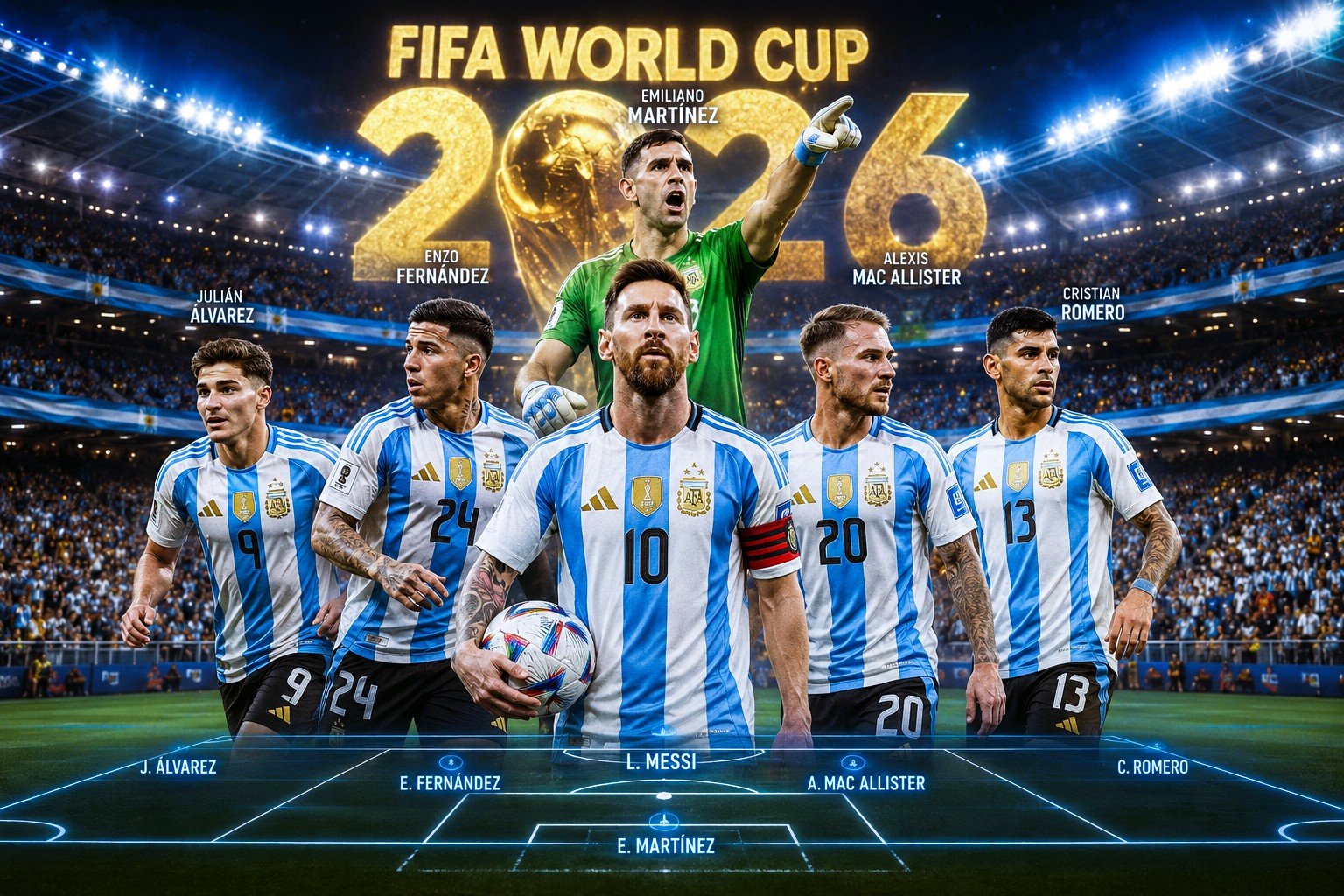
Before diving into the tactical nuances, here is Argentina’s strongest predicted lineup heading into the 2026 FIFA World Cup:
Formation: 4-4-2
| Position | Player | Club |
| GK | Emiliano Martínez | Aston Villa |
| RB | Nahuel Molina | Atlético Madrid |
| CB | Cristian Romero | Tottenham Hotspur |
| CB | Lisandro Martínez | Manchester United |
| LB | Nicolás Tagliafico | Lyon |
| CM | Alexis Mac Allister | Liverpool |
| CM | Enzo Fernández | Chelsea |
| CM | Thiago Almada | Atlético Madrid |
| RW | Lionel Messi | Inter Miami |
| ST | Julián Álvarez | Atlético Madrid |
| CF | Lautaro Martínez | Inter Milan |
This lineup assumes Messi confirms his participation — a question that has dominated Argentinian football for much of the past year. With the preliminary 55-man squad released and Messi included, all signs point toward him suiting up one final time.
Argentina’s Best XI for the 2026 World Cup
Goalkeeper – Emiliano Martínez Still No. 1?
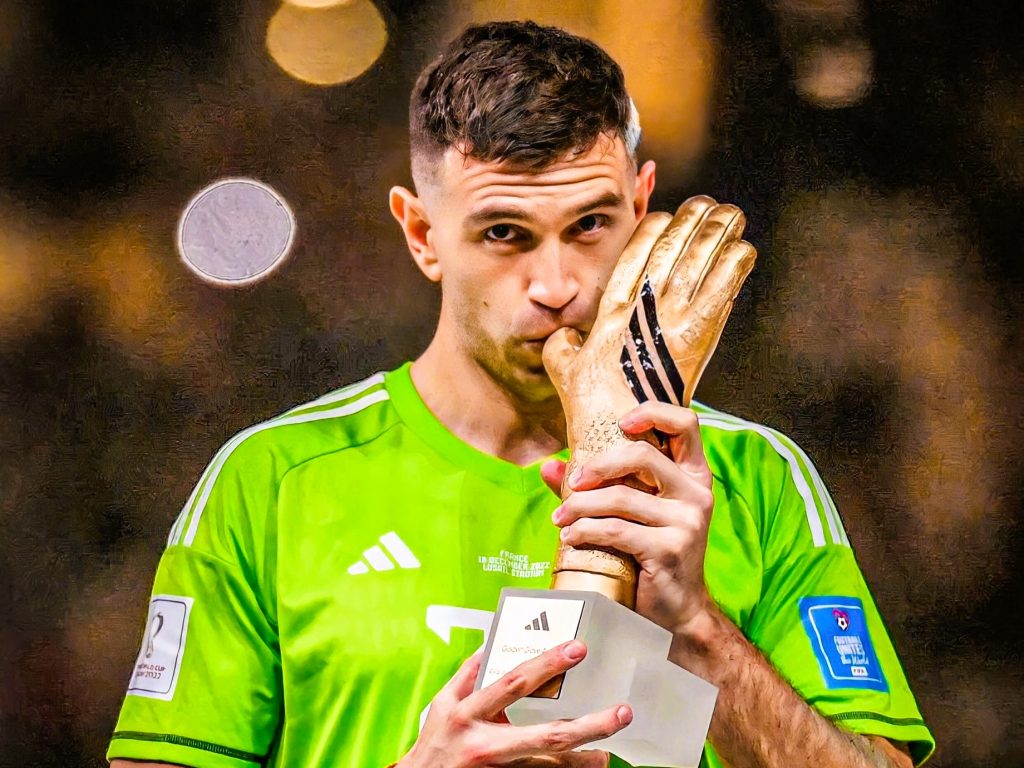
There is no debate here. Emiliano Martínez remains the undisputed first-choice goalkeeper for Argentina, and arguably the best in the world in high-pressure moments.
The Aston Villa shot-stopper was the hero of the 2022 World Cup final shootout against France and the Copa América triumphs, and his commanding presence between the posts is a cornerstone of Scaloni’s system.
At 33, this will likely be Martínez’s final World Cup. He brings not just elite shot-stopping but also a psychological edge — few goalkeepers in the world intimidate penalty-takers the way he does.
Behind him, Gerónimo Rulli (Marseille) and Walter Benítez (Crystal Palace) provide capable backup, but Dibu Martinez’s status as Argentina’s starting goalkeeper is unquestionable.
Defense – Argentina’s Strongest Back Four
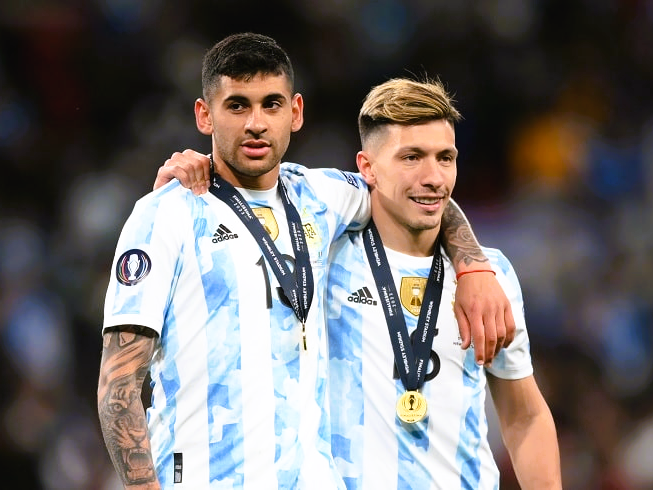
Argentina’s defensive setup underwent a quiet evolution after Qatar 2022 — and it has emerged stronger for it.
The retirement of veteran Angel Di María shifted the tactical balance, while the emergence of Lisandro Martínez as a commanding centre-back gave Scaloni a more dynamic option alongside the ever-reliable Cristian Romero.
Romero is the defensive heartbeat — aggressive, composed in possession, and a natural leader.
He is working to recover from a partial MCL tear suffered late in the Premier League season, but the expectation is that the Tottenham defender will prove his fitness in time for the tournament.
Lisandro Martínez, meanwhile, has brought a new physicality and left-footed balance to the back line that Argentina lacked in previous cycles.
In the full-back positions, Nahuel Molina on the right and Nicolás Tagliafico on the left are Scaloni’s trusted options — both capable of marauding forward to support attacks while providing defensive solidity.
Nicolás Otamendi remains an experienced option off the bench and could start should Romero’s fitness be compromised.
Midfield – Enzo Fernández and Mac Allister Partnership
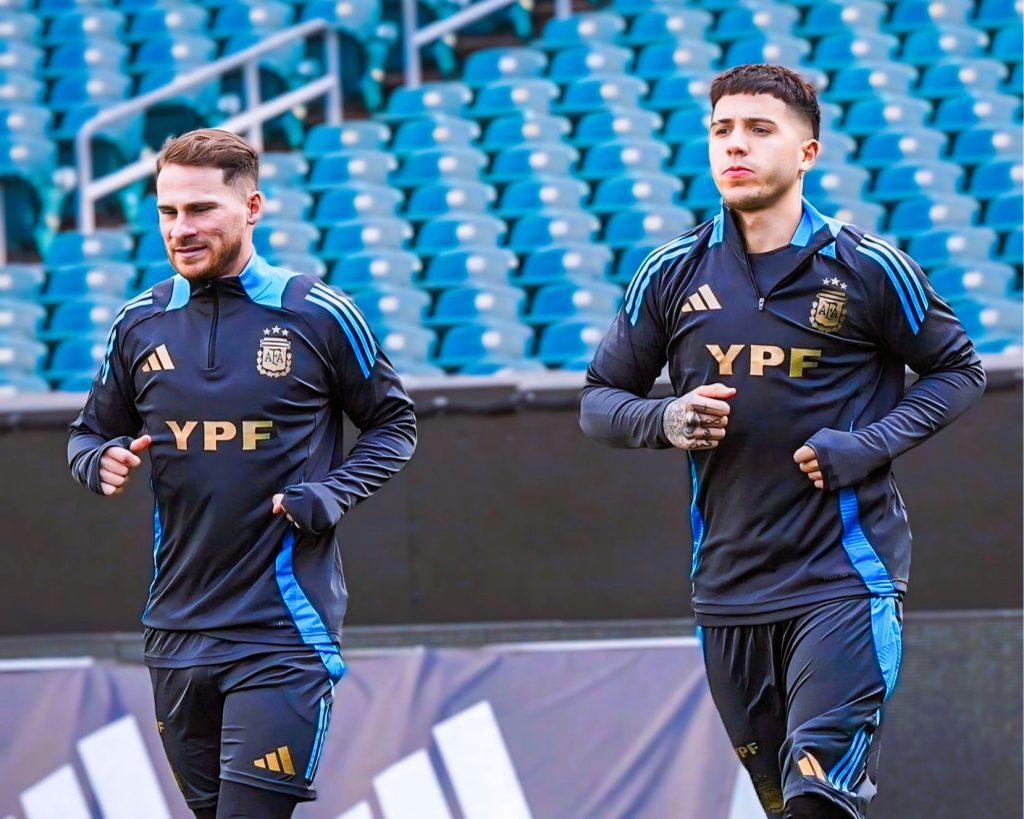
The midfield is where Argentina’s transformation has been most striking.
Alexis Mac Allister (Liverpool) has established himself as one of the finest box-to-box midfielders in world football, combining relentless pressing with intelligent positioning and an eye for goal. He is essentially undroppable in Scaloni’s system.
Alongside him, Enzo Fernández brings creativity and dynamism from deep.
The Chelsea midfielder was named the Best Young Player at Qatar 2022, and while his club form has been inconsistent at times, his international performances have remained strong.
Scaloni uses Fernández at the base of the midfield rather than as a traditional holding midfielder — a setup that demands energy and technical quality in equal measure.
The third midfield spot is fiercely contested. Thiago Almada (Atlético Madrid) has been hugely impressive under Scaloni in recent months and edges the competition, bringing directness and the ability to carry the ball into dangerous areas.
Rodrigo De Paul, long a pillar of Scaloni’s system, is facing an uncertain role — reports suggest the manager is not fully convinced by De Paul’s recent form, raising real questions about his place in the final 26.
Leandro Paredes provides a more conservative, ball-retaining option off the bench.
Attack – Messi, Julián Álvarez and the Future
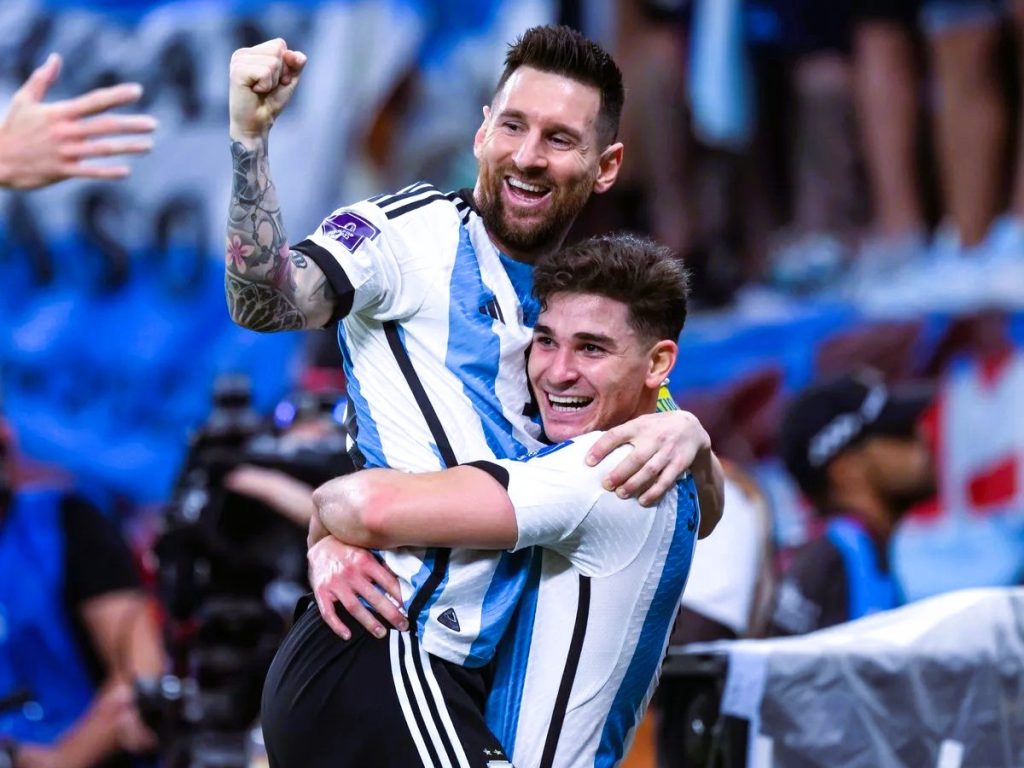
If Messi plays, Argentina’s forward line is terrifying.
The right-wing role is crafted specifically around the 38-year-old captain — a free position with reduced pressing demands that lets him operate in the pockets where he is most dangerous: collecting the ball between lines, playing one-twos, and producing moments of pure magic.
Julián Álvarez spearheads the attack from the centre-forward position.
The Atlético Madrid striker was superb at Qatar 2022, scoring four goals, and has continued to develop into one of Europe’s most complete forwards — pressing, intelligent movement, and clinical finishing.
He is dealing with a minor ankle issue late in the club season but is expected to be fully fit for the tournament.
Lautaro Martínez provides another world-class option, either on the left wing or as a second striker.
The Inter Milan captain was crucial during the 2024 Copa América triumph and has consistently delivered on the biggest stages.
His relationship with Álvarez is one of the most productive striker partnerships in South American football.
Argentina’s Best Formation and Tactical Setup
Why the 4-3-3 Formation Fits Argentina
Scaloni’s preferred system is a 4-3-3, and it remains the formation best suited to Argentina’s squad profile.
The shape allows Messi the freedom he requires at this stage of his career while maintaining midfield control through the Mac Allister–Fernández axis.
The front three can press intensely when needed, while the deeper-lying wide forwards can tuck in to create a 4-5-1 defensive structure out of possession.
As one tactical analysis noted, Scaloni masterfully shifted his midfield shape at Qatar 2022 specifically to reduce the physical demands on Messi, freeing him to play a libero-style role that maximised his ability without burning him out over seven matches.
That same principle will apply in 2026, only now Argentina have a far deeper squad to absorb the workload.
Could Argentina Switch to a 4-4-2 or 3-5-2?
Scaloni is no tactical purist. He has shown willingness to deploy a 4-4-2 diamond when he wants additional attacking firepower, or a back three when facing teams that threaten in wide areas.
In scenarios where Messi is rested or used as a substitute, Argentina have demonstrated they can win comfortably without him — including a dominant 4-1 victory over Brazil that highlighted just how balanced the squad has become.
The 3-5-2 is another option, particularly against compact defensive blocks, with the wing-backs providing width and the double pivot offering solidity.
But the 4-3-3 remains the default, and with the current player pool, it is the formation that best exploits Argentina’s attacking depth.
Argentina’s Tactical Strengths Ahead of 2026
Argentina’s greatest tactical strength heading into 2026 is their adaptability.
They can win ugly, grind out results in knockout football, or dismantle opponents with fluid attacking play.
Their high press — led by Álvarez and Lautaro — is among the most effective in world football, and their transition speed from defense to attack is exceptional.
Add to this the depth at every position and Scaloni’s calm, measured management style, and Argentina are as formidable a unit as they have ever been.
Argentina’s Full Squad for the 2026 World Cup
Argentina’s 26-man squad for the 2026 FIFA World Cup (announced by coach Lionel Scaloni around May 28, 2026; provisional until FIFA’s final confirmation around early June).
Goalkeepers
- Emiliano Martínez (Aston Villa)
- Gerónimo Rulli (Marseille / Olympique de Marseille)
- Juan Musso (Atlético Madrid)
Defenders
- Nahuel Molina (Atlético Madrid)
- Gonzalo Montiel (River Plate)
- Cristian Romero (Tottenham Hotspur)
- Leonardo Balerdi (Marseille)
- Nicolás Otamendi (Benfica)
- Lisandro Martínez (Manchester United)
- Nicolás Tagliafico (Lyon / Olympique Lyonnais)
- Facundo Medina (Marseille)
Midfielders
- Leandro Paredes (Boca Juniors)
- Rodrigo De Paul (Inter Miami)
- Alexis Mac Allister (Liverpool)
- Enzo Fernández (Chelsea)
- Giovani Lo Celso (Real Betis)
- Exequiel Palacios (Bayer Leverkusen)
- Valentín Barco (Strasbourg / RC Strasbourg)
Forwards
- Lionel Messi (Inter Miami) — Captain
- Lautaro Martínez (Inter Milan / Internazionale)
- Julián Álvarez (Atlético Madrid)
- Nicolás González (Atlético Madrid)
- Thiago Almada (Atlético Madrid)
- Nicolás Paz (Como)
- Giuliano Simeone (Atlético Madrid)
- José Manuel López (Palmeiras)
Young Players Who Could Break Into Argentina’s 2026 Squad
One of the most exciting storylines of Argentina’s 2026 World Cup campaign is the emergence of a brilliant new generation.
Scaloni has been deliberately integrating these players into the national setup, and several of them could play pivotal roles in North America.
Nico Paz
The Como midfielder, son of former Argentine international Pablo Paz, has become a regular in Scaloni’s extended squads and has drawn praise from across European football for his intelligence, technique, and ability to control the tempo of a game.
FIFA themselves highlighted Paz as one of the tournament’s standout wonderkids. His composure and range of passing make him an ideal rotational option in the middle of the park.
Will Lionel Messi Play at the 2026 FIFA World Cup?
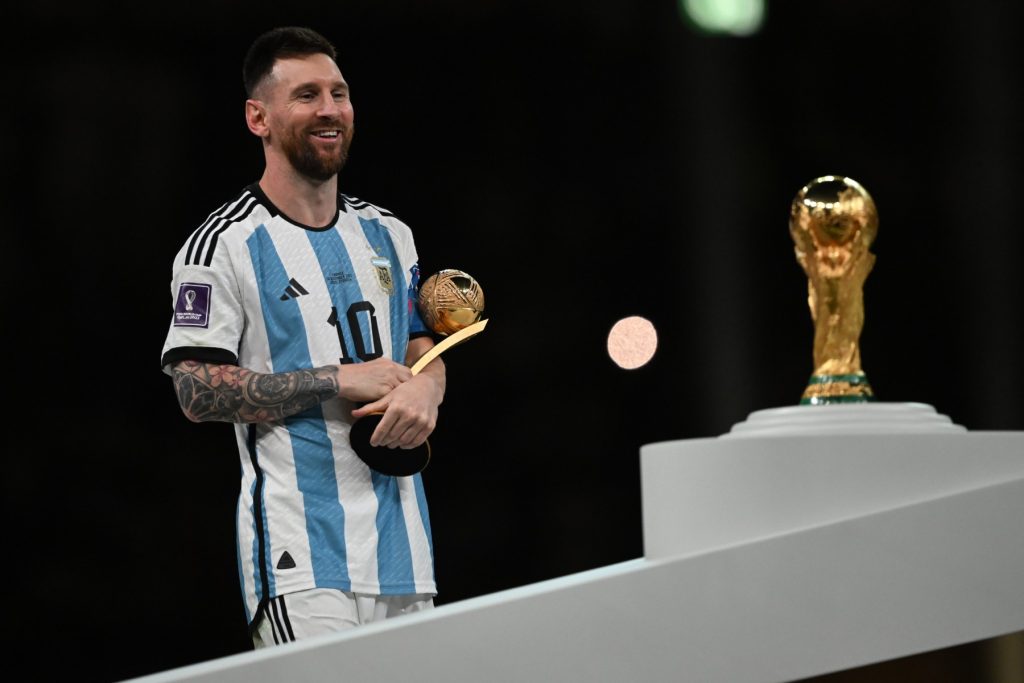
It is the question that has consumed Argentine football for the past three years — and as of this writing, it appears to have a positive answer.
Messi’s Role in Scaloni’s System
Messi confirmed in October 2024 that the 2026 World Cup would be his last: “The upcoming World Cup will be my last World Cup. I will definitely stay!” he declared after a hat-trick and two assists against Bolivia, in a role specifically tailored by Scaloni to extend his brilliance into his late 30s.
The system places him on the right side of a front three, but with the freedom to drift infield and operate as a second striker — reducing high-intensity running while preserving his influence on the game’s key moments.
His inclusion in the 55-man preliminary squad, coupled with a strong finish to the MLS season — he played 90 minutes for Inter Miami just the day before the squad announcement, setting up two goals and scoring one himself — strongly suggests he will feature in North America.
The decision rests entirely with Messi: Scaloni has made clear he would call him up regardless of fitness, but the player himself has said he will only go if he feels capable of performing at his best.
Can Messi Start Every Match?
Almost certainly not. At 38 — he turns 39 during the tournament on June 24 — Messi will require careful management across a potential seven-match campaign.
Scaloni is likely to rotate him during the group stage, potentially resting him for one of Argentina’s three group matches against Algeria, Austria, and Jordan. The priority will be ensuring he peaks physically for the knockout rounds.
Recent tactical evidence is encouraging. At the FIFA Club World Cup with Inter Miami, while his take-on rate and attacking-third passes dipped compared to the regular season, his ability to produce match-defining moments against elite opposition was still in evidence.
The shift from ‘Messi carrying Argentina’ to a more balanced collective approach will be crucial.
Potential Successors to Messi
The next chapter is already being written. Garnacho, Mastantuono, Echeverri, and Paz represent a generational wave of talent that will take Argentina forward into the 2030s.
The 2026 World Cup, staged on a continent where Messi has many admirers, offers a perfect handover moment — one final bow for the greatest, and a first major stage for his heirs.
Argentina’s Biggest Strengths and Weaknesses Before World Cup 2026
Biggest Strengths
Argentina’s most significant strength is their winning culture. They have now won three consecutive major tournaments — the 2021 Copa América, the 2022 FIFA World Cup, and the 2024 Copa América — and within that team is a core of players who know exactly what it takes to win when it matters.
Emiliano Martínez in goal, the Romero-Lisandro defensive axis, and the Fernández-Mac Allister midfield engine are among the finest combinations in world football at their respective positions.
The squad’s depth is also remarkable. Argentina can field competitive XIs across multiple systems, and Scaloni’s man-management — his ability to keep a large group of players engaged and motivated — has been one of the quiet secrets of this golden era.
Key Weaknesses
The right flank is a genuine concern without Messi. While Garnacho and Mastantuono provide exciting options, neither has proven themselves consistently at international level yet.
Argentina’s dependence on Messi’s moments of brilliance to unlock stubborn defences — as exposed in the 1-2 loss to Colombia during qualifying — remains a vulnerability.
In midfield, the potential absence of a fit and in-form Rodrigo De Paul removes an important experience layer. De Paul’s reported drop in form has raised questions Scaloni must answer before the tournament begins.
Areas Argentina Must Improve
Set-piece delivery and conversion remains an area that can be sharpened.
In the 2024 Copa América, Argentina relied heavily on individual moments rather than structured attacking design from dead balls.
Against the top European sides expected in the later knockout rounds, those margins will be finer.
Tactical discipline in the transitional phases — especially when chasing a game — also showed vulnerabilities during the qualification period.
Best Argentina Lineup Compared to the 2022 World Cup Winning Team
Key Differences From Qatar 2022
The most significant difference between Qatar 2022 and Argentina’s 2026 squad is the departure of Ángel Di María.
The former Juventus winger was instrumental in the 2022 final, coming off the bench to score a crucial goal — his emotional farewell to international football.
Filling that creative, left-sided influence remains one of Scaloni’s primary selection challenges.
Leandro Paredes remains in the squad but is no longer a certain starter; the midfield has evolved toward a more dynamic, press-oriented shape.
Rodrigo De Paul, a starting figure in Qatar, faces a battle to make the 11.
Meanwhile, Lisandro Martínez has supplanted Germán Pezzella as the primary central defensive partner for Romero.
New Players in the Squad
The biggest new additions are generational ones: Thiago Almada has integrated seamlessly into the midfield, offering a box-to-box energy that Argentina lacked in 2022.
Garnacho provides pace and directness on the left. Mastantuono, Echeverri, and Paz represent the future arriving early, even if their roles at this tournament will likely be limited.
Can Argentina Defend the Trophy?
Argentina is a top contender to defend its crown at the upcoming FIFA World Cup 2026. History says it is extraordinarily difficult. No team has retained the World Cup since Brazil’s back-to-back triumphs in 1958 and 1962.
But no team has entered a World Cup in recent memory with the combination of proven winners, emerging talent, tactical sophistication, and sheer belief that this Argentina squad possesses.
Scaloni has built something that transcends individual brilliance — a team identity, a system, and a culture of winning that does not rely solely on Messi.
Argentina’s Possible Bench Options for World Cup 2026
One of the most underappreciated elements of Scaloni’s squad is its depth.
The Argentina substitutes available at this World Cup are not mere squad fillers — several could walk into the starting XI of almost any other nation at the tournament.
That bench depth may prove decisive across a gruelling seven-match campaign in the North American summer heat.
Backup Goalkeeper
Gerónimo Rulli (Marseille) is the natural deputy to Emiliano Martínez.
The 32-year-old has been in strong form in Ligue 1 and brings considerable experience at club level.
Walter Benítez (Crystal Palace) provides a third option with Premier League pedigree.
Neither will play unless Martínez is injured, but knowing the position is covered by quality keepers gives Scaloni genuine peace of mind.
Defensive Cover
Nicolás Otamendi (Benfica) is arguably the most experienced defender in the squad and can cover either central defence position.
A veteran of two World Cups, his leadership value in the dressing room alone justifies his inclusion.
Marcos Senesi (Bournemouth) has enjoyed an excellent season and provides left-sided cover across the back line, while Leonardo Balerdi (Marseille) adds another reliable option should Romero or Lisandro Martínez encounter fitness issues.
Midfield Rotation
Leandro Paredes is the classic Scaloni rotation piece in the engine room — a composed, technically excellent holding midfielder whose ability to control tempo and recycle possession is invaluable when Argentina are protecting a lead in the knockout stages.
He may not start, but the Boca Juniors veteran belongs in any World Cup squad conversation for Argentina.
Giovani Lo Celso (Real Betis) and Exequiel Palacios (Bayer Leverkusen) offer different midfield profiles — the former with creativity and close control, the latter with physicality and defensive awareness.
Either could be decisive coming off the bench against an opponent who has found a way to neutralise the starting midfield.
Impact Substitutes in Attack
This is where Argentina’s bench becomes truly frightening for opponents.
Alejandro Garnacho off the bench is a nightmare matchup for any tired full-back late in a knockout match — his pace, directness and willingness to run at defenders make him one of the most potent impact substitutes in the tournament.
Lautaro Martínez, if starting on the wing rather than centrally, effectively creates a double threat in the second half: Álvarez pressing and Lautaro cutting inside.
If Messi is rested for a group match, Franco Mastantuono could make his senior tournament debut in that slot — a prospect that excites Argentine supporters enormously.
Nicolás González (Atlético Madrid) adds versatility across the forward line, able to play on either wing or as a second striker, giving Scaloni multiple options depending on the game state.
Why This Bench Depth Matters
In a 48-team, expanded World Cup format, the demands on squads are greater than ever — particularly for a seeded side like Argentina, who could face physically demanding opponents in sweltering conditions across multiple time zones.
Scaloni’s ability to rotate without a significant drop in quality is a tactical luxury few other nations possess.
It is no coincidence that Argentina have won three consecutive major tournaments: their backup players believe they can win, and that confidence is earned.
Frequently Asked Questions
What is Argentina’s best lineup for the 2026 World Cup?
Argentina’s strongest predicted XI in a 4-3-3 is: Martínez; Molina, C. Romero, L. Martínez, Tagliafico; Mac Allister, Fernández, Almada; Messi, J. Álvarez, Lautaro Martínez. This lineup assumes Messi is available and fit.
Will Lionel Messi play in the 2026 FIFA World Cup?
Messi has been included in Argentina’s 55-man preliminary squad and confirmed in October 2024 that the 2026 World Cup will be his last. He has said he will play if he feels fully fit and capable of performing at the required level. All current indications suggest he will be part of the final squad.
Who are Argentina’s key players for World Cup 2026?
Beyond Messi, Argentina’s key players are Emiliano Martínez (GK), Cristian Romero and Lisandro Martínez (CB), Alexis Mac Allister and Enzo Fernández (midfield), and Julián Álvarez and Lautaro Martínez (attack). Thiago Almada is emerging as a crucial midfield figure.
What formation will Argentina use in 2026?
Scaloni’s preferred formation is a 4-3-3, which best accommodates Messi’s tailored role on the right. He may switch to a 4-4-2 or 3-5-2 in specific scenarios, but the 4-3-3 is expected to be the primary shape for the tournament.
Can Argentina win the 2026 FIFA World Cup?
Argentina are among the favourites and are arguably the best-equipped team to go all the way. Retaining the World Cup would be historically unprecedented in the modern era, but this Albiceleste squad — built on three consecutive major titles, a world-class goalkeeper, elite midfield talent, and one of history’s greatest strikers — has every quality required to achieve it.
Conclusion
Argentina’s best XI for the 2026 World Cup is a formidable blend of proven champions and hungry new talent.
From the psychological fortress that is Emiliano Martínez in goal to the controlled dynamism of Mac Allister and Fernández in midfield, and the lethal combination of Messi, Álvarez, and Lautaro up front, the Albiceleste possess the ingredients to achieve something that has not been done in over 60 years.
The 2026 FIFA World Cup, hosted across the United States, Canada, and Mexico, offers Lionel Messi the perfect farewell stage — and Argentina the chance to cement their status as the dominant force in world football.
If Scaloni manages his squad wisely, keeps his key players fit, and the next generation steps up when called upon, there is no reason why Argentina cannot emerge from North America as back-to-back world champions.
The defending champions are ready. The question is whether the rest of the world can stop them.