
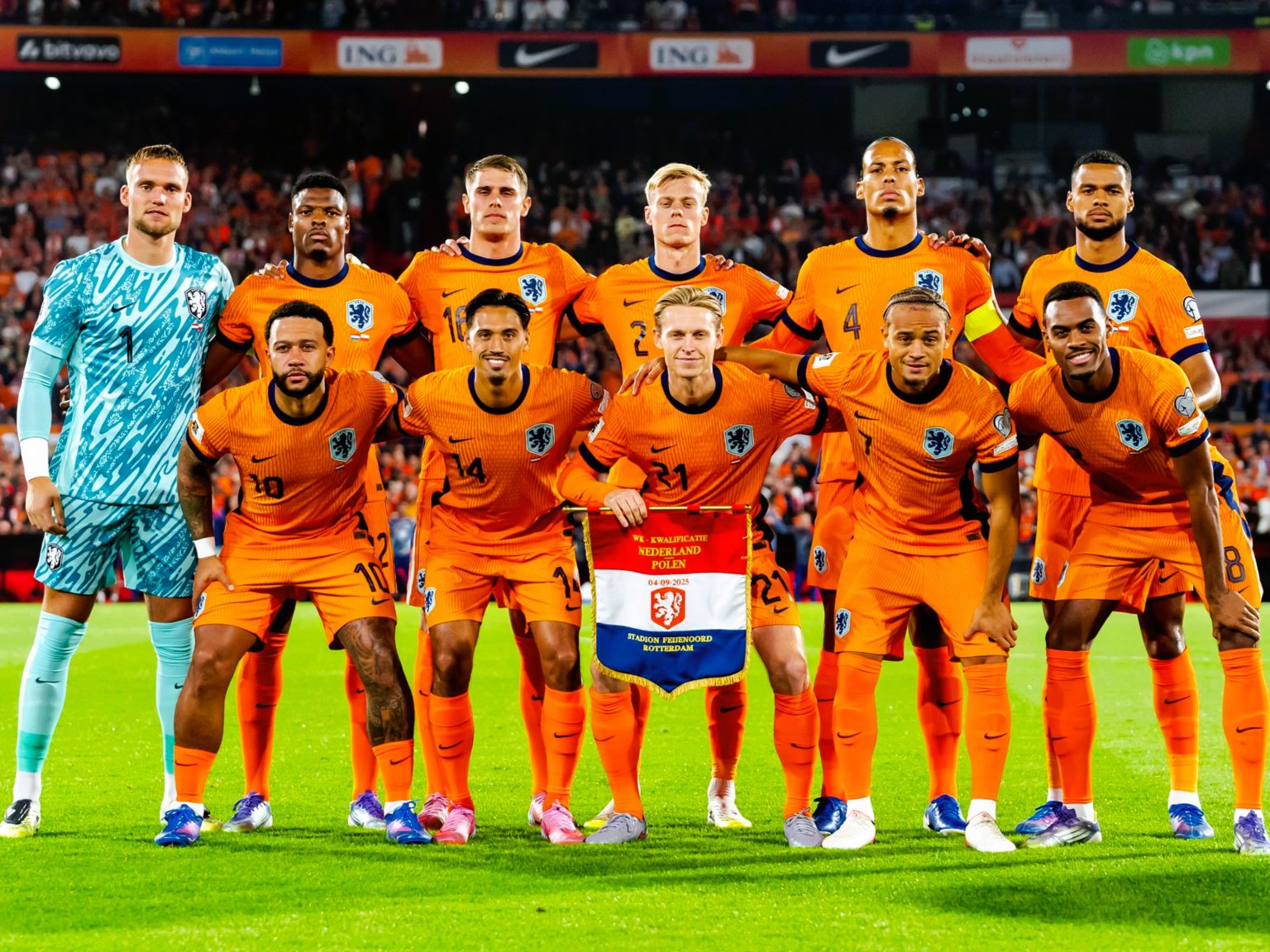

The stage is set, the groups are drawn, and for the three-time runners-up the Netherlands national football team, the road to the 2026 FIFA World Cup final in New Jersey is finally taking shape.
Memories of their dramatic exit at the last tournament still linger, and the Oranje arrive on the global stage once again determined to complete unfinished business by lifting football’s most prestigious trophy.
With the competition expanding to 48 teams for the first time, the journey to the final will be longer and more complex than ever before.
The Netherlands must first navigate Group F, where every result could dramatically shape their position in the knockout bracket and determine whether their path to glory becomes favorable—or brutally difficult.
In this guide, we break down the Netherlands’ complete route to the 2026 World Cup final, including their group-stage opponents, qualification scenarios, potential Round of 32 matchups, and the major challenges they could face on the road to MetLife Stadium, where the world champion will be crowned.
When Does Netherlands’ 2026 FIFA World Cup Journey Begin?
The Netherlands will kick off their 2026 FIFA World Cup campaign in Texas on Sunday, June 14, 2026, at AT&T Stadium in Arlington, facing a crucial Group F opener that could set the tone for the tournament.
Under the expanded 48-team format, the Dutch will remain in the central U.S. for the group stage, travelling next to Houston on June 20 and concluding in Kansas City on June 25.
This regional setup reduces travel fatigue, giving the Netherlands a strategic advantage as they aim to top the group and secure a favourable knockout path.
Netherlands’ Group Opponents
The Netherlands has been drawn into Group F for the 2026 FIFA World Cup. Their opponents include Japan (AFC), Tunisia (CAF), and the winner of the UEFA Path B playoff, which will be determined on March 31, 2026, between Albania, Poland, Sweden, or Ukraine.
This group offers a tactical challenge and a diverse mix of playing styles. Japan are known for their high-pressing approach, disciplined positioning, and rapid counterattacks, with players like Kaoru Mitoma providing dangerous speed on the wings.
Tunisia brings physicality, strong set-piece play, and a resilient approach that has historically produced surprises, including their shock victory over France in 2022. Matches against them demand patience and tactical awareness.
Sweden qualified for the 2026 World Cup via the UEFA play-offs under manager Graham Potter, overcoming a tough qualifying campaign with strong performances in the knockouts, notably powered by Viktor Gyökeres.
The team boasts significant attacking talent across Europe’s top clubs, making them dangerous on the counter and in transitions.
Star forwards include Alexander Isak (Liverpool) and Viktor Gyökeres (Arsenal), supported by wingers like Anthony Elanga (Newcastle).
The defense features experienced players such as Victor Lindelöf (Aston Villa). Sweden’s physicality, set-piece threat, and clinical finishing could make them a tough opponent capable of challenging for a top-two spot in Group F.
Overall, Group F is winnable for the Netherlands. Top spot is expected, but they must respect the pace of Japan, the physicality of Tunisia, and the potential firepower or resilience of the playoff winner.
Maintaining focus, squad depth, and tactical discipline will be key to securing a favorable knockout path.
Netherlands Group Stage Schedule
As the top seed in Group F, the Netherlands will play all three of its opening matches in the Central United States (Texas and Missouri).
| Date (2026) | Opponent | Venue | Kick-off Time (ET) |
|---|---|---|---|
| June 14 | Japan | AT&T Stadium | 4:00 PM |
| June 20 | Sweden | NRG Stadium | 1:00 PM |
| June 25 | Tunisia | Arrowhead Stadium | 7:00 PM |
Netherlands Group Standings
The table below reflects the group standings before kickoff and will be updated after each matchday.
| Pos | Team | MP | W | D | L | GD | Pts |
|---|---|---|---|---|---|---|---|
| 1 | Netherlands | 0 | 0 | 0 | 0 | 0 | 0 |
| 2 | Japan | 0 | 0 | 0 | 0 | 0 | 0 |
| 3 | Sweden | 0 | 0 | 0 | 0 | 0 | 0 |
| 4 | Tunisia | 0 | 0 | 0 | 0 | 0 | 0 |
How Netherlands Qualifies for the Knockout Stage
To advance to the knockout stage of the 2026 FIFA World Cup, the Netherlands must finish as one of the top two teams in Group F or qualify as one of the eight best third-placed teams across the 12 groups.
As the group’s top seed and one of the highest-ranked teams globally, the Oranje are heavily favoured to secure an automatic Round of 32 spot by finishing first or second in Group F against Japan, Tunisia, and the UEFA playoff winner.
If the Netherlands suffer an unexpected stumble and finish third in Group F, they still have a chance to progress. Under the 2026 rules, the eight best third-place finishers across all groups will also advance to the Round of 32.
In the event of a points tie at the end of the group stage, FIFA’s strict tiebreaker system is applied. The first decider is overall goal difference, followed by total goals scored across all three matches.
If those metrics are identical, the ranking moves to the head-to-head result between the tied teams, and finally to “fair play” points, based on yellow and red cards received.
Netherlands Potential Knockout Stage Path
The Netherlands’ path through the 2026 FIFA World Cup knockout stages will depend on their final position in Group F against Japan, Tunisia, and the UEFA playoff winner.
As Group F Winners: The Oranje would remain in the Central and South Zone for the opening knockout rounds. Their Round of 32 match is projected against the runner-up of Group C, which features Brazil, Morocco, and other contenders.
A win here would likely lead to a Round of 16 clash in Houston or Dallas, allowing them to avoid other group winners until the quarterfinals.
As Group F Runners-Up: Finishing second would place the Netherlands in a tougher bracket, likely facing the winner of Group C—Brazil is the heavy favourite.
This route is more challenging, as it involves an early high-stakes matchup against one of the tournament’s top-ranked nations.
As a Third-Place “Wildcard”: If the Netherlands finish third but qualify among the eight best third-placed teams, their path becomes unpredictable. Depending on other advancing third-place teams, they could face a group winner in the Round of 32.
This scenario is the most demanding, potentially requiring matches against hosts or top-tier world powers with minimal rest and extensive travel.
Netherlands as Group Winner
If the Netherlands national football team win Group F, they will secure a knockout route that begins with Mexico and will have a strategic advantage by avoiding many of the tournament’s top-ranked “heavyweights” until the later stages.
The route begins with a round of 32 match at the Estadio Monterrey in Guadalupe, Mexico, on Monday, June 29, 2026.
Their opponents in this opening knockout match will be the runner-up of Group C, a spot that is more likely to be occupied by Morocco or Scotland.
The most significant advantage of finishing first in Group F is the high probability of avoiding a premature clash with Brazil, who are favored to win Group C and will instead face the runner-up of Group F.
Success in Monterrey will send the Netherlands back to the United States for a round of 16 match at NRG Stadium in Houston, Texas, on July 4, 2026.
As the tournament progresses, group winners Netherlands will move to the East Coast for a possible quarterfinal in Foxborough (Boston) on July 9, where they will likely face Spain.
If they reach the semifinals on July 14, they will return to Texas for a match at AT&T Stadium in Arlington, where a clash with defending champions Argentina is statistically predicted.
This route ensures that the Netherlands avoid most group winners until the later knockout rounds, significantly increasing their chances of reaching the final at MetLife Stadium.
| Round | Date (2026) | Potential Opponent | Venue |
|---|---|---|---|
| Round of 32 | June 29 | Runner-up of Group C | Estadio Monterrey |
| Round of 16 | July 4 | Winner of Group A runners-up vs. Group B runners-up | NRG Stadium |
| Quarterfinals | July 9 | Winner Match 89 | Gillette Stadium |
| Semifinals | July 14 | Winner Match 98 | AT&T Stadium |
| Final | July 19 | TBD | MetLife Stadium |
Netherlands as Group Runner-Up
If the Netherlands finishes as the runner-up in Group F, they enter a “bracket of death” scenario that significantly complicates their road to the final.
This path is widely considered the most difficult outcome for Oranje, as it likely forces a high-stakes, early-round collision with Brazil—the heavy favourites to win Group C.
The knockout journey as a runner-up would begin on Monday, June 29, 2026, at NRG Stadium in Houston, Texas.
In this Round of 32 clash, the Netherlands would face the Winner of Group C, a spot almost universally projected for the top-ranked Brazilians.
While the Dutch have historically performed well against the Seleção in World Cups, facing them in the very first elimination round is a logistical and competitive nightmare that most top seeds aim to avoid by winning their group outright.
Compared to the winner’s path, this route involves significantly more international travel and a much higher concentration of elite opponents in the early stages.
| Round | Date (2026) | Potential Opponent | Venue |
|---|---|---|---|
| Round of 32 | June 29 | Winner of Group C | NRG Stadium |
| Round of 16 | July 5 | Winner of Group E runners up vs Group I runners-up | MetLife Stadium |
| Quarterfinals | July 11 | Winner Match 92 | Hard Rock Stadium |
| Semifinals | July 15 | Winner Match 100 | Mercedes-Benz Stadium |
| Final | July 19 | TBD | MetLife Stadium |
Netherlands as Best Third-Placed Team
If the Netherlands fails to secure a top-two spot in Group F but advances as one of the eight best third-placed teams, their knockout path becomes highly unpredictable and potentially daunting.
Under the 48-team format, a third-place finisher from Group F is mathematically eligible for one of five different Round of 32 slots, depending on which other groups produce advancing “wildcard” teams.
This uncertainty means the “Oranje” could find themselves facing a top-tier group winner with significantly less recovery time than their opponents.
One likely scenario for a third-placed Group F team involves a high-stakes matchup against the Winner of Group E, currently projected to be Germany.
This match would take place on June 29, 2026, in Boston (Foxborough, MA), just four days after the Netherlands’ final group match in Kansas City.
To qualify as a “best third,” the Netherlands must rank among the top eight out of 12 third-place finishers based on total points, goal difference, and goals scored.
While this route provides a safety net, it often forces the team into a “bracket of death” where they must immediately overcome a world power just to reach the Round of 16.
| Scenario | Date (2026) | Potential Opponent | Venue |
|---|---|---|---|
| Winner Group E | June 29 | Potential opponent such as Germany | Gillette Stadium |
| Winner Group A | June 30 | Potential opponent such as Mexico | Estadio Azteca |
| Winner Group I | June 30 | Potential opponent such as France | MetLife Stadium |
| Winner Group D | July 1 | Potential opponent such as USA | Levi’s Stadium |
| Winner Group B | July 2 | Potential opponent such as Canada | BC Place |
Netherlands’ Best Route to the 2026 FIFA World Cup Final
The Netherlands’ most favorable route to the 2026 FIFA World Cup Final is to win Group F, a scenario that secures a mathematically “easier” opening knockout match and optimises their travel schedule within the central and eastern United States.
By topping a group that includes Japan, Tunisia, and a UEFA playoff winner, the “Oranje” would face the runner-up of Group C (likely Morocco or Scotland) in the Round of 32.
This match is scheduled for June 29, 2026, at Estadio Monterrey in Mexico, allowing the team to avoid a premature clash with Brazil, who are favoured to win Group C.
Strategically, winning the group also positions the Netherlands for a Round of 16 encounter on July 4, 2026, at NRG Stadium in Houston, Texas.
This Independence Day fixture is projected to be a heavyweight European derby against Germany, should they win Group E.
By advancing through this “winner’s path,” the Dutch would then move toward the East Coast for a potential Quarterfinal in Foxborough on July 9, likely against Spain, before a projected Semifinal showdown with defending champions Argentina in Arlington on July 14.
In contrast, finishing as a runner-up in Group F would force the Netherlands into a “bracket of death” with a Round of 32 match against the Winner of Group C—almost certainly Brazil—in Houston.
This path not only presents a much steeper competitive hurdle in the very first elimination round but also increases travel complexity by shifting the team’s base of operations more frequently between the U.S. and Mexico.
For a squad led by veterans like Virgil van Dijk, winning the group is essential to preserving energy for the ultimate title match at MetLife Stadium on July 19.
2026 FIFA World Cup Guides
Explore our complete tactical breakdowns and knockout bracket projections for the biggest teams at the 2026 FIFA World Cup.