








In the history of the FIFA World Cup, youth often grabs the headlines — but experience writes the legacy. The oldest goal scorer in World Cup history proved that age is just a number, delivering unforgettable moments on football’s biggest stage.
From legendary veterans to record-breaking icons, this article explores the oldest players to score in FIFA World Cup matches, their incredible stories, and the records that still stand today.
Who Is the Oldest Goal Scorer in World Cup History?
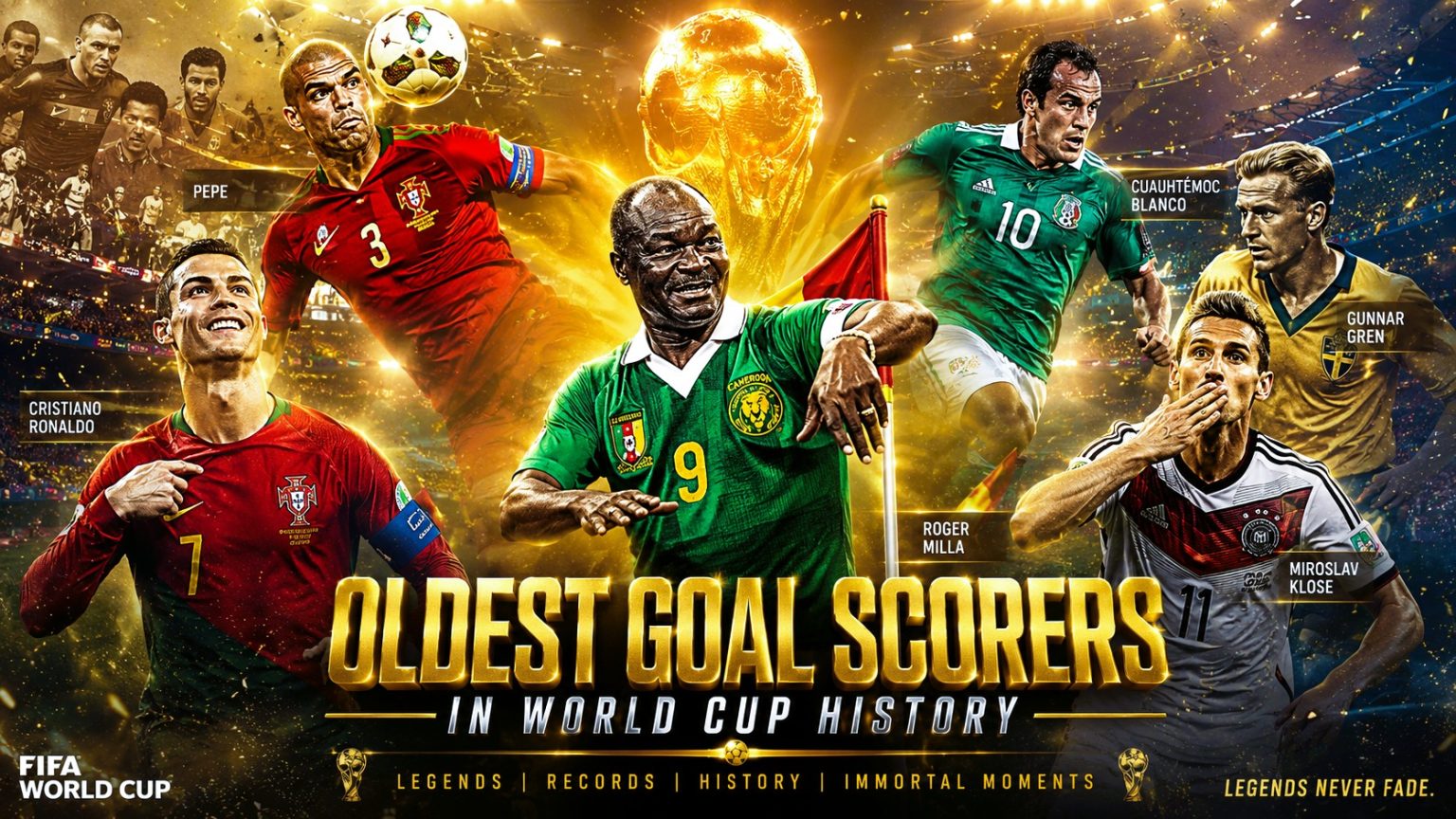
Roger Milla of Cameroon is the oldest goal scorer in FIFA World Cup history. He scored against Russia in 1994 at the age of 42 years and 39 days.
On 28 June 1994, in a group stage match against Russia at the FIFA World Cup in the United States, Milla stepped off the bench and found the back of the net.
That goal made him the oldest goal scorer in World Cup history at 42 years and 39 days old — a record officially recognised by the Guinness World Records, FIFA, and every major football authority on the planet.
What makes the feat even more staggering is the context. Milla had already retired from international football in 1987.
He was living a quiet life on the island of Réunion in the Indian Ocean when football’s most prestigious stage came calling — not once, but twice.
His 1994 record extended a benchmark he had already set four years earlier, in Italy, when he was 38 years and 34 days old. He simply broke his own record by four years.
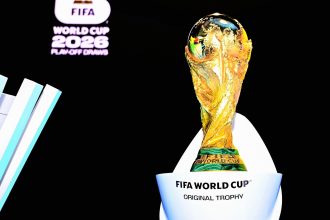
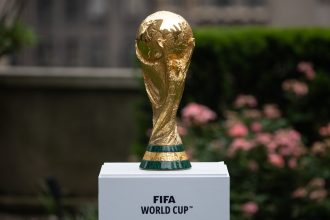
To this day, Roger Milla remains the only player over 40 years of age to have scored at a FIFA World Cup.
Oldest Goal Scorers in World Cup History (Full List)
The table below ranks the oldest players to score at a men’s FIFA World Cup, based on their age at the time of the goal:
| Rank | Player | Age When Scoring | National Team |
| 1 | Roger Milla | 42y, 39d | Cameroon |
| 2 | Pepe | 39y, 283d | Portugal |
| 3 | Cristiano Ronaldo | 37y, 292d | Portugal |
| 4 | Gunnar Gren | 37y, 236d | Sweden |
| 5 | Cuauhtémoc Blanco | 37y, 151d | Mexico |
| 6 | Felipe Baloy | 37y, 120d | Panama |
| 7 | Obdulio Varela | 36y, 279d | Uruguay |
| 8 | Martín Palermo | 36y 227d | Argentina |
| 9 | Georges Bregy | 36y, 152d | Switzerland |
| 10 | Olivier Giroud | 36y, 71d | France |
| 11 | Tom Finney | 36y, 64d | England |
| 12 | Miroslav Klose | 36y, 29d | Germany |
| 13 | John Aldridge | 35y, 279d | Republic of Ireland |
| 14 | Nils Liedholm | 35y, 264d | Sweden |
| 15 | Lionel Messi | 35y, 177d | Argentina |
| 16 | Giovanni van Bronckhorst | 35y, 151d | Netherlands |
| 17 | Rafael Márquez | 35y, 130d | Mexico |
| 18 | Ricardo Peláez | 35y, 103d | Mexico |
| 19 | Yahya Golmohammadi | 35y, 84d | Iran |
| 20 | Safet Sušić | 35y, 67d | Bosnia and Herzegovina |
Related Articles You May Enjoy:
- FIFA World Cup Winners List — All Champions (1930–2022)
- All-Time Golden Boot Winners — World Cup Top Scorers
- FIFA World Cup Golden Glove Winners
- FIFA World Cup Golden Ball Winners
- FIFA World Cup Best Young Player
Top 5 Oldest World Cup Goal Scorers – Detailed Breakdown
1. Roger Milla (Cameroon) — 42 Years, 39 Days | 1994
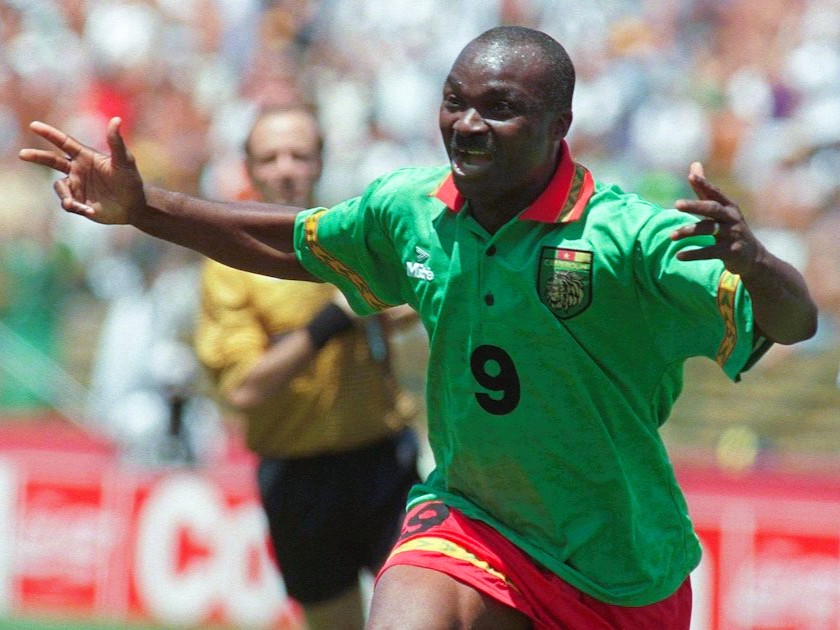
No story in football longevity matches this one. Born Albert Roger Miller on 20 May 1952 in Yaoundé, Cameroon, Milla changed his surname as a young man to gain greater recognition across Africa. He earned it — twice over.
After a distinguished career across French clubs including Bastia, Saint-Étienne, and Montpellier, Milla retired from international football in 1987 at age 35.
Three years later, a phone call changed everything. Cameroonian President Paul Biya personally pleaded with Milla to come out of international retirement and rejoin the Indomitable Lions for the 1990 World Cup in Italy.
Milla agreed, becoming, at 38, arguably the most electrifying substitute in World Cup history.
He scored four goals in Italy — all as a substitute — celebrating each with his now-iconic corner flag shimmy, a joyful dance that swept across global football culture.
Two goals came against Romania, and two more arrived in extra time against Colombia in the Round of 16, carrying Cameroon to the quarter-finals — the furthest any African team had progressed at that point in World Cup history.
Then, four years later, against all logic, he did it again. At 42 years old, Milla came on as a substitute against Russia and scored a consolation goal in a 6-1 defeat.
Cameroon were eliminated in the group stage, but the goal itself was immortal. It extended his own record as the oldest goal scorer in World Cup history by over four years — and no one has come close since.
In 2004, Pelé named Milla in the FIFA 100 list of the world’s greatest living footballers. The Confederation of African Football later named him the best African player of the previous 50 years.
2. Pepe (Portugal) — 39 Years, 283 Days | 2022
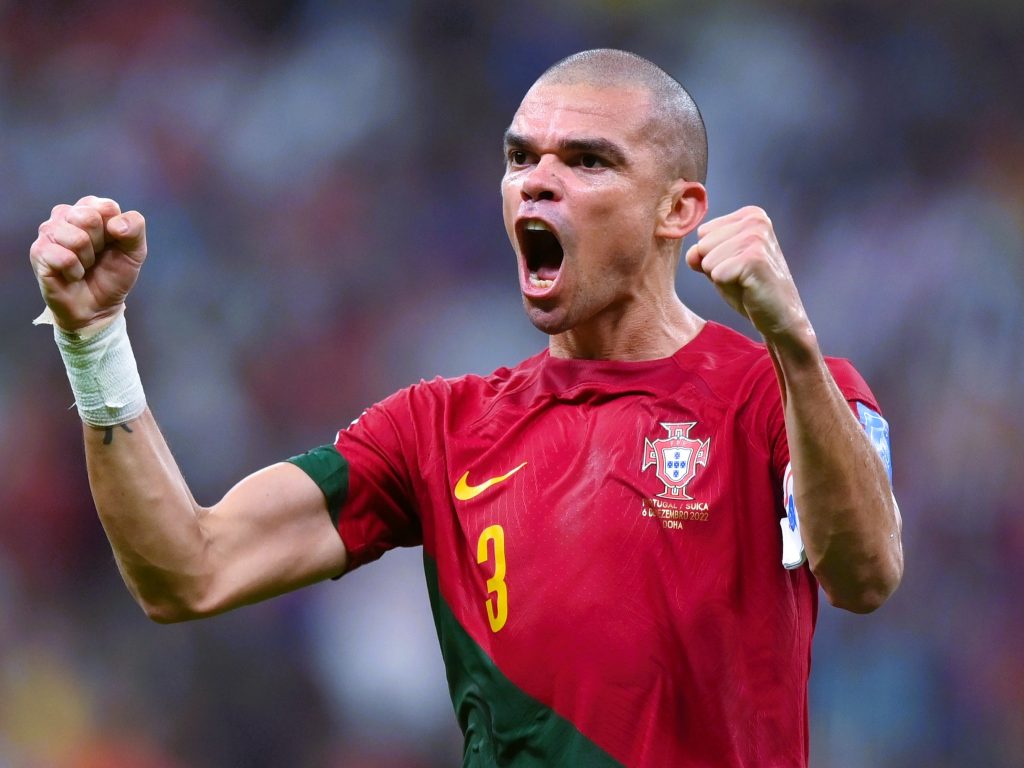
Rui Pedro dos Santos Paim — better known as Pepe — proved at the 2022 World Cup in Qatar that defenders can write history too.
Heading into a round-of-16 demolition of Switzerland, Pepe rose to meet a corner from Bruno Fernandes and powered a header past Yann Sommer to make it 2-0. Portugal won 6-1.
The goal made Pepe the oldest goalscorer in a knockout game in World Cup history and the second-oldest scorer overall, overtaking his own Portugal teammate Cristiano Ronaldo who had claimed that position just weeks earlier in the same tournament.
Remarkably, Pepe went on to play at Euro 2024 the following year, cementing his status as one of football’s most extraordinary veterans.
3. Cristiano Ronaldo (Portugal) — 37 Years, 292 Days | 2022
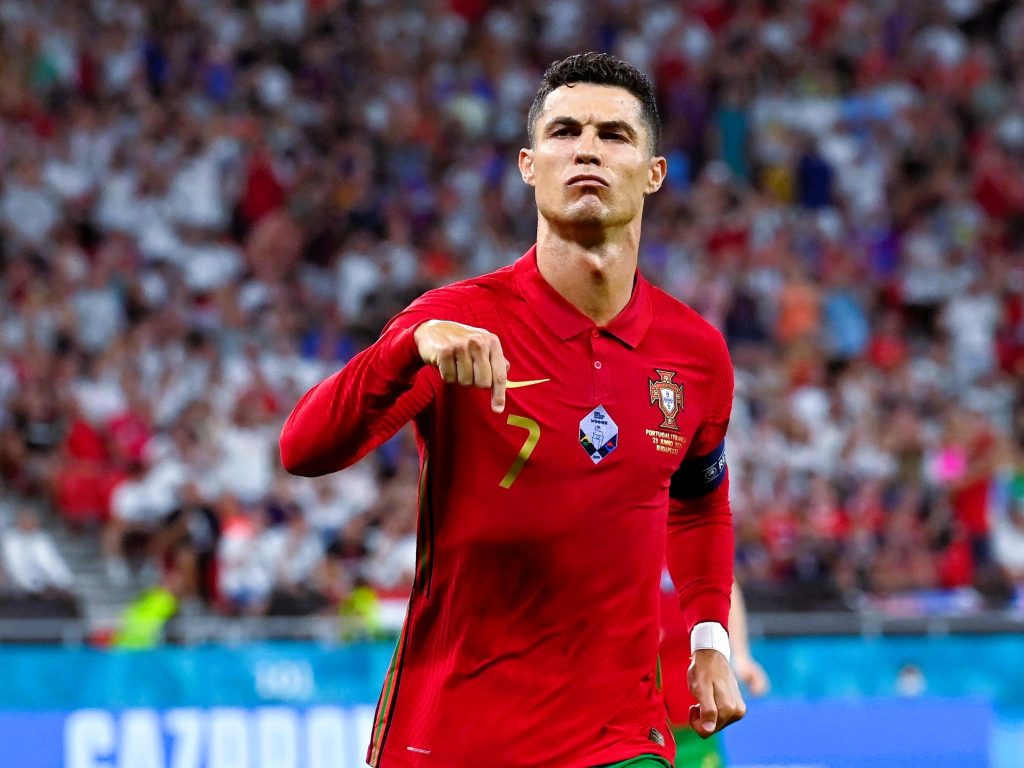
The greatest goalscorer in men’s international football history added another milestone at Qatar 2022.
In Portugal’s Group H opener against Ghana, Ronaldo converted a 65th-minute penalty to open the scoring in what became a 3-2 victory.
At 37 years and 292 days old, the goal made him, at the time, the second-oldest player to score in World Cup history — a position he held until his own teammate Pepe overtook him in the same tournament.
Ronaldo is also the only player in men’s World Cup history to have scored in five consecutive tournaments (2006, 2010, 2014, 2018, and 2022), a testament to a career of extraordinary longevity.
4. Gunnar Gren (Sweden) — 37 Years, 236 Days | 1958
Before Roger Milla rewrote the record books in 1990, Gunnar Gren of Sweden held the title of oldest World Cup goal scorer for over three decades.
His solitary World Cup goal came in the semi-final of the 1958 tournament in Sweden, against West Germany, putting his team in front in a 3-1 victory.
Sweden advanced to the final, where they ultimately lost 5-2 to a Pelé-inspired Brazil.
Gren’s contribution to that run, well into his late 30s, made him a pioneering figure for veteran scorers on the world stage.
5. Cuauhtémoc Blanco (Mexico) — 37 Years, 151 Days | 2010
Mexican playmaker Cuauhtémoc Blanco was never a player who conformed to convention.
At the 2010 World Cup in South Africa, he scored against France at 37 years and 151 days old — one of three separate World Cups in which he netted for Mexico (1998, 2002, and 2010).
Only Chicharito and Rafael Márquez share that distinction among Mexican players. Blanco’s goal-scoring longevity on the sport’s biggest stage reflects both extraordinary technical quality and remarkable physical resilience.
Oldest Goal Scorers by World Cup Year
The following list identifies the oldest player to score a goal in each edition of the FIFA World Cup.
| Year | Player | Country | Age |
|---|---|---|---|
| 2022 | Pepe | Portugal | 39y 283d |
| 2018 | Felipe Baloy | Panama | 37y 120d |
| 2014 | Miroslav Klose | Germany | 36y 29d |
| 2010 | Cuauhtémoc Blanco | Mexico | 37y 151d |
| 2006 | Yahya Golmohammadi | Iran | 35y 84d |
| 2002 | Fernando Hierro | Spain | 34y 76d |
| 1998 | Ricardo Peláez | Mexico | 35y 103d |
| 1994 | Roger Milla | Cameroon | 42y 39d |
| 1990 | Roger Milla | Cameroon | 38y 34d |
| 1986 | Oleg Blokhin | USSR | 33y 216d |
| 1982 | László Fazekas | Hungary | 34y 243d |
| 1978 | Rob Rensenbrink | Netherlands | 30y 335d |
| 1974 | Martin Hoffmann | East Germany | 29y 100d |
| 1970 | Uwe Seeler | West Germany | 33y 221d |
| 1966 | Garrincha | Brazil | 32y 259d |
| 1962 | Adolfo Pedernera | Colombia | 33y 200d |
| 1958 | Gunnar Gren | Sweden | 37y 236d |
| 1954 | Obdulio Varela | Uruguay | 36y 279d |
| 1950 | Obdulio Varela | Uruguay | 32y 282d |
| 1938 | Tore Keller | Sweden | 33y 162d |
| 1934 | Raymond Braine | Belgium | 27y 30d |
| 1930 | Tom Florie | USA | 32y 309d |
Oldest vs. Youngest World Cup Scorers – A Striking Contrast
The gap between the oldest and youngest goal scorers in World Cup history is almost 25 years — a testament to how uniquely wide-ranging the World Cup stage can be.
Youngest: Pelé (Brazil) scored against Wales at the 1958 World Cup at just 17 years and 239 days old — in the same tournament where Gunnar Gren, at 37, also found the net. Two scorers, 20 years apart in age, competing on the same stage, in the same competition.
Oldest: Roger Milla, at 42, scored in 1994 — an age by which Pelé had long since retired and become an ambassador for the sport.
The contrast reveals something beautiful about football: it is a game wide enough to accommodate prodigies who mature at 17 and legends who refuse to fade at 42.
The oldest scorers typically rely on positional intelligence, set-piece delivery, and tactical discipline. The youngest rely on fearlessness, raw pace, and instinctive brilliance. Both have a place on football’s biggest stage.
| Metric | Oldest Scorer | Youngest Scorer |
| Player | Roger Milla | Pelé |
| Country | Cameroon | Brazil |
| Age | 42y, 39d | 17y, 239d |
| Year | 1994 | 1958 |
| Age Gap | 24 years, 165 days between the two records |
Can This Record Be Broken in World Cup 2026?
The short answer: it would take something truly extraordinary.
Roger Milla’s record of 42 years and 39 days has stood since 1994 — over three decades.
In that time, the game has changed enormously. Modern sports science, nutrition, and recovery methods mean footballers are playing longer than ever before.
In the 2022 Qatar World Cup alone, Ronaldo (37) and Pepe (39) demonstrated that elite players can still perform at the highest level well into their late 30s.
But scoring at 42 in a FIFA World Cup? That still seems almost impossible to replicate.
For the record to fall, a player would need to:
- Still be fit and competitive at 42 or older
- Be selected in their national squad
- Be given playing time at the tournament
- Score a goal
The 2026 World Cup, hosted across the United States, Canada, and Mexico, will be played with 48 teams for the first time.
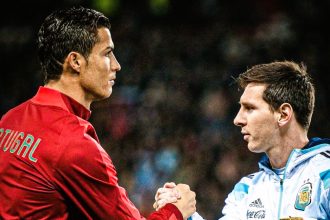
Ronaldo would be 41 years old and has not officially retired from international football. Messi will be 38.
While both are extraordinary cases of longevity, even they are unlikely to challenge Milla’s benchmark.
The record appears safe — a monument to one of football’s most unlikely and enduring stories.
FAQs: Oldest Goal Scorers in World Cup
Who is the oldest goal scorer in World Cup history?
Roger Milla of Cameroon holds the record. He scored against Russia at the 1994 FIFA World Cup in the United States at the age of 42 years and 39 days — a record officially recognised by the Guinness World Records
How old was Roger Milla when he scored his most famous World Cup goals?
Milla scored four goals at the 1990 World Cup in Italy at the age of 38, including a decisive brace against Colombia in the Round of 16. He was 42 when he scored his record-breaking goal in 1994.
Has anyone scored after age 40 in the World Cup?
Yes — but only one player ever has: Roger Milla. He is the only man in the history of the men’s FIFA World Cup to have scored a goal after turning 40.
Who is the second-oldest goal scorer in World Cup history?
Pepe of Portugal, who scored against Switzerland at the 2022 World Cup in Qatar at the age of 39 years and 283 days old.
Who is the oldest player to have played in a World Cup?
Egypt’s goalkeeper Essam El-Hadary, who appeared against Saudi Arabia at the 2018 World Cup at the age of 45 years and 161 days old — though he did not score.
Can Roger Milla’s record be broken at the 2026 World Cup?
It would be extraordinarily difficult. No current international footballer appears likely to still be playing at 43+. The record has stood for over 30 years and remains one of the most secure in football history.
The FIFA World Cup is often seen as a stage for rising stars — a tournament where 19-year-old prodigies announce themselves to the world and careers are launched in 90 minutes.
But the story of the oldest goal scorer in World Cup history tells a different, quieter kind of legend.
Roger Milla was 35 when most thought his international career was over. He was 38 when he danced around a corner flag in Italy and became Africa’s greatest World Cup hero.
He was 42 when he walked onto a pitch in the United States and wrote his name permanently into the record books — a record that has stood for more than 30 years.
The oldest goal scorers in World Cup history — Milla, Pepe, Ronaldo, Gunnar Gren, Cuauhtémoc Blanco — remind us that football rewards intelligence, experience, and passion as much as it rewards pace and power. That greatness doesn’t have an expiry date.
In a sport obsessed with youth, these veterans dared to stay. And the game was better for it.